Culture
Chiang Mai, and the kingdom that outlasted its name
Northern Thailand was ruled for centuries by a kingdom with its own language and script, absorbed into Siam only in the nineteenth century, and its old capitals still tell three separate stories rather than one.
By Arthur Penhallow26 September 20263 min read
Chiang Mai is routinely described as northern Thailand's capital, which is true today and slightly misses the point: for roughly five and a half centuries, it was the capital of somewhere else entirely. The Lanna Kingdom, founded in 1296 by King Mangrai, developed its own language, its own script and its own distinct Buddhist artistic style, and it remained politically separate from the Thai kingdoms further south, Sukhothai and later Ayutthaya, for most of its existence, even after periods of Burmese overlordship complicated the picture further.
A kingdom, not a province
Lanna's independence ended only formally in the late nineteenth century, when the expanding kingdom of Siam, under pressure from British and French colonial interests closing in from Burma and Indochina respectively, absorbed the northern principalities more fully into a centralised Thai state, partly as a defensive measure against losing the territory to a colonial power outright. Chiang Mai's older identity has not entirely dissolved into that arrangement: the northern Thai dialect, Kham Muang, is still spoken locally, the old Lanna script survives in temple manuscripts and occasional revival use, and the city's architecture, wooden temples with multi-tiered roofs, carved gables, retains a visibly different character from central Thai building traditions.
A temple on the mountain, and a legend about an elephant
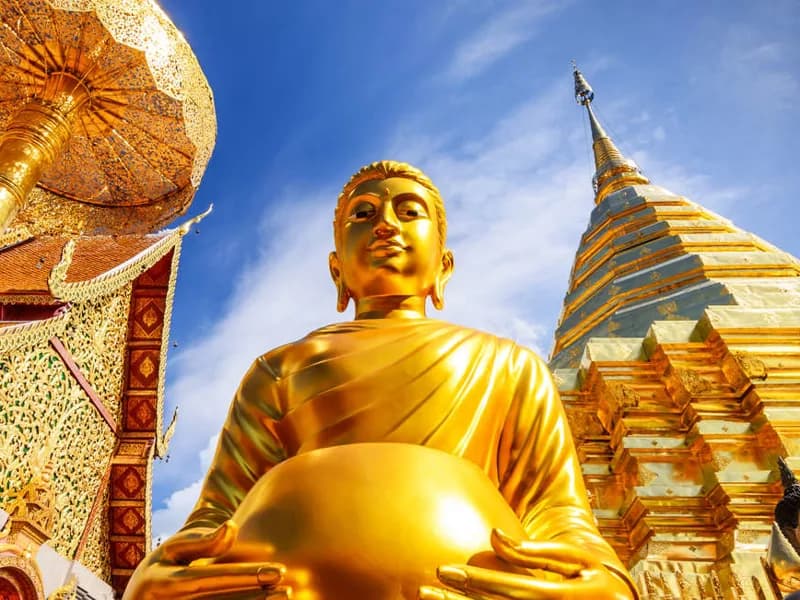
Above the city, Wat Phra That Doi Suthep sits on a forested mountainside reached by a long stairway, its site chosen, according to a well-known local legend, by releasing a white elephant carrying a Buddhist relic and building the temple wherever the animal stopped and died. Whatever the literal truth of the story, the temple, founded in the fourteenth century, has functioned since as one of northern Thailand's most significant pilgrimage sites, and its elevated position gives it a view across the Chiang Mai valley that most visitors come for as much as the temple itself.
For roughly five and a half centuries, it was the capital of somewhere else entirely.
Two older capitals, further south
A northern Thailand itinerary routed through Kanchanaburi typically also passes Sukhothai and Ayutthaya, two separate and successive capitals of the Thai kingdoms that eventually absorbed Lanna. Sukhothai, founded in the thirteenth century, is generally regarded as the first properly independent Thai kingdom, and its ruined temple complex, now a UNESCO World Heritage Site, is laid out with an openness and scale distinct from later Thai architecture. Ayutthaya, capital from the fourteenth century until its destruction by Burmese forces in 1767, was for a long period one of Asia's wealthiest trading cities, its ruins now similarly protected and similarly worth the comparison with what came before and after it.
A craft economy that outlasted the kingdom too
Lanna's decline as an independent political entity did not take its craft traditions with it. The villages around Chiang Mai remain known for silverwork, lacquerware, celadon ceramics and umbrella-making, skills generally traced back to the Lanna period and, in several cases, to craft communities that migrated into the region from Burma during periods of closer contact between the two. Bo Sang, a village a short drive from the city, has specialised in hand-painted paper umbrellas for long enough that the craft has become closely associated with the wider region's identity, sold today largely to visitors but rooted in a genuinely older decorative tradition rather than invented for the tourist trade.
Reading three cities as one story
Taken together, Sukhothai, Ayutthaya and Chiang Mai read less as three separate stops than as three different answers to the same question, how a Thai kingdom organised itself, over roughly five hundred years and considerable distance. None of the three needs the others to be worth visiting, but seeing them in sequence, as most northern Thailand tours do, makes the differences between them considerably easier to notice, from Sukhothai's open, unhurried scale to Ayutthaya's dense concentration of ruined spires to Chiang Mai's continued, living use of the temples it built.
By Arthur Penhallow, the name Atlas & Passage’s editorial team writes under. Prices and dates in the trips below come from the operators and can change.