Journeys
Colombia's coffee country and its colonial towns
In the green hills of the central Andes, Colombia grows some of the world's finest coffee on small farms whose way of life UNESCO has recognised. Nearby are valleys of the tallest palm trees on earth, and colonial towns of whitewashed houses that have hardly changed in two centuries.
By Walter Pellow2 November 20264 min read
Colombia has changed enormously in a generation. For decades, its name was associated abroad with conflict and drugs; since a peace agreement with the largest guerrilla group in 2016, and years of steady change before that, it has become one of the most rewarding countries to visit in South America. It has a bit of everything: two coastlines, the Andes, the Amazon, colonial cities and some of the friendliest people on the continent. And in the middle of the country, it has coffee.
The coffee axis
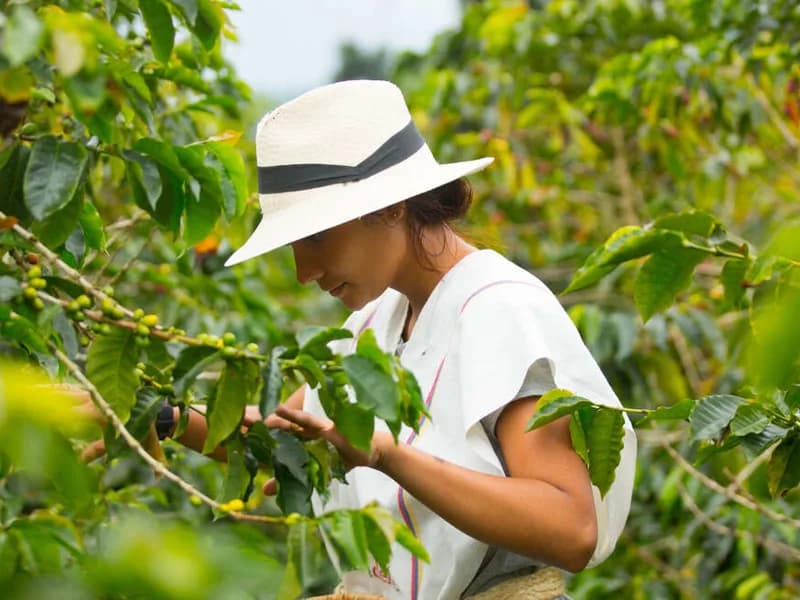
Colombia's coffee country, the Eje Cafetero, lies in the central Andes, in the departments of Caldas, Risaralda and Quindío, around the cities of Manizales, Pereira and Armenia. It is a landscape of steep green hills, banana and bamboo groves, and small farms, the fincas, where coffee bushes grow in the shade on slopes too steep for machines. The coffee is still picked by hand, cherry by cherry, as the berries ripen.
The region's mixture of mountain farming, family farms, settlements and traditions is recognised by UNESCO as the Coffee Cultural Landscape of Colombia, a World Heritage Site. Many of the fincas welcome visitors, and a visit usually means a walk through the plantation, an explanation of how the cherries are picked, pulped, fermented, dried and roasted, and a cup of coffee at the end, often from beans grown a few yards away.
Salento and the Cocora Valley
Salento is a small town in the hills of Quindío, with a main square of brightly painted colonial houses with wooden balconies, a church and a viewpoint at the top of a long flight of steps. It is the base for the Cocora Valley, one of the most extraordinary landscapes in the Andes.
The valley is home to the Quindío wax palm, the national tree of Colombia and the tallest palm in the world, which can grow to more than fifty metres. Its thin, pale trunks rise in groves above green pastures, topped by small crowns of leaves, often wreathed in mist. A walking trail loops through the valley and up into the cloud forest above, where hummingbirds feed at flowers.
The colonial towns
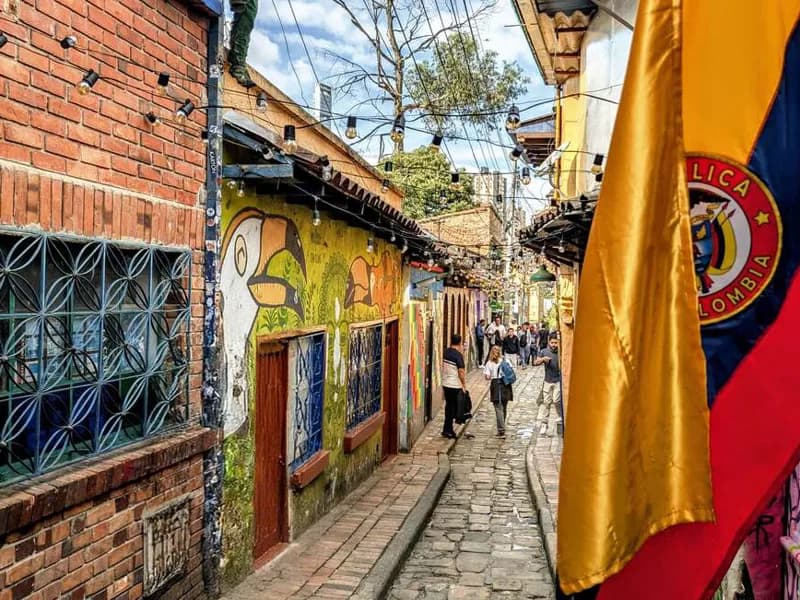
North of Bogotá, in the department of Boyacá, Villa de Leyva is one of the best preserved colonial towns in Colombia. It was founded in the late sixteenth century, and it has hardly been modernised since: its huge cobbled main square, one of the largest in South America, is surrounded by whitewashed houses with red-tiled roofs and wooden balconies, against a background of dry hills.
Further north, in Santander, Barichara is a small town of stone streets and white houses on a plateau above a canyon, sometimes called the prettiest town in Colombia. An old stone path, the Camino Real, leads from it down through the countryside to the village of Guane. Nearby, the Chicamocha Canyon is a huge, dry gorge with a cable car across it.
On the way from Bogotá to Villa de Leyva, Zipaquirá has an underground cathedral carved inside a salt mine, with a vast nave lit in changing colours.
Medellín, Colombia's second city, has done more than anywhere to change the country's image. In the 1990s it was notorious; since then it has invested heavily in public transport and in its poorest districts, linking hillside neighbourhoods to the centre with cable cars, the Metrocable, and in Comuna 13 with a series of outdoor escalators, now surrounded by murals and street art. Nearby, at Guatapé, a huge granite monolith, El Peñol, rises above a lake of many arms, and a staircase of more than seven hundred steps climbs to the top for the view.
The tours
Explore Worldwide's Contrasts of Colombia, thirteen nights, starts in Bogotá and travels to Zipaquirá, Villa de Leyva, Barichara, Guane and the Chicamocha National Park, then to the coffee country at Armenia and Salento, the Cocora Valley, Medellín and Guatapé, ending in Cartagena on the Caribbean coast. It runs from December to March, in July and in October and November.
Explore's Upgraded: Highlights of Colombia, seven nights, takes in Bogotá, and Pereira, Finca del Café and Finca Romelia in the coffee country, then Medellín, with the transformed hillside district of Comuna 13, Guatapé, and Cartagena with La Boquilla. It runs in February, March, August, October and November.
Colombia lies close to the equator, so the temperature depends more on altitude than on the season. The coffee country is mild all year, with two rainy seasons, roughly April to May and October to November, and two main harvests. The drier months, from December to March, are the most popular for travel.
By Walter Pellow, the name Atlas & Passage’s editorial team writes under. Prices and dates in the trips below come from the operators and can change.