Journeys
Penjikent and the Fann Mountains, Tajikistan's Sogdian valley
Just across the border from Samarkand, Penjikent was a city of the Sogdians, the merchants of the Silk Road, until the Arabs came in 722. Above it rise the Fann Mountains and the Seven Lakes, each a different shade of blue.
By Walter Pellow2 November 20263 min read
For most travellers in Central Asia, Tajikistan is the mountainous country on the map beyond Samarkand, rarely visited and little known. But it begins very close to the famous Silk Road cities. A short drive east of Samarkand, across the border, the valley of the Zeravshan river leads into Tajikistan, and the first town is Penjikent: a quiet place of orchards and markets, with a ruined city on its edge and high mountains above it.
The Sogdian city
Long before the Silk Road had its name, the people of this valley were the Sogdians, an Iranian people whose merchants carried silk, silver, spices and ideas between China, Persia and India, and whose language was, for centuries, a common tongue of the trade routes. Their cities lay in the valleys of what are now Uzbekistan and Tajikistan, around Samarkand, and Penjikent was one of them.
On a terrace above the modern town, the ruins of ancient Penjikent spread across the hillside: the outlines of streets, houses, temples and a citadel, built of mud brick and now worn down to low walls. In its heyday, between about the fifth and eighth centuries, it was a prosperous town of merchants and craftsmen, and its houses were decorated with wall paintings of extraordinary richness: scenes of feasts, hunts, battles, gods and heroes, and stories from the epics of the Persian world.
It ended with the Arab conquest of Central Asia. In 722 the Arabs reached Penjikent, and its ruler, Devashtich, fled into the mountains, where he was captured and executed. The town was abandoned in the decades that followed, and the paintings lay buried. Excavated in the Soviet era, the best of them are now in the Hermitage in St Petersburg, and others in the museums of Dushanbe and in the Rudaki Museum in Penjikent itself, which is worth an hour.
West of the town is a much older site. Sarazm, a settlement of the fourth and third millennia BC, bears witness to the beginnings of town life in Central Asia, and in 2010 it became Tajikistan's first UNESCO World Heritage Site.
The Fann Mountains
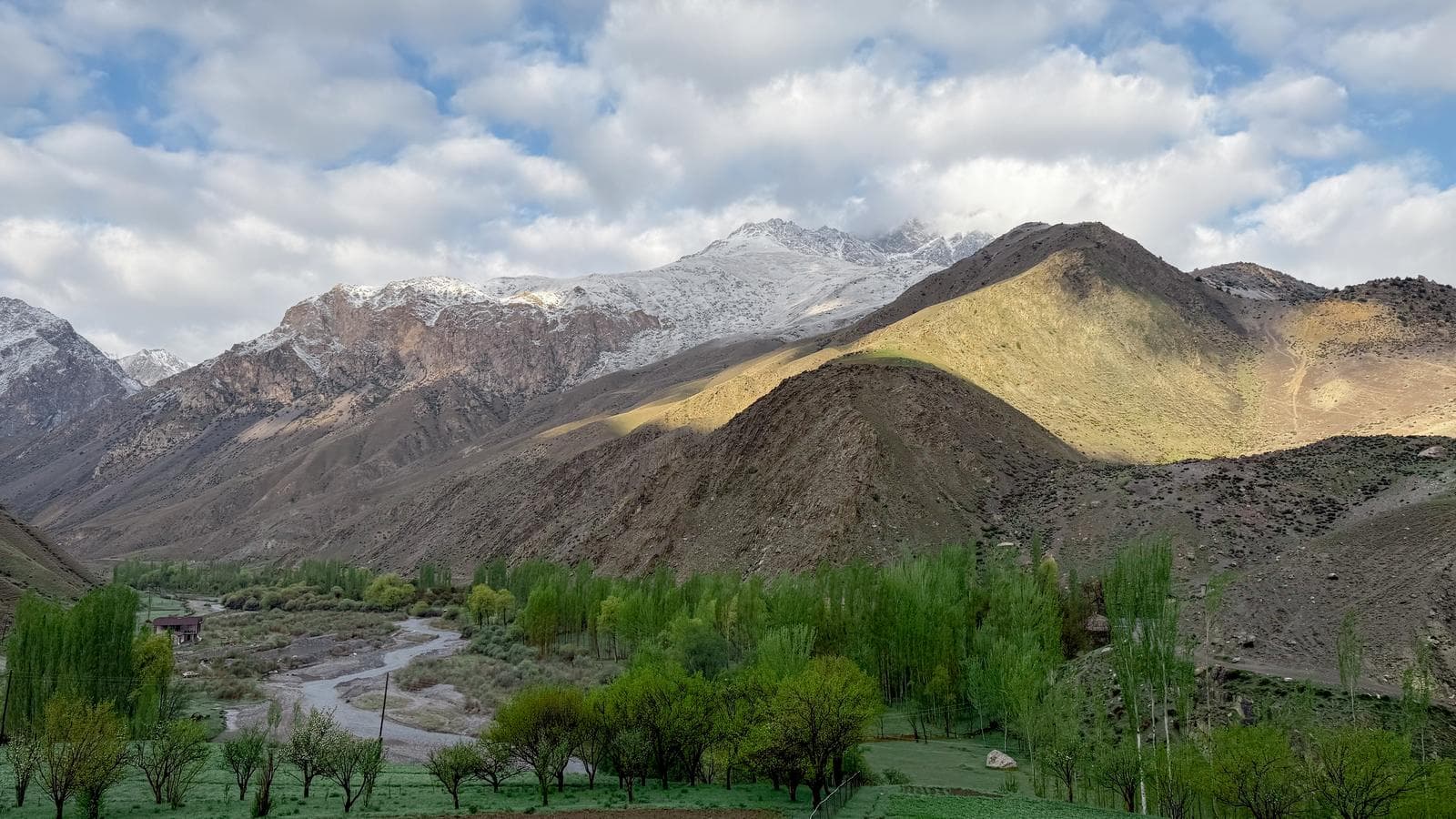
South of Penjikent rise the Fann Mountains, a compact range of jagged, glacier-hung peaks whose highest, Chimtarga, reaches about 5,489 metres. They are a famous trekking ground, with high passes, turquoise lakes and villages where life follows the seasons.
The easiest way into them is the Shing valley, south of Penjikent, where the Seven Lakes, Haft Kul, also called the Marguzor lakes, lie one above another along the river. Each is a different colour, from turquoise to emerald and deep blue, depending on the altitude and the light. A rough road and a path climb from lake to lake through small villages, orchards and steep walls of rock. It is a day trip from Penjikent, or longer for those who want to walk and stay in the villages. The weather in the mountains changes quickly, and even in summer the evenings by the upper lakes are cold, so take a warm layer whatever the forecast in the valley says.
Tours that cross from Samarkand
G Adventures' eleven-night Uzbekistan and Tajikistan: Silk Roads & The Seven Lakes goes from Tashkent to Khiva, Bukhara and Samarkand, then crosses into Tajikistan for Panjakent and the Marguzor Lakes. It departs in April and May.
G Adventures' eighteen-night Five Stans: Silk Road Highlights crosses five countries, with Ashgabat and Old Nisa, Khiva, Bukhara and the Siyab Bazaar, Panjakent Market and the Seven Lakes, Samarkand, Tashkent, Bishkek, Ak-Orgo and Karakol in its list. It departs from April to July.
G Adventures' fourteen-night Central Asia: Uzbekistan, Tajikistan, Kazakhstan & Kyrgyzstan also visits Panjakent and the Marguzor Lakes, between Samarkand and southern Kazakhstan, with Shymkent, Sayram Su Lake and Taraz.
When to go
Late spring and early autumn are the best times: in April and May, when these trips run, the valleys are green and the orchards in blossom, though the high passes may still be snowbound. Summer is hot in Penjikent but pleasant at the lakes. Bring your passport for the border crossing, a warm layer for the mountains, and time. Penjikent is not a place to rush through on the way to somewhere else; it is a place to stop.
By Walter Pellow, the name Atlas & Passage’s editorial team writes under. Prices and dates in the trips below come from the operators and can change.