History
Prague, Vienna and Budapest, three capitals of one empire
For centuries Prague, Vienna and Budapest answered to the same Habsburg crown. They are now the capitals of three countries, but a week between them still reads like a tour of one empire's rooms.
By Walter Pellow2 November 20264 min read
Before 1918, a traveller could go from Prague to Vienna to Budapest without crossing an international border. All three cities lay within the Austro-Hungarian Empire, ruled by the Habsburg dynasty from Vienna, and for the empire's last half-century Budapest was joint capital of its Hungarian half. The First World War ended all that. The empire broke apart, and the three cities became the capitals of new countries, later divided again by the Iron Curtain, with Vienna on one side and Prague and Budapest on the other.
What survives is a shared look. The grand boulevards, the opera houses, the coffee houses with their marble tables and newspapers on wooden poles, the yellow-painted provincial palaces: these belong to all three, and seeing them together makes each easier to understand. The cities are also close. The train from Vienna to Budapest takes under three hours, and Prague is a few hours further in the other direction.
Vienna, the centre
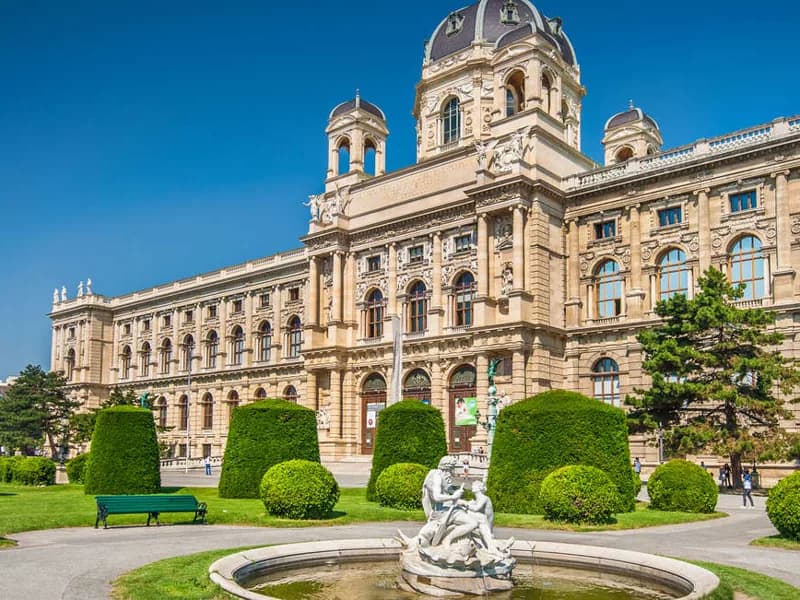
Vienna was the heart of the empire, and it still feels like a capital built for a much larger country. The Ringstrasse, the broad boulevard laid out in the nineteenth century on the line of the old city walls, is lined with the monuments of imperial confidence: the parliament, the city hall, the opera, the museums of art and natural history, and the university. Inside it, the old centre clusters around St Stephen's Cathedral and the Hofburg, the sprawling palace from which the Habsburgs ruled for centuries.
Outside the centre is Schönbrunn, the summer palace, with its yellow facades and formal gardens, built to rival Versailles. The city's music is everywhere, from the concert halls where Mozart, Haydn, Beethoven and Brahms worked, to the waltzes of the Strauss family.
Budapest, the other half
Budapest is two cities joined: Buda, on its hills on the west bank of the Danube, with the royal palace and the old town, and Pest, flat and urban on the east bank. They were formally united in 1873, a few years after the compromise of 1867 created the Dual Monarchy and gave Hungary its own government under the Habsburg crown. The city celebrated with a building boom. Its parliament, completed in the early twentieth century, is one of the largest in the world, a vast neo-Gothic building on the river that dominates every view of the Danube.
Budapest is also a city of thermal baths. Hot springs rise beneath it, and the baths built over them, from the Ottoman domes of the sixteenth century to the great yellow Széchenyi bath in the city park, are among its pleasures.
A week between them still reads like a tour of one empire's rooms.
Prague, the older crown
Prague was an imperial capital long before Vienna's dominance, the seat of the Holy Roman Emperor Charles IV in the fourteenth century, who gave it its university, its New Town and the stone bridge across the Vltava that now bears his name. It came under the Habsburgs in the sixteenth century, and for a time under Rudolf II it was again the imperial residence, filled with painters, astronomers and alchemists.
Unlike much of central Europe, Prague came through the Second World War with relatively little damage, and its old town, castle district and bridge survive as one of the most complete historic city centres in Europe. The castle on the hill above the river is one of the largest castle complexes in the world, with St Vitus Cathedral at its heart.
The tours that link them
Travelsphere's Imperial Capitals: Budapest, Vienna & Prague, seven nights, travels from Budapest through Bratislava, the Slovak capital, to Vienna, then to the small Bohemian town of Český Krumlov, and ends in Prague.
Just You's Prague, Vienna & Budapest, seven nights, for solo travellers, goes in the other direction, from Prague and Český Krumlov to Vienna, Szentendre and Budapest, with a stop at Lake Balaton, the largest lake in central Europe.
Explore Worldwide's Budapest to Prague Adventure, seven nights, takes in Bratislava and Vienna on the way, and adds the wine town of Mikulov and the Lednice-Valtice cultural landscape, a park of palaces and follies in southern Moravia. It runs from May to October.
All three cities are good at any time of year. Spring and early autumn are the most comfortable for walking, and December brings the Christmas markets, when the squares of all three fill with wooden stalls and the smell of mulled wine.
By Walter Pellow, the name Atlas & Passage’s editorial team writes under. Prices and dates in the trips below come from the operators and can change.