History
Taormina, the Greek theatre above the sea
High on a terrace of Monte Tauro, the ancient theatre of Taormina looks through its broken stage wall to the sea and, on a clear day, to the snow on Etna. Goethe stood in it in 1787 and found it hard to believe, and it is still the reason to climb the hill.
By Walter Pellow2 November 20264 min read
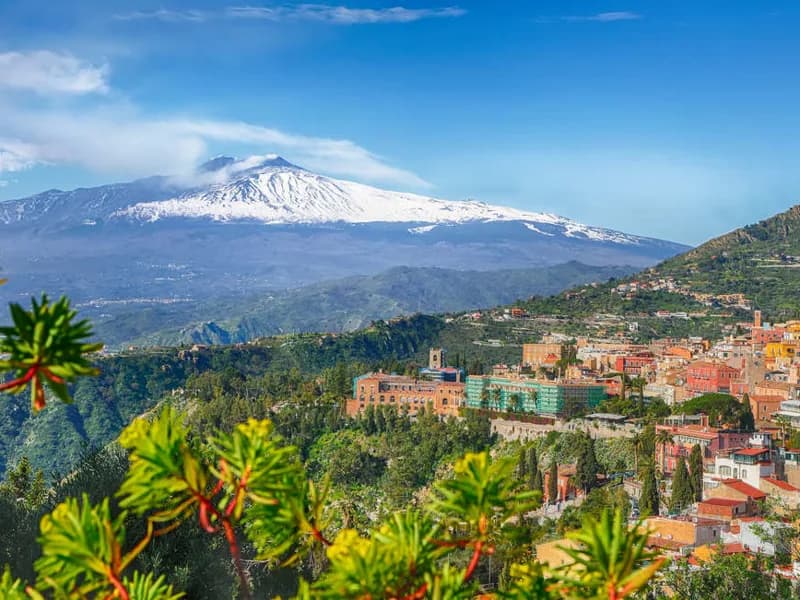
Taormina should not work. It is a small town strung along a ledge high above the Ionian Sea, with one main street, too many visitors in summer and a great many shops selling ceramics and lemon liqueur. And yet the setting is so good that none of that matters very much. The town looks south along the coast of Sicily, with Etna smoking at the far end of the view, and east across the strait to the mountains of Calabria. At its edge, on a terrace cut into the hill, is the ancient theatre, built so that every member of the audience looked past the stage to that view.
Greeks below, Greeks above
The story starts down by the sea. On the headland below Taormina, where the resort of Giardini Naxos now spreads along the bay, Greek colonists from Chalcis and the island of Naxos founded a settlement around 734 BC. It is usually described as the oldest Greek colony in Sicily, and they named it after the island many of them had come from. Its ruins, and a small museum, are still there among the lemon trees.
Naxos did not last. It was destroyed in the wars between the Greek cities of Sicily, and in the fourth century BC the survivors and their descendants moved up the hill to a site that could be defended, on the slopes of Monte Tauro. The new town was Tauromenion, the town on Tauros, and its name has come down, smoothed over the centuries, as Taormina.
Every member of the audience looked past the stage to that view.
The theatre
The theatre is Greek in origin and Roman in most of what you see. It was probably first built in the Hellenistic age, around the third century BC, cut into the rock of the hill in the usual Greek way, with tiers of seats curving round a circular orchestra. Under Rome it was rebuilt and enlarged, mainly in the second century AD, in red brick as well as stone, and adapted to Roman tastes in spectacle, including the games and combats that the Greeks had not staged.
The result is a hybrid, and an unusually good one. The tiers of the cavea sweep round in a half-circle; behind the stage stood a tall Roman wall of columns and niches, the scaenae frons, and it is the ruin of that wall, broken open, that makes the theatre famous. The gap frames the view: the line of the coast running south, the sea, and Etna, its upper slopes white for much of the year. Whether the original builders meant it or not, few stages anywhere have a backdrop like it.
Goethe came on 7 May 1787 during his journey through Italy, and in the account he later published wrote of the spectacle of sea, mountain and coast laid out in front of the seats, as if no theatre audience had ever had a view like it. Travellers have been quoting him, and climbing up to check, ever since.
The theatre is not only a ruin. Since 1983 it has been the main stage of Taormina Arte, the town's summer programme of concerts, opera, dance and theatre, and it is the home of the Taormina Film Festival. A seat on the old stone on a warm evening, with the sea going dark beyond the stage, is a fine way to see it, and the theatre is open to visitors by day for the rest of the time. Go early in the morning or late in the afternoon, when the coach parties are elsewhere and the light comes in low across the seats.
The rest of the town
The theatre sits at one end of the Corso Umberto, the street that runs the length of the old town between its two surviving gates. Along it are the small squares of Taormina, the best of them the Piazza IX Aprile, a terrace with a black-and-white pavement and a view down over the coast, and the cathedral, with its fortress-like front. The lanes running uphill and down from the Corso are where the town is quieter.
Below the town, a cable car runs down to the beach at Mazzarò and the cove of Isola Bella, a small island joined to the shore by a narrow strip of shingle. Above it, on a higher crag still, is the village of Castelmola, whose café terraces look down on Taormina the way Taormina looks down on the sea.
Holidays that include Taormina
Explore's seven-night Walking in Sicily is based on this side of the island. Among its places are Giardini Naxos and Taormina, Mount Etna, Linguaglossa, Castiglione di Sicilia, Francavilla di Sicilia and the Alcantara Gorge, with the island of Lipari and Milazzo, and in the south-east the Pantalica Gorge and Syracuse with its island old town of Ortygia. It departs in May, September and October, which are the right months for walking here; high summer is too hot.
Travelsphere's ten-night The Soul of Southern Italy travels through Puglia, with Ostuni, Alberobello, Cisternino and Locorotondo, to Matera, then down through Calabria to Diamante and Pizzo, and across to Sicily for Messina, Giardini Naxos, the hill village of Savoca and Taormina.
Travelsphere's twelve-night The Best of Sicily with Aeolian Islands Add-on takes in Catania, Mount Etna and Taormina, the Roman mosaics of the Villa del Casale, Campofelice di Roccella, the Valley of the Temples at Agrigento, Palermo, Monreale and Cefalù, with Lipari for the islands.
Whichever you choose, make sure the day in Taormina leaves time for the theatre at the right hour. The view does not change, but the light does.
By Walter Pellow, the name Atlas & Passage’s editorial team writes under. Prices and dates in the trips below come from the operators and can change.