Journeys
The Salar de Uyuni, the salt flat that mirrors the sky
High on the Bolivian altiplano lies a sheet of salt more than ten thousand square kilometres across. In the dry months it is a white desert; after rain, a few centimetres of water turn it into a mirror.
By Walter Pellow2 November 20264 min read
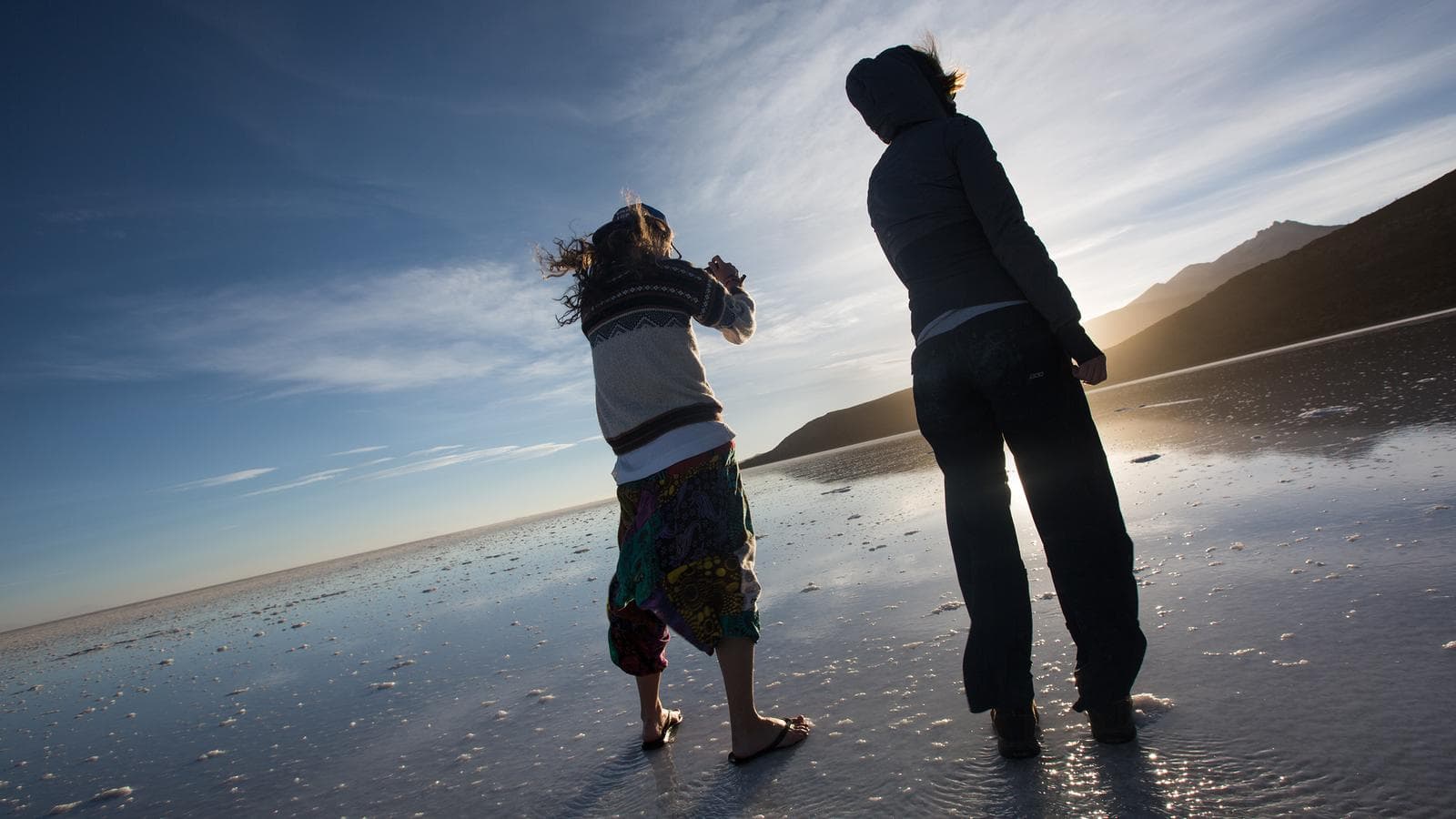
There is a point, a little way out onto the Salar de Uyuni, where the horizon disappears. The salt runs white and flat in every direction, the sky comes down to meet it, and the eye loses any sense of distance: a jeep a mile off looks like a toy, and a person ten paces away looks like a giant. Travellers have been taking trick photographs here for as long as there have been cameras small enough to carry, and the flat obliges every time.
It is the largest salt flat in the world, a little over ten thousand square kilometres of it, lying at about 3,650 metres on the altiplano of south-western Bolivia. Once this was part of a great prehistoric lake. As the lake dried, it left behind a crust of salt over a brine rich in minerals, lithium among them, and a surface so level that satellites have used it to calibrate their instruments.
The desert and the mirror
The salar has two faces, and which you see depends on the month.
In the dry season, from about May to November, it is a desert of white. The surface dries into a pattern of hexagons, ridged at the edges where the salt has crystallised, and the jeeps can drive freely across it to its islands. The best known of these is Incahuasi, a hump of rock in the middle of the flat covered in tall cactuses, from whose top the salt runs to the horizon on every side.
In the wet season, usually from about December to March or April, rain on the surrounding mountains and on the flat itself leaves a thin film of water across parts of the surface, often only a few centimetres deep. When the wind drops, that water becomes a mirror. The sky is reflected so exactly that clouds seem to lie on the ground, and at dawn and dusk the whole flat turns pink and gold above and below. This is the picture most people come for. The trade-off is that the wet season limits where the jeeps can go: the islands may be out of reach, and heavy rain can close the tracks altogether for a while.
Uyuni and the altiplano
The town of Uyuni, on the eastern edge of the flat, is a plain railway town of low buildings and cold winds, and it grew up as a junction on the line that carried minerals from the Bolivian mines to the Pacific. On its outskirts is the train cemetery, a line of rusting steam locomotives left on the plain when the railway's fortunes faded, and most trips onto the salt stop there first.
The altitude matters. At over 3,600 metres, nights are cold all year, the sun is strong, and the first day or two can bring headaches and breathlessness. Most tours of Bolivia approach the salar gradually, from La Paz, at a similar height, or from the old silver city of Potosí, which is higher still.
Tours that go there
Of the three holidays here, only G Adventures' ten-night Bolivia Discovery goes onto the salt flat. It starts in La Paz, and its places include the Uyuni salt flats and the Salar de Uyuni, the white colonial city of Sucre, Bolivia's constitutional capital, and Potosí, the city below the Cerro Rico, whose silver poured into Spain for centuries. It departs in January, February, March, May and December: the first three in the wet season, when the mirror is likeliest, and May at the start of the dry.
The other two pair Bolivia with Peru and leave the salar out, keeping to the altiplano around Lake Titicaca. G Adventures' fourteen-night Inca Empire runs from La Paz and the ruins of Tiahuanaco to Lake Titicaca, then on to Cusco, the Sacred Valley, Lamay and Ccaccaccollo, and the Inca Trail to Machu Picchu. It departs in January, February, March, May and December.
Travelsphere's seventeen-night Latin Wonders of the World covers more ground still, from Lima, Cuzco, Machu Picchu and the Sacred Valley by way of Raqchi and the La Raya pass to Puno, Lake Titicaca and the Sun Island, and on to La Paz, with Argentina and Brazil also among its countries.
If the mirror is what you want, go in the wet months and keep a day in hand for the weather. If you would rather drive across the white to Incahuasi, go in the dry. Either way, take sunglasses: the salt reflects the high-altitude sun with a vengeance.
By Walter Pellow, the name Atlas & Passage’s editorial team writes under. Prices and dates in the trips below come from the operators and can change.