Culture
Valparaíso, the port city of funiculars and painted hills
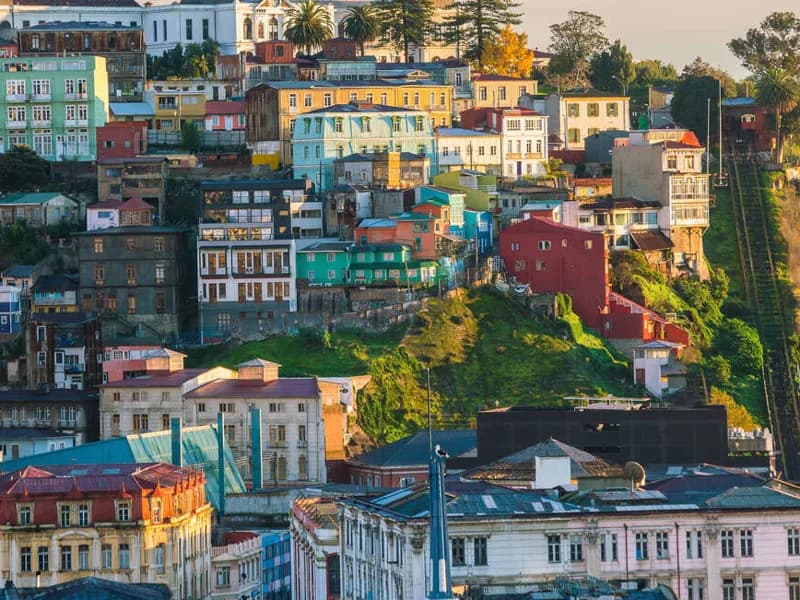
Chile's great port climbs a ring of steep hills above its bay, its houses painted in every colour and its streets linked by old funicular lifts and stairways. Once the busiest harbour on the Pacific coast of South America, it is now a city of murals, poets and views.
By Walter Pellow20 October 20264 min read
Valparaíso lies on the Pacific coast of Chile, about an hour and a half's drive west of Santiago. It is built on a narrow strip of flat land beside the bay and on more than forty steep hills that rise behind it like an amphitheatre. The flat part, the plan, holds the port, the banks and the old commercial streets. The hills, the cerros, hold the houses, piled one above another, painted in yellows, blues, reds and greens, and connected by a maze of winding lanes, steep stairways and lifts.
The port
In the nineteenth century, Valparaíso was the most important port on the Pacific coast of South America. Ships sailing between the Atlantic and the Pacific had to go round Cape Horn, and Valparaíso was the first major port they reached on the Pacific side. It became a busy, cosmopolitan city, with British, German, Italian and French merchants, banks, newspapers, schools and churches. Many of the merchants built fine houses on the hills, and their influence can still be seen in the architecture.
The opening of the Panama Canal in 1914 changed everything. Ships no longer needed to round the Horn, and Valparaíso's trade declined. It remains an important port and the seat of Chile's National Congress, but much of its old prosperity faded. Its historic quarter, a remarkable example of a nineteenth-century port city, became a World Heritage Site in 2003.
The ascensores
The city's most charming feature is its ascensores, the funicular lifts built from the late nineteenth century to carry people up the steep hills from the plan. At one time there were around thirty. Some have closed, but several still run, restored, with small wooden cars that creak up rails set into the hillside. A ride takes a minute or two, and it is the easiest way up to the viewpoints at the top, where promenades look out over the cranes of the port, the ships at anchor and the curve of the bay.
The best way to explore the hills is on foot. Cerro Alegre and Cerro Concepción, the most visited, are a maze of lanes lined with old houses clad in painted corrugated iron, many now restored as small hotels, cafés and galleries. Street art covers many walls, from small pieces to murals spanning whole buildings, and the city has become one of the best-known places for street art in South America.
The hills have suffered fires. Many of the houses are built of wood and corrugated iron, packed closely on steep slopes, and wind-driven fires have destroyed whole neighbourhoods, worst of all in 2014, when thousands of homes were lost on the upper hills. Earthquakes, too, are a fact of life on this coast, and much of the old city was rebuilt after a severe earthquake in 1906. Each time, the people of the hills have rebuilt, often in the same bright colours.
Neruda, and Viña del Mar
The poet Pablo Neruda, who won the Nobel Prize for Literature in 1971, loved Valparaíso. His house there, La Sebastiana, high on Cerro Bellavista, is a tall, narrow house full of the curious objects he collected, from ships' figureheads to maps, with views over the city and the bay from every floor. It is now a museum, as are his two other houses in Chile, in Santiago and at Isla Negra on the coast.
Next door to Valparaíso, along the bay to the north, Viña del Mar is a very different place, a seaside resort of beaches, gardens, apartment blocks and a casino. It is known as the garden city, and its flower clock is a popular photograph.
Travelsphere's Chile, Argentina and Brazil, thirteen nights, includes Valparaíso and Santiago in Chile, Mendoza and Buenos Aires in Argentina, and Iguaçu Falls and Rio de Janeiro in Brazil.
Explore Worldwide's Highlights of Chile: Atacama to Paine, twelve nights, includes Valparaíso and Viña del Mar with Santiago, San Pedro de Atacama, El Tatio, Puerto Montt, Puerto Varas, Punta Arenas and Torres del Paine.
Valparaíso is pleasant for most of the year, with a mild climate. Spring and summer, from about October to March, are the sunniest seasons. Wear comfortable shoes: the hills are steep, and the stairways are many.
By Walter Pellow, the name Atlas & Passage’s editorial team writes under. Prices and dates in the trips below come from the operators and can change.