Travel guide
Iceland holidays: a travel guide for UK visitors
Volcanoes, glaciers, geysers and the Northern Lights — Iceland is a land of raw, elemental scenery and one of the North Atlantic’s most striking cruise destinations.
Why visit Iceland
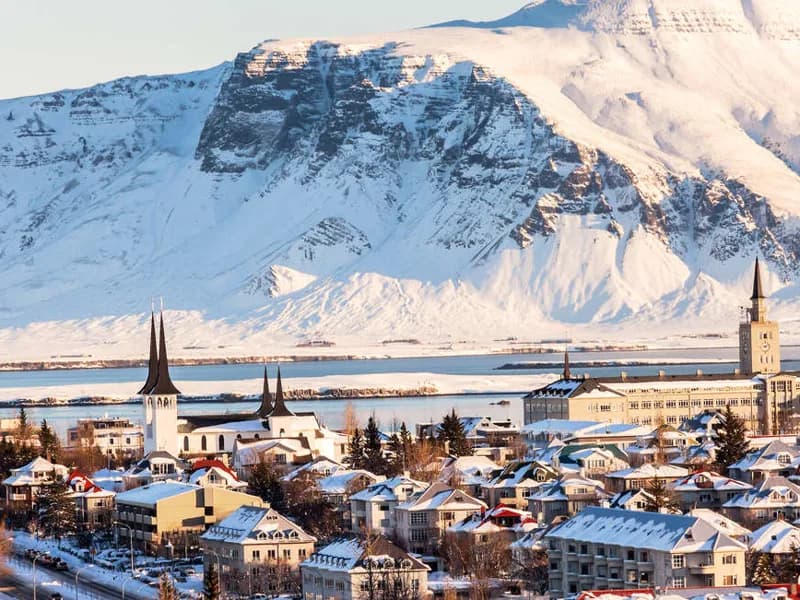
Iceland feels less like a country than a work in progress, its landscape still being shaped by fire and ice. Waterfalls thunder off green cliffs, geysers spout on cue, and black-sand beaches meet glaciers that calve into lagoons. Reykjavík, the world’s northernmost capital, is a small, creative city of geothermal pools and good coffee, while the Golden Circle packs the country’s headline sights into an easy day. In summer the sun barely sets; in winter the aurora dances overhead. For cruise passengers, ports around the island open up some of the most dramatic scenery in Europe.
Best time to visit
June to August brings the mildest weather, the midnight sun and the greenest landscapes — peak season for cruising and touring, with nearly round-the-clock daylight. For the Northern Lights, travel between late September and March, when the long Arctic nights are dark enough to see them, though the weather is colder and wilder.
Top things to do in Iceland
- 1
Tour the Golden Circle
Þingvellir National Park, the erupting Geysir and the mighty Gullfoss waterfall form Iceland’s most famous route, an easy excursion from Reykjavík that packs in the country’s greatest hits.
- 2
Bathe in geothermal waters
From the milky-blue Blue Lagoon near the capital to natural hot springs around the island, soaking in warm geothermal water surrounded by lava fields is a quintessential Icelandic experience.
- 3
See glaciers, whales and the aurora
Whale-watching from Húsavík and Akureyri, the glacier lagoon of Jökulsárlón and, in winter, the Northern Lights make Iceland’s coast and interior endlessly dramatic, with many cruises circling the island.
The cheapest Iceland holidays right now
Lowest lead-in prices first, from live availability. Open one for its dates, and book directly with its operator.
Iceland travel questions
- When is the best time to visit Iceland?
- June to August offers the mildest weather, the midnight sun and the most accessible scenery — the peak season for cruising. For the Northern Lights, travel between late September and March, accepting colder, wilder conditions.
- Can you see the Northern Lights in Iceland?
- Yes. The aurora is visible on clear, dark nights from roughly late September to March, away from city lights. A little patience and luck with the weather are the key ingredients, and several autumn and winter cruises seek them out.
- Do UK citizens need a visa for Iceland?
- No. UK passport holders can visit Iceland without a visa for tourism. Iceland is in the Schengen Area, so the 90-days-in-180 limit applies across all Schengen countries combined.
- What currency does Iceland use?
- Iceland uses the Icelandic Króna (ISK). It is one of the most card-friendly countries in the world, so you may barely need cash at all, even for small purchases.
- Is Iceland expensive to visit?
- Iceland is among Europe’s pricier countries, especially for eating out and alcohol. A cruise can be good value here, bundling meals, accommodation and scenic travel together in a country where restaurant prices run high.
- How many hours behind is Iceland compared with the UK?
- Iceland stays on Greenwich Mean Time all year and does not change its clocks. It matches the UK in winter and is one hour behind during British Summer Time.
- Do I need a travel adaptor for Iceland?
- Yes. Iceland uses Type F sockets at 230V, so you will need a European travel adaptor for your UK three-pin plugs. UK devices work happily on the local voltage.
- What should I pack for Iceland?
- Layers and good waterproofs are essential in any season, as the weather changes fast. Bring sturdy walking shoes, a windproof jacket and swimwear for the geothermal pools, plus warm clothing if visiting in winter.
- Is Iceland safe for tourists?
- Iceland is one of the safest countries in the world, with very low crime. The main things to respect are the weather and the terrain — keep to marked paths and heed local advice near cliffs, glaciers and hot springs.
- Do they speak English in Iceland?
- Yes, almost universally and to a high standard. English is taught from a young age, so visitors have no trouble communicating in Reykjavík, on excursions or on board ship.
Related travel guides
Denmark
Harbour-side capitals, fairy-tale castles and easy island-hopping — Denmark pairs design-led Copenhagen with a gentle Baltic coastline that cruises love.
Norway
Mirror-still fjords, midnight sun and the Northern Lights — Norway is one of the world’s great cruising destinations, dramatic in every season.
Sweden
A capital built on fourteen islands, deep forests and a thousand miles of Baltic coast — Sweden blends cool, walkable cities with vast, calming nature.