First time
A first Nile cruise, temples by day and the boat by night
A first trip to Egypt has an unusually large amount of history to fit into a fairly short time. A boat that moves while you sleep and stops at temples while you eat breakfast turns out to be the simplest way to manage it.
By Arthur Penhallow26 September 20263 min read
Egypt presents a first-time visitor with a genuine logistical puzzle: the monuments that matter most, the pyramids, the Valley of the Kings, the temples at Luxor, Kom Ombo, Edfu and Aswan, are spread along several hundred miles of the Nile valley, and driving between them would eat up days that could otherwise be spent actually looking at them. A cruise solves the problem by doing the travelling overnight or over lunch, leaving the daylight hours free for the sites themselves.
What a first route typically covers
Most first-time itineraries begin in Cairo, with a day or two given over to the pyramids and Sphinx at Giza and, usually, the treasures recovered from Tutankhamun's tomb. From there, a flight or short transfer connects to Luxor, where the cruise itself begins: a few days sailing south towards Aswan, with stops along the way at Kom Ombo's unusual double temple and the well-preserved temple at Edfu, before the boat turns and the return leg, or a flight back north, completes the loop.
Why it works particularly well for families
A Nile cruise removes several of the usual friction points of a family trip to a historically dense destination: no daily repacking, no repeated hotel check-ins, and a fixed, familiar base to return to after a morning spent among temples that, however impressive, can be a lot for younger attention spans to sustain for hours at a stretch. Ancient Egypt also has an advantage few other historical destinations can claim with children: hieroglyphics, mummies and pharaohs are already reasonably familiar from school and popular culture before anyone arrives, which tends to make the actual monuments feel like confirmation of something half-known rather than an entirely cold introduction.
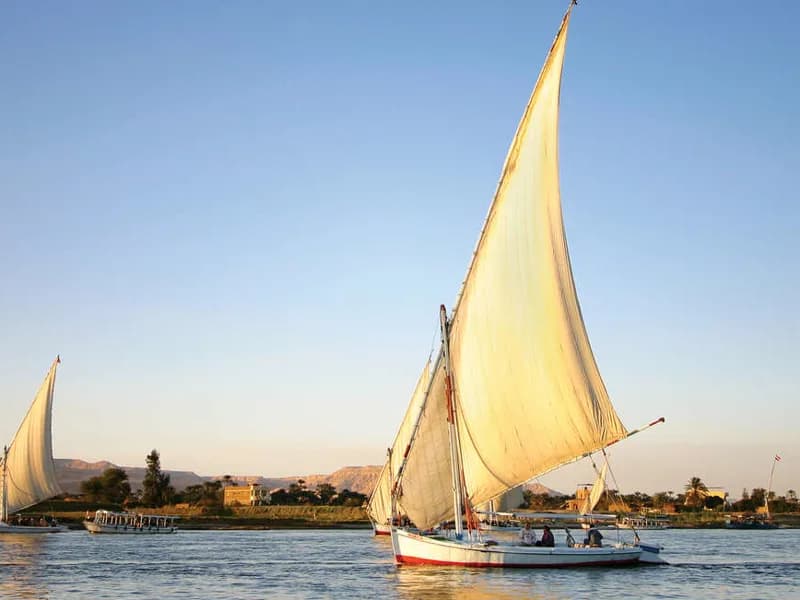
A boat that moves while you sleep and stops at temples while you eat breakfast.
Extending the trip to the coast
Some itineraries add a stretch on the Red Sea coast, usually at Hurghada, after the Nile portion finishes, trading temples for a stretch of straightforward beach time and warm water. For a first trip in particular, this works as a deliberate change of pace rather than an afterthought: a few days of comparatively little sightseeing after several days of fairly intensive history, giving everyone, adults included, a chance to properly absorb what they have just seen rather than moving straight from an ancient temple to a departure lounge.
The practical basics
Flights from the UK to Cairo generally take around five hours, and Egypt's currency, the Egyptian pound, is straightforward to use once exchanged, with major hotels and cruise boats generally set up to handle payments in a way that keeps things simple for visitors unfamiliar with the currency. None of this is complicated once underway; the main planning decision for a first trip is really just how much time to allow, since a Nile cruise alone easily fills a week, and adding Cairo properly, along with a few days on the coast, can stretch a first visit comfortably towards a fortnight.
Seeing the whole river, not just a temple at a time
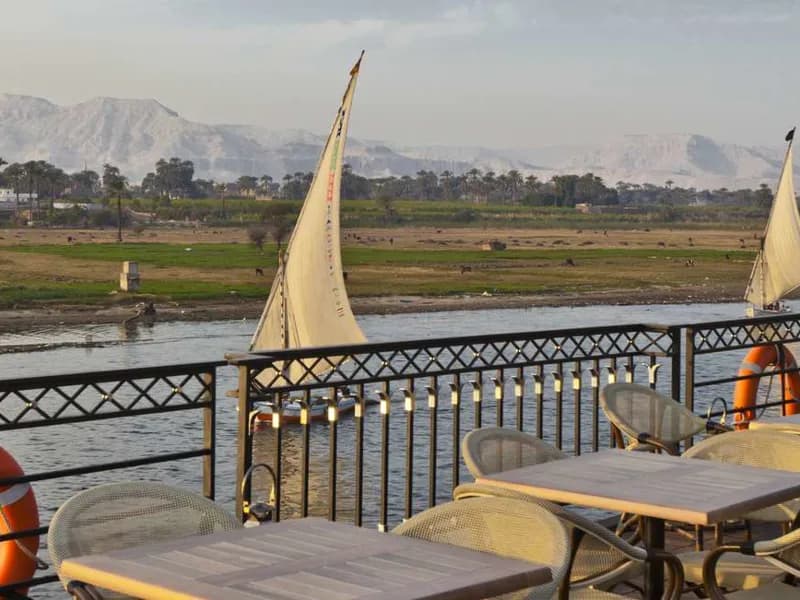
A typical day on a Nile cruise settles into an easy rhythm fairly quickly: an early start for a temple visit before the heat builds, a return to the boat for lunch while it moves on to the next stop, and free time in the afternoon before an evening spent on deck watching riverside villages, date palms and the occasional sailing boat go by. It is a considerably gentler pace than the packed, site-a-day itinerary a first-timer might expect from a country with this much to see, and that gentleness is deliberate: the temples themselves reward unhurried attention rather than a rushed tick-list approach.
What a first Nile cruise ultimately offers is scale without exhaustion: the same river that made ancient Egyptian civilisation possible carries a modern visitor past most of its greatest surviving monuments in roughly the order they were built, without the daily upheaval that trying to do the same journey by road would involve. It is, for a first encounter with a civilisation this old, a remarkably gentle way to cover an enormous amount of ground.
By Arthur Penhallow, the name Atlas & Passage’s editorial team writes under. Prices and dates in the trips below come from the operators and can change.