Journeys
Petra to the Pyramids, Jordan and Egypt in one trip
Two of the most famous ancient sites in the world lie a few hundred kilometres apart, separated by the Gulf of Aqaba and the mountains of Sinai. A journey between them takes in a Roman city, a desert, a coral sea and one of the oldest monasteries in Christendom.
By Walter Pellow20 October 20264 min read
On a map, Jordan and Egypt look close together, and they are. Between them lies only the narrow Gulf of Aqaba, the north-eastern arm of the Red Sea. Around its head, in the space of a few kilometres, four countries meet: Jordan, Israel, Egypt and Saudi Arabia. On the far side lies the Sinai peninsula, a triangle of desert mountains between Africa and Asia, and beyond it, the Nile and Cairo. A journey from one to the other links the rose-red city of Petra with the Pyramids of Giza, and it crosses some of the most dramatic and historic landscapes in the Middle East on the way.
Jordan
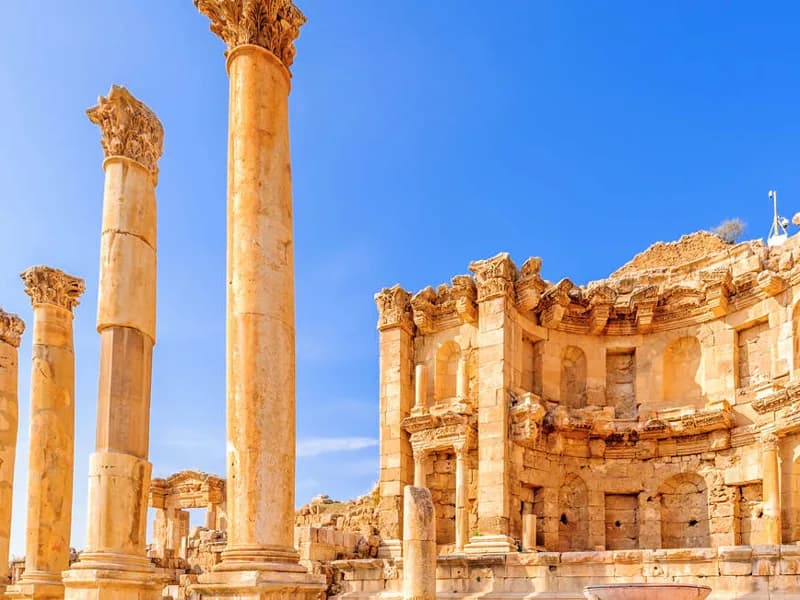
The Jordan half of the journey follows the classic route. There is Amman, the capital, and Jerash, one of the best-preserved Roman cities in the world. Madaba has its sixth-century mosaic map, and the Dead Sea, at the lowest point on earth, is the place to float. Kerak, the great Crusader castle, sits on the old King's Highway. Then come Petra, carved from the rock by the Nabataeans and reached through the narrow gorge of the Siq, and Wadi Rum, the red desert valley that T. E. Lawrence wrote about. Aqaba, Jordan's only port, on the Red Sea, is the place to cross into Egypt.
Sinai
The Sinai peninsula is a world of its own: a land of barren granite mountains, deep wadis and Bedouin camps, bordered by coral reefs. On its east coast, facing Saudi Arabia across the Gulf of Aqaba, Dahab is a laid-back seaside town with some of the best snorkelling and diving in the Red Sea. There are reefs a few steps from the shore, and the famous Blue Hole, a deep sinkhole in the reef. The mountains rise straight behind it.
In the high mountains of southern Sinai stands St Catherine's Monastery, built on the orders of the Byzantine emperor Justinian in the sixth century. It is one of the oldest continuously inhabited Christian monasteries in the world. Its walls enclose a church with Byzantine mosaics, a library of ancient manuscripts among the most important in the world, and a bush said to descend from the burning bush from which, according to the Bible, God spoke to Moses. The monastery and the mountains around it are a World Heritage Site.
Above the monastery rises Mount Sinai, Jebel Musa, the mountain where, by tradition, Moses received the Ten Commandments. Many visitors climb it in the dark to watch the sunrise from the summit, either by a winding camel path or by the steep stone stairway known as the Steps of Repentance, built by monks. The summit is cold before dawn, even in summer, and blankets are hired out at the top.
Between Sinai and the Nile lies the Suez Canal, opened in 1869 to link the Mediterranean and the Red Sea, and still one of the busiest shipping lanes in the world. Crossing it, by bridge or tunnel, marks the passage from Asia to Africa. Cairo itself, sprawling along the Nile, is the largest city in the Arab world, with its medieval Islamic quarter, its bazaars and its great museums of antiquities.
The Pyramids
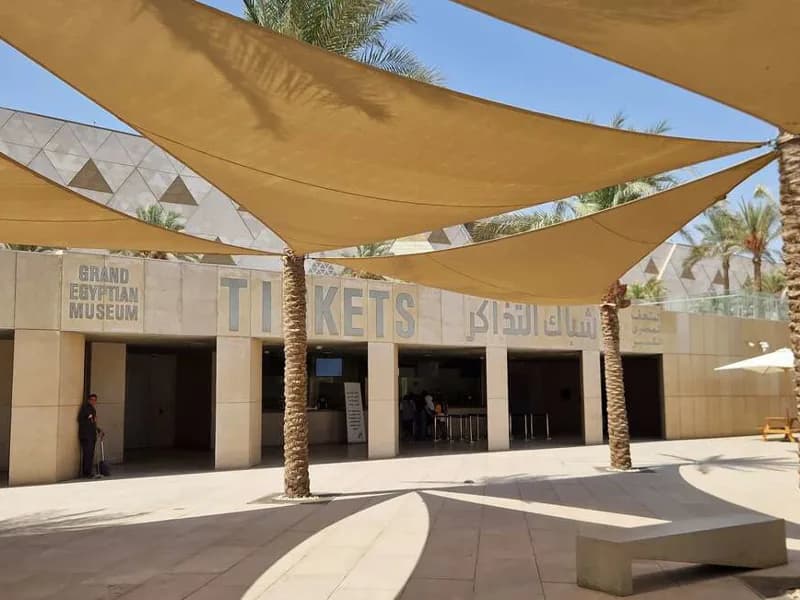
The journey ends at Giza, on the edge of Cairo, where the three great pyramids rise from the desert plateau beside the Sphinx. The Great Pyramid, built for the pharaoh Khufu around four and a half thousand years ago, is the only one of the Seven Wonders of the Ancient World still standing. Seeing it after Petra puts the two in perspective: the Pyramids were already more than two thousand years old when the Nabataeans began carving their city.
Explore Worldwide's Jordan and Egypt: Petra to the Pyramids, fourteen nights, covers the whole journey. In Jordan its places include Amman, Jerash, Madaba, the Dead Sea, Kerak, Petra, Wadi Rum and Aqaba. In Egypt they include Taba, Dahab, St Catherine's Monastery and Mount Sinai, with the Pyramids, as its name says, at the end.
For a shorter trip focused on Jordan, Explore Worldwide's Jordan Discovery, eight nights, covers Amman, Jerash, Madaba, Mount Nebo, Kerak, Petra, Wadi Rum, Aqaba and the Dead Sea.
Spring and autumn are the best seasons for the combined trip. Summer is very hot in the desert and the Nile Valley, and winter nights in the Sinai mountains are bitterly cold. Pack for both heat and cold, and for an early start on Mount Sinai.
By Walter Pellow, the name Atlas & Passage’s editorial team writes under. Prices and dates in the trips below come from the operators and can change.