Walking
Into Petra by the back door, on foot from Little Petra
Almost everyone enters Petra through the Siq, the famous gorge. There is another way in: a walk over the mountains from Little Petra that arrives at the Monastery from behind, then descends into the city as the Nabataeans' caravans once did.
By Walter Pellow20 October 20264 min read
The Siq, the narrow, winding gorge that leads to Petra's Treasury, is one of the most famous entrances to any ancient site in the world, and nobody who visits Petra should miss it. But it is also busy, and by mid-morning it is full of people. The Nabataeans built their city among mountains, and they did not reach it only through the Siq. Caravans arrived along several routes, and some of the old paths can still be walked. The finest of them starts at Little Petra, a few kilometres to the north, and crosses the high ground to reach Petra by what is often called the back door.
Little Petra and Beidha
Little Petra, known in Arabic as Siq al-Barid, the "cold canyon", is a short, narrow valley of carved façades, cisterns and rooms cut into the rock. It is thought to have been a suburb where caravans arriving from the north were received, with places for traders to rest, store goods and water their animals. In one of its rooms, part of a painted ceiling survives, with vines, birds and figures, a rare glimpse of the colours that once decorated Nabataean buildings.
Nearby lies Beidha, one of the oldest villages in the Middle East, a Neolithic settlement of stone houses occupied around nine thousand years ago, long before the Nabataeans. The low walls of its round and rectangular houses are a reminder of how long people have lived in these hills.
The walk
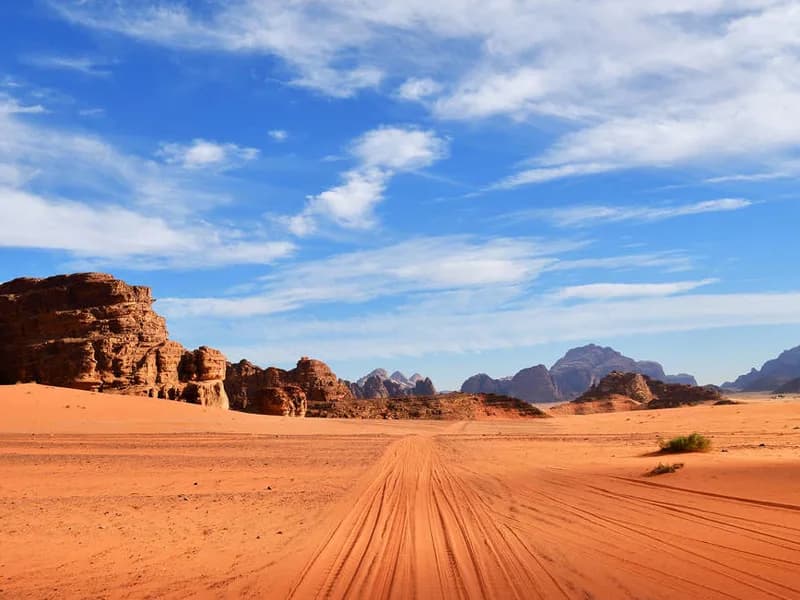
The route from Little Petra to the Monastery takes most walkers two to three hours or more, depending on pace and stops. It climbs gradually through a landscape of sandstone domes and narrow valleys, along old paths and rock-cut steps, past Bedouin encampments and goat herds, with wide views across the mountains. There are steep sections, loose rock and some exposed ledges, but no technical climbing. The path is not always obvious, and walking it with a local guide is strongly recommended, both for the route and for the stories.
The Bedouin of the Bdoul tribe lived among the ruins of Petra itself, in caves and tents, until the 1980s, when they were rehoused in a village nearby. Many still work in and around the site, and they know these mountains better than anyone.
On the way, the walk passes through the domain of the Bedouin families who still graze goats in these hills. There are tea stops at small shelters, and there may be a chance to sit and share a glass of sweet sage tea. The landscape changes with the light, from pale yellow in the morning to deep orange and red in the late afternoon, and the silence, away from the crowds in the main valley, is one of the walk's great pleasures.
Arriving at the Monastery
The reward comes at the end. The path brings you out above Ad-Deir, the Monastery, Petra's largest façade, almost fifty metres high, carved into the mountainside. Most visitors reach it by climbing some eight hundred rock-cut steps up from the city below. Arriving from behind, with the façade suddenly appearing across the open plateau, is a very different experience. There are viewpoints nearby over the deep valleys towards Wadi Araba, the Dead Sea rift and, on a clear day, the hills of the Negev.
From the Monastery, the descent down the steps leads into the heart of Petra. The way passes tombs and side valleys to the colonnaded street, the temples and the Royal Tombs, and finally, at the end, the Siq and the Treasury, seen in reverse.
The active Jordan tours
Explore Worldwide's Walking Jordan's Spice Trails, seven nights, includes Little Petra, Petra and Wadi Shamassat, as well as Wadi Rum, Amman, Kerak, Madaba, Mount Nebo, the Dead Sea and Jerash.
Explore Worldwide's Cycle Jordan, eight nights, includes Little Petra and the Neolithic site of El Beidha. It also takes in Madaba, Mount Nebo, the Dead Sea, Shobak, Petra and Wadi Musa, Wadi Rum, Aqaba and Amman.
The walk is best done in spring or autumn, when the days are warm but not too hot. Start early, carry plenty of water and wear good boots. The Treasury will still be there in the afternoon, and seeing it last, after a day in the mountains, is a fitting end.
By Walter Pellow, the name Atlas & Passage’s editorial team writes under. Prices and dates in the trips below come from the operators and can change.