History
Jerash, the Roman city the sand kept
An hour north of Amman lies one of the best-preserved Roman provincial cities anywhere. It has a colonnaded street still rutted by cart wheels, an oval forum, theatres and temples, all buried by earthquake and soil for centuries until travellers rediscovered them.
By Walter Pellow20 October 20264 min read
Most visitors to Jordan come for Petra, and many are surprised to find that the country has another ancient city almost as remarkable, and far easier to understand. Jerash, ancient Gerasa, lies in the green hills of northern Jordan, about an hour's drive from Amman. It was one of the cities of the Decapolis, a league of Greek and Roman cities on the eastern edge of the Roman world, and it grew rich on farming and trade. Under Roman rule, especially in the second century AD, it was rebuilt on a grand scale, with temples, theatres, baths and colonnaded streets. When the emperor Hadrian visited in the winter of 129 to 130, the city built a great triumphal arch in his honour, which still stands at the southern approach.
Buried and rediscovered
The city prospered into the Byzantine period, when many churches were built, some with fine mosaic floors. Its decline came gradually, as trade routes shifted, and then suddenly. A great earthquake in 749 brought down much of the city, and over the following centuries, the ruins were gradually covered by soil and silt. Much of the ancient city lay buried and forgotten until a German traveller, Ulrich Jasper Seetzen, came across the ruins in 1806. Excavation and restoration began in earnest in the twentieth century and continue today. Part of the reason so much survives is simply that it was buried for so long.
Walking through Gerasa
You enter through Hadrian's Arch and pass the hippodrome, the stadium for chariot races, before reaching the South Gate of the city. Beyond it, the Oval Plaza is one of the most striking sights in the Roman world: an irregular oval forum, paved with stone and surrounded by a curving colonnade of Ionic columns. No one is quite sure why it was built in this unusual shape, though it may have been designed to link the city's main street with the temple on the hill above.
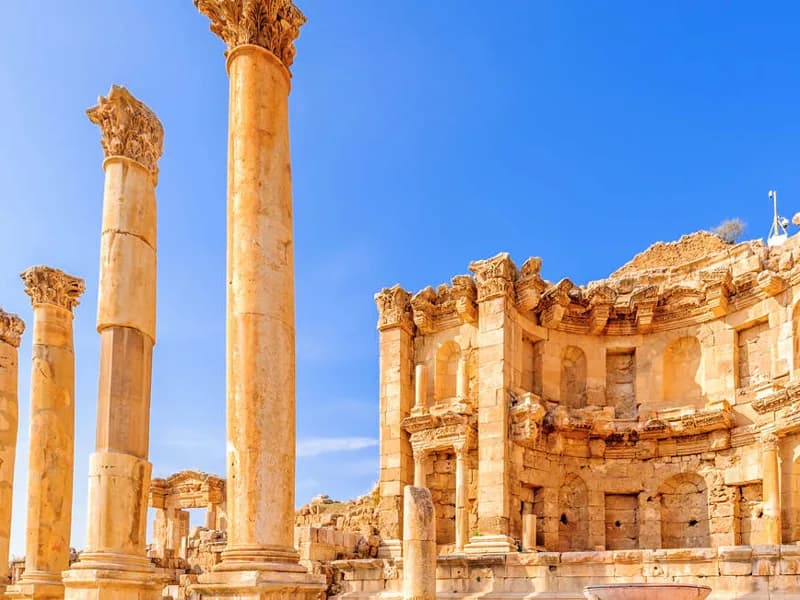
From the plaza, the Cardo, the city's main street, runs north for the best part of a kilometre, lined on both sides by columns. Its original paving stones still bear the ruts worn by cart wheels, and the drains beneath it can be seen through holes in the paving. Along the street are the remains of shops, a monumental public fountain, the Nymphaeum, and the great gateway and staircase that once led to the Temple of Artemis, the city's patron goddess. Some of the temple's tall columns still stand above the town.
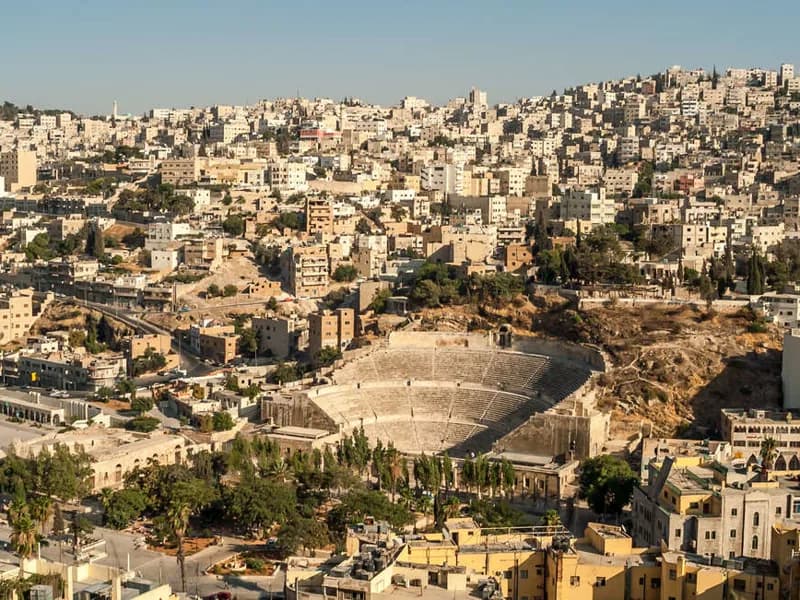
The South Theatre, built into the hillside near the Oval Plaza, still has excellent acoustics. Musicians sometimes play Scottish bagpipes there, a legacy of Jordan's military ties with Britain, and the sound echoing round the stone is an unexpected pleasure. The ruins of several Byzantine churches lie behind the temple, some with their mosaic floors still in place.
Jerash comes alive at certain times. Each summer, the Jerash Festival brings music, dance and theatre to the ancient theatres and plazas, with performers from Jordan and across the Arab world. In the hippodrome, re-enactments of Roman chariot races and gladiator fights have been staged for visitors, with performers in costume, a spectacle that is enjoyable in its own right and gives a sense of the scale of the arena.
Ajloun, and the tours
Close to Jerash, on a hilltop above the Jordan valley, stands Ajloun Castle. It was built in the twelfth century by one of Saladin's commanders to guard the region against the Crusaders. Its towers give wide views across to the West Bank on a clear day.
Explore Worldwide's Upgraded Treasures of Jordan, eight nights, includes both Ajloun and Jerash, with Amman, Mount Nebo, Madaba, Kerak, Petra, Wadi Rum, Aqaba and the Dead Sea.
Travelsphere's Jordan's Ancient Wonders, seven nights, includes Jerash with Amman, Mount Nebo, Madaba, Shobak, Petra, Siq al-Barid, Wadi Rum and the Dead Sea. Explore Worldwide's Jordan Discovery, eight nights, includes Jerash too.
Allow at least half a day for Jerash, and more if you can. Spring, when the hills around are green and the wild flowers are out, is the loveliest time to visit, and the heat of summer makes early starts essential.
By Walter Pellow, the name Atlas & Passage’s editorial team writes under. Prices and dates in the trips below come from the operators and can change.