Culture
Bangkok by its river and canals
Bangkok was built on water. Its river and the canals that branch from it were once its streets, and they are still the best way to understand the city, and to escape its traffic.
By Walter Pellow20 October 20264 min read
Bangkok sits on the low, flat delta of the Chao Phraya river, a few dozen kilometres from the sea. When King Rama I founded his capital here in 1782, the land was a patchwork of rice fields, orchards and swamps, laced with channels. The new city was built around canals, khlongs, dug both to defend the royal island and to move people and goods. For most of the nineteenth century, Bangkok's people lived on and beside the water. They travelled by boat, bought from floating vendors and lived in stilt houses or floating houses moored along the banks. European visitors of the time took to calling it the Venice of the East.
In the twentieth century, most of the canals on the eastern bank were filled in and paved over to make roads, and Bangkok became notorious instead for its traffic jams. But the river remains the city's great thoroughfare, and on the western bank, in the old district of Thonburi, many of the canals survive, with life along them that is surprisingly unchanged.
The river
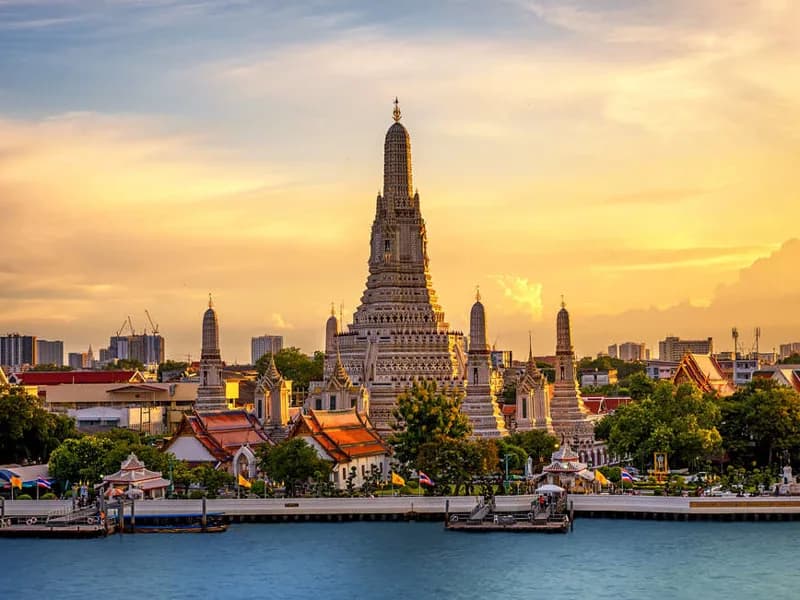
The Chao Phraya winds through the centre of Bangkok in great loops, wide, brown and busy with traffic: rice barges towed in long strings, ferries criss-crossing between the banks, long-tail boats roaring past and the public express boats that run up and down it. The express boats are one of the best ways to see the city. They stop at piers close to the Grand Palace, Wat Pho and, across the water, Wat Arun, and give a passing view of the old warehouses, churches, mosques, temples and riverside hotels that line the banks.
The river is at its best in the late afternoon and at dusk, when the heat eases and Wat Arun and the Grand Palace are lit up against the evening sky.
But the river remains the city's great thoroughfare.
The canals of Thonburi
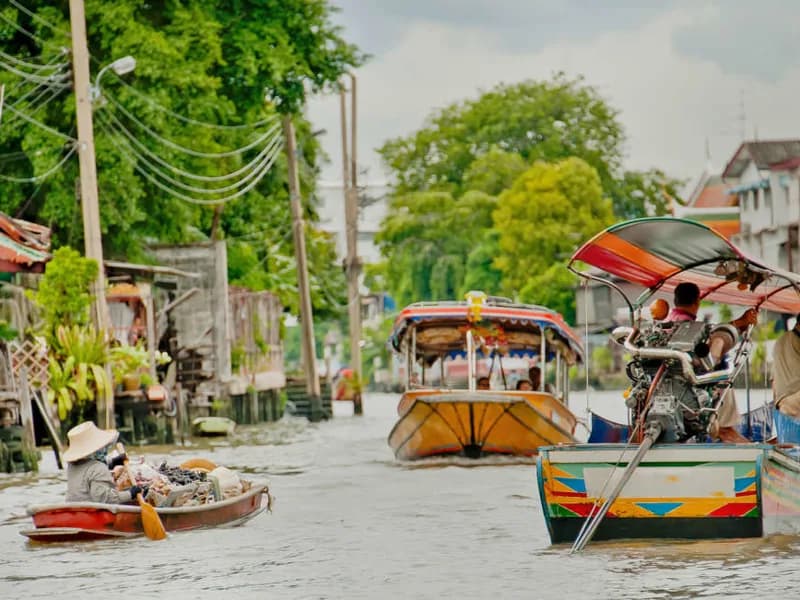
Thonburi, on the western bank, was briefly the capital itself after the fall of Ayutthaya, before the court crossed the river. Its canals, such as Khlong Bangkok Noi and Khlong Bangkok Yai, are best explored by long-tail boat. Within minutes of leaving the river, you are in a different city: wooden houses on stilts with potted plants on their verandas, children jumping into the water, now and then a monk collecting alms by boat in the early morning, temples at every bend, and orchids hanging from the eaves. It is quieter, greener and slower than the city across the river. Nearby, the Royal Barge Museum houses the long, gilded ceremonial barges used for royal processions on the river.
Green bends and railway markets
South of the city centre, the river makes a great loop around a district called Bang Kra Jao, often called Bangkok's green lung. It is a patch of plantations, mangroves and villages, with raised concrete paths through the greenery that are ideal for cycling, all within sight of the towers across the water.
An hour or so west of the city, the town of Maeklong has one of the most famous markets in Thailand. A railway line runs straight through the middle of it. Several times a day a train trundles slowly through, the stall-holders fold back their awnings and pull in their goods just in time, and as soon as it has passed, the market closes in again behind it.
The tours that start here
Most tours of Thailand begin in Bangkok. Explore Worldwide's Bangkok to Saigon by Bike, thirteen nights, includes Bang Kra Jao in Bangkok, then Siem Reap, the temples of Angkor, the Tonle Sap lake, Battambang and Phnom Penh in Cambodia, on the way to Vietnam.
Explore Worldwide's Family Thailand: Beach and Jungle Adventure, twelve nights, includes Bangkok, the Maeklong railway market and Khlong Noi. It then covers the national parks of Khao Sam Roi Yot and Kui Buri, the coast at Prachuap Khiri Khan and Pranburi, Khao Sok and its lake, and the beach at Khao Lak. Explore Worldwide's Discover Thailand, eleven nights, combines Bangkok with Kanchanaburi and Hellfire Pass, the coast, Khao Sok, Koh Lanta and Krabi.
Wherever you are heading next, give Bangkok's river at least an afternoon. It is the oldest street in the city, and still the best.
By Walter Pellow, the name Atlas & Passage’s editorial team writes under. Prices and dates in the trips below come from the operators and can change.