First time
Thailand for the first time: Bangkok, the old capitals and the north
Thailand is many people's first taste of South-east Asia, and it is a good one. A first trip that runs north from Bangkok through the ruined capitals to Chiang Mai shows why the country is more than its beaches.
By Walter Pellow20 October 20264 min read
Thailand is the only country in South-east Asia that was never colonised by a European power. Its kings played Britain and France off against each other through the nineteenth century, ceded territory when they had to, and modernised the state on their own terms. That independence shows. Thai culture is deeply self-confident, with its own script, its own form of Buddhism, a monarchy that is treated with great reverence, and a cuisine that it has exported to the world on its own terms.
Most people's first picture of Thailand is a beach, and the islands of the south deserve their reputation. But a first trip that only goes to the beach misses most of the country. The classic route runs the other way, north from Bangkok through the ruins of the earlier capitals to the hills around Chiang Mai, with the beach at the end as a reward.
Bangkok
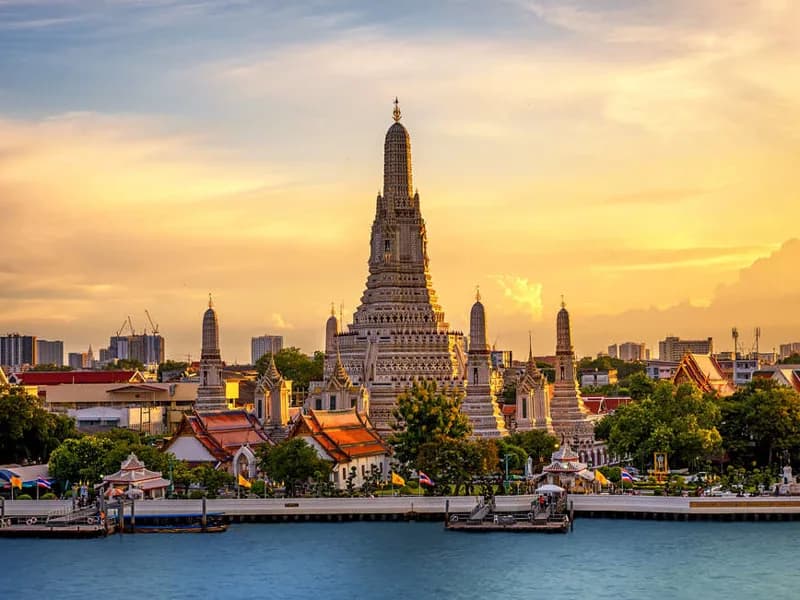
Bangkok became the capital in 1782, when King Rama I, founder of the present Chakri dynasty, moved the court across the Chao Phraya river and began building a new royal city on an island in its bend. His Grand Palace, with the Temple of the Emerald Buddha in its grounds, is still the city's great sight: a glittering complex of gilded spires, mirrored mosaics and guardian giants. Wat Pho, next door, has a gilded reclining Buddha about forty-six metres long, and Wat Arun, across the river, is a tall, porcelain-studded tower that catches the light at dawn and dusk.
Beyond the old royal city, Bangkok is a vast, hot, noisy metropolis of more than ten million people. It is exhausting and exhilarating in equal measure, with superb street food, canal-side communities, malls of startling scale and a river that is still one of the best ways to get about. Two or three days are enough for most first visits.
The River Kwai and the old capitals
West of Bangkok, Kanchanaburi is where the Japanese army built the Burma Railway in the Second World War using prisoners of war and conscripted Asian labourers, tens of thousands of whom died. The bridge over the river Kwai and the cutting at Hellfire Pass, hacked out of solid rock by hand, are moving places to visit, as are the war cemeteries in the town.
North of Bangkok lie the capitals that came before it. Ayutthaya was the capital of a powerful kingdom for four centuries, until the Burmese sacked it in 1767. Its ruined temples and brick towers now stand among the parks and rivers of the modern town. Sukhothai, further north, is older still, regarded as the first great Thai kingdom of the thirteenth century, with serene Buddha statues among lotus ponds. Both are World Heritage Sites.
Chiang Mai and the north
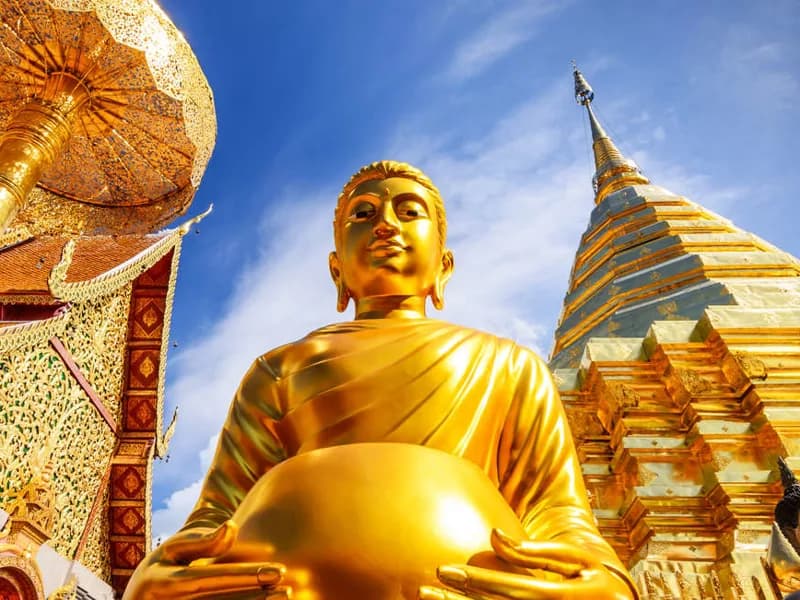
Chiang Mai, in the hills of the north, was the capital of the Lanna kingdom. Its old city is still surrounded by a moat and fragments of wall, with hundreds of temples in and around it. It has a cooler climate, a more relaxed pace than Bangkok, and good food of its own. The temple of Doi Suthep, on the mountain above the city, has views across the valley.
Just You's Thailand: a Land of Smiles, thirteen nights for solo travellers, follows the classic route: Bangkok and Kanchanaburi, Ayutthaya, Phitsanulok and Sukhothai, Lampang and Chiang Mai, and Krabi on the coast.
Explore Worldwide's Best of Northern Thailand, nine nights, covers similar ground: Chiang Mai and the Elephant Nature Park, Si Satchanalai, Sukhothai, Uthai Thani and Ayutthaya, Kanchanaburi and the Erawan waterfall, the Maeklong railway market and Bangkok. Explore Worldwide's Discover Thailand, eleven nights, covers the south instead. After Bangkok, Kanchanaburi and Hellfire Pass, its places include Phetchaburi and Pranburi on the coast, the rainforest of Khao Sok, Koh Lanta and Krabi.
The best time to go is the cool, dry season from November to February. March to May is very hot, and the monsoon brings heavy rain from roughly June to October, though often in short downpours rather than all day.
By Walter Pellow, the name Atlas & Passage’s editorial team writes under. Prices and dates in the trips below come from the operators and can change.