History
Bulgaria, from Sofia to Veliko Tarnovo and the Rila Monastery
Most British visitors know Bulgaria for its Black Sea beaches. Inland is an older country of medieval capitals, painted churches and a great monastery in the mountains, and a week is enough to see the best of it.
By Walter Pellow2 November 20264 min read
Bulgaria is one of the least visited countries in Europe for its history. Most British holidaymakers who go there go to the coast, and the inland country, with its mountains, monasteries and medieval towns, is left to those who know to look for it. It repays them well. This is the land where two medieval empires rose and fell, and where, under five centuries of Ottoman rule, the monasteries kept the language and the faith alive.
Three places tell most of that story: Sofia, the capital; the Rila Monastery, in the mountains to the south; and Veliko Tarnovo, the old royal city in the centre of the country.
Sofia and Boyana
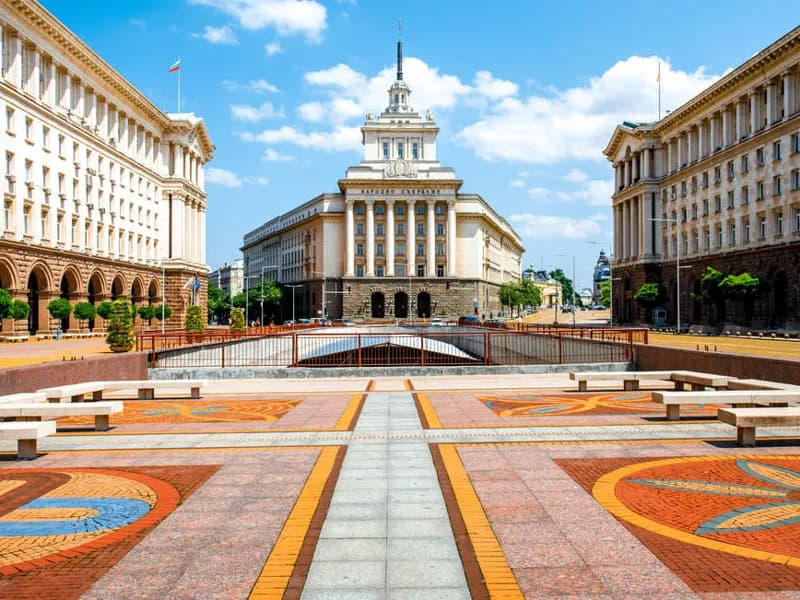
Sofia is an easy-going capital with a long past just below the surface. Roman Serdica lies under the city centre, and its streets and walls appear in the metro stations and in glass-covered pits in the pavement. Above them stand the Orthodox churches, the Ottoman mosque and the synagogue within a few minutes' walk of each other, and the great gold-domed Alexander Nevsky Cathedral, built in thanks for the Russian part in Bulgaria's liberation from the Ottomans.
The city's great treasure is on its edge. In the suburb of Boyana, at the foot of Mount Vitosha, a small medieval church holds frescoes painted in 1259, among the most important surviving medieval paintings in Europe. Its saints and donors are painted with a humanity and individual expression that seem far ahead of their time. Visits are short and numbers limited, to protect the paint, and it is worth arriving early.
The Rila Monastery
Two hours or so south of Sofia, in a deep valley of the Rila mountains, stands the largest and most famous monastery in Bulgaria. It was founded in the tenth century by St John of Rila, a hermit who withdrew to the mountains and around whom a community grew. The monastery became the country's spiritual heart, and through the centuries of Ottoman rule it was a keeper of Bulgarian learning and books.
What you see today is mostly nineteenth century: the old buildings burned, and the present complex was completed in 1862. It is a fortress-like square of stone, with arcaded galleries striped in black and white rising tier on tier around a courtyard, and in the middle a church painted inside and out with saints, sinners and a lively, frightening Last Judgement. Only the stone tower of an earlier age, Hrelyo's Tower, survives from the medieval monastery. Rila has been a UNESCO World Heritage Site since 1983, and it is still home to a community of monks.
Arcaded galleries striped in black and white rise tier on tier around the courtyard.
Veliko Tarnovo
In the centre of the country, the River Yantra cuts a series of deep loops through a limestone gorge, and on the hills inside the loops stands Veliko Tarnovo. From 1185 it was the capital of the Second Bulgarian Empire, one of the great powers of the medieval Balkans, until it fell to the Ottomans in 1393.
The heart of the old city was the hill of Tsarevets, almost surrounded by the river and walled all round. On it stood the royal palace and the patriarch's palace, and on the summit the Patriarchal Church. Today the walls and gates have been partly restored, the foundations of the palaces can be walked, and the church at the top has been rebuilt and painted with modern murals of the empire's history. On some evenings the hill is lit by a sound and light show.
Across the gorge, the town's old houses are stacked up the cliffs above the river, with views across to Tsarevets, and the street of the craftsmen, with its workshops and small shops, winds down the hill.
How to go
Bulgaria is usually seen as part of a wider tour of the Balkans, and all three holidays here cross borders.
Just You's twelve-night Balkan Explorer, for solo travellers, starts in Bucharest and enters Bulgaria for Veliko Tarnovo and Sofia, before continuing through Skopje in North Macedonia and Niš, Belgrade and Novi Sad in Serbia, and back into Romania.
Explore's fourteen-night Ancient Macedonia begins in Sofia and heads south-west by way of the Saint Joakim Osogovski Monastery and the old mining town of Kratovo to Skopje, the Matka Gorge, Lake Ohrid, the Saint Jovan Bigorski Monastery, Vevchani, Ohrid and Struga, then Lin and Podgradec. It departs in May, June, August, September and October.
Explore's fifteen-night Grand Tour of Romania, Serbia & Bulgaria joins the three countries in one long loop, with Bucharest, Transylvania and Bran Castle, the Danube at Orsova, Belgrade, Novi Sad and Devil's Town. It runs from April to October.
Late spring and early autumn are best for the inland country: May and June are green and warm, September and October are clear and golden, and the mountains around Rila are pleasant for walking. Summer is hot in the valleys, though the monastery's mountain air is cooler. Whenever you go, allow time. Bulgaria's sights are spread out, its roads are slow, and the pleasure is in the long drives through the mountains as much as in the places at the end of them.
By Walter Pellow, the name Atlas & Passage’s editorial team writes under. Prices and dates in the trips below come from the operators and can change.