Journeys
Bucharest to Skopje, the Balkans in one long ride
Romania, Bulgaria, North Macedonia and Serbia share a history of empires, monasteries and mountains, but each has done something different with it. Travelling between them by road, over the Danube and through the Balkan mountains, is the way to see how.
By Walter Pellow2 November 20264 min read
The Balkans are often seen only in pieces: a week on the Croatian coast, a city break in Sofia, a stop in Belgrade. Travelling through several of its countries in one journey brings out how much they share and how much they differ. For five centuries much of the region was under Ottoman rule, and the Orthodox church kept language and identity alive through it. Then, in the nineteenth and twentieth centuries, each country took its own path to independence, kings, communism and the present.
Romania, and across the Danube
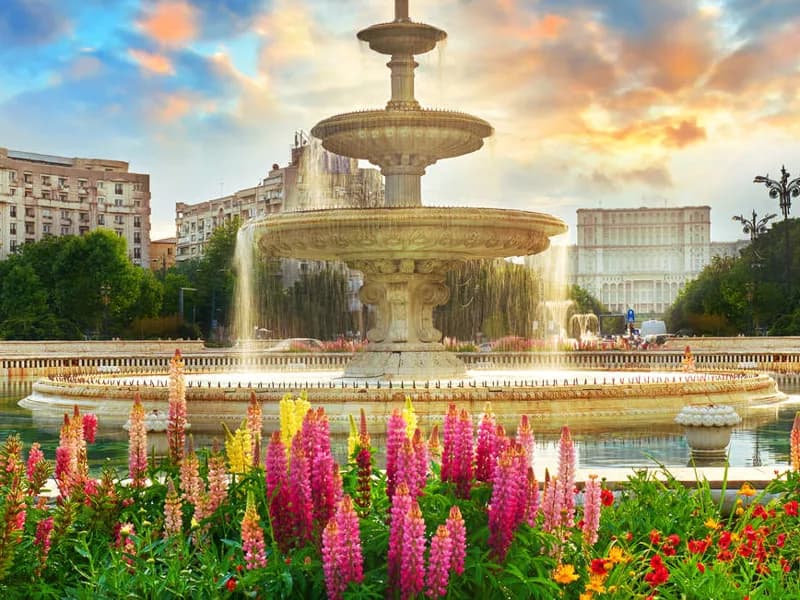
Bucharest, the Romanian capital, is a city of broad boulevards, Orthodox churches and the vast Palace of the Parliament, built by the dictator Nicolae Ceauşescu in the 1980s, one of the largest administrative buildings in the world. Its old quarter is full of cafés, and its nineteenth-century villas once earned it the nickname of the little Paris of the east.
South of Bucharest, the Danube forms most of the border with Bulgaria, and crossing it marks a change of country, language and alphabet: Bulgaria uses Cyrillic, which was developed in the first Bulgarian state in the ninth and tenth centuries.
Bulgaria, from Tarnovo to Sofia
Veliko Tarnovo, the medieval capital of Bulgaria, stands on hills above a looping river, the Yantra, its houses stacked up the slopes. On a hill in the river's curve stands Tsarevets, the fortress of the Bulgarian tsars of the Second Bulgarian Empire, its walls and patriarchal church rebuilt on the ruins. In summer, a sound and light show is sometimes staged over the hill.
Sofia, the capital, sits beneath Mount Vitosha. Its centre is dominated by the Alexander Nevsky Cathedral, with its gilded domes, built in memory of the Russian soldiers who died in the war that freed Bulgaria from Ottoman rule in 1878. Nearby, the little brick church of St George, built by the Romans in the fourth century, is one of the oldest buildings in the city. South of Sofia, in the Rila mountains, the Rila Monastery is the most important in Bulgaria, its striped arcades and painted church set in a deep forested valley.
Sofia is also a very old city. As the Roman town of Serdica it was a favourite of Constantine the Great, and the excavations of its streets, walls and buildings, uncovered while the city's metro was being built, have been left open beneath the modern centre, so that passengers walk past Roman foundations on their way to the trains.
Each country took its own path to independence, kings, communism and the present.
North Macedonia and Serbia
Skopje, the capital of North Macedonia, was largely destroyed by an earthquake in 1963 and rebuilt in the modernist style of the time. More recently, a much-debated building project filled its centre with statues, fountains and neoclassical facades. Its old bazaar, across a medieval stone bridge over the Vardar river, is one of the largest and best preserved in the Balkans outside Istanbul, with mosques, inns and workshops.
From Skopje the road runs north into Serbia, past Niš, an old Roman city that was the birthplace of Constantine the Great, and on to Belgrade, the Serbian capital, at the meeting of the Sava and the Danube. Its great Kalemegdan fortress looks down on the confluence. Further north, Novi Sad, on the Danube, has a baroque centre and the Petrovaradin fortress above the river, and hosts one of the largest music festivals in Europe each summer.
The tours
Just You's Balkan Explorer, twelve nights for solo travellers, makes this journey in one loop. It starts in Bucharest and travels through Veliko Tarnovo and Sofia to Skopje, then north through Niš to Belgrade and Novi Sad, and back into Romania through Timişoara, Sibiu, Braşov, Zărneşti and Bran.
Explore Worldwide's Grand Tour of Romania, Serbia & Bulgaria, fifteen nights, covers Romania in more depth, with Sinaia, Bran Castle, Braşov, Sibiu and Corvin Castle, then follows the Danube to Orşova, the Roman site of Viminacium, Belgrade and Novi Sad, and the extraordinary rock formations of Devil's Town in southern Serbia, before continuing into Bulgaria. It runs from April to October.
Spring and autumn are the best seasons for a long journey like this: warm enough to enjoy the evenings, cool enough for the cities, and with the hills green or turning gold. It is a journey for people who like the road as much as the arrival.
By Walter Pellow, the name Atlas & Passage’s editorial team writes under. Prices and dates in the trips below come from the operators and can change.