Rail
The Balkans by train, Ljubljana to Sarajevo and beyond
The railways of the former Yugoslavia were built to tie a difficult country together, and they still run through some of the most spectacular mountain country in Europe. The line from Belgrade to the Adriatic is one of the great rail journeys of the continent.
By Walter Pellow2 November 20264 min read
Rail travel in the Balkans is not fast. The trains are often old, the lines single-track and winding, and timetables can change. But the railways of the region run through landscapes that roads rarely reach: gorges, mountains and high plateaus. A journey by train through the countries of the former Yugoslavia is a way of seeing both the scenery and the history of a region that, within living memory, was one country.
From the Alps to the Adriatic
The journey usually starts in the north-west, in Slovenia, the most Alpine of the former Yugoslav republics. Ljubljana, its small capital, is a city of baroque churches, riverside cafés and bridges designed by the architect Jože Plečnik, who shaped much of its centre in the twentieth century. Lake Bled is a short trip away.
From there the line runs south-east to Zagreb, the Croatian capital, a city of Habsburg avenues and a medieval upper town. Between Zagreb and the coast lie the Plitvice Lakes, a chain of turquoise lakes linked by waterfalls in a forested valley, one of the most visited national parks in Europe.
Sarajevo and Mostar
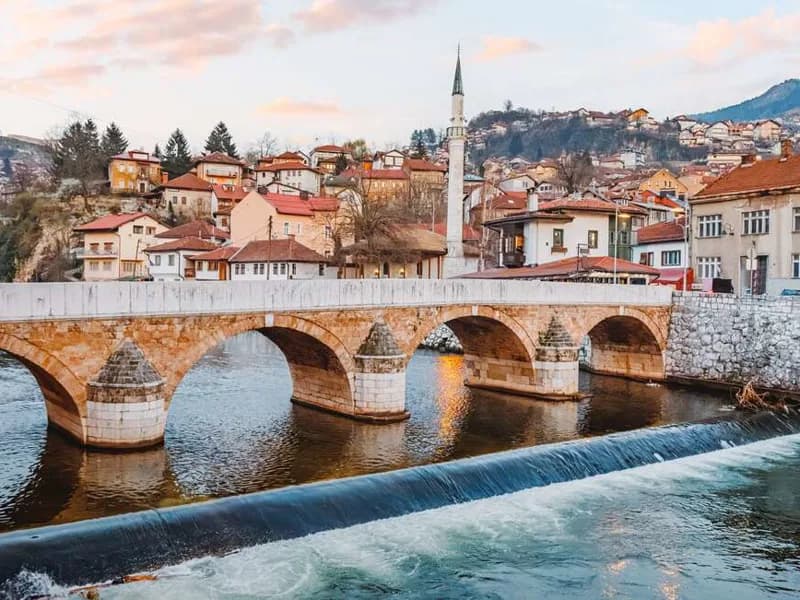
Sarajevo, the capital of Bosnia and Herzegovina, sits in a narrow valley ringed by hills, and it is a city of layers. Its old bazaar, Baščaršija, with its copper workshops, mosques and coffee houses, was built under the Ottomans; its avenues and civic buildings under the Austro-Hungarians, who took over in 1878; its tower blocks under socialist Yugoslavia. It was here, in 1914, that the assassination of the Archduke Franz Ferdinand set off the First World War. And it was besieged for nearly four years in the 1990s, during the Bosnian war, a siege still marked by memorials and by the scars on its buildings.
South of Sarajevo, the line and the road follow the Neretva river through a deep gorge to Mostar, famous for its Old Bridge, a single high stone arch built by the Ottomans in the sixteenth century. It was destroyed by shelling in 1993 and rebuilt with original techniques and stone recovered from the river, reopening in 2004. Young men still dive from it into the cold green water below.
The railways of the region run through landscapes that roads rarely reach.
The line to the sea
The highlight of the rail journey for many is the line from Belgrade, the Serbian capital, to Bar on the Montenegrin coast. Built under Yugoslavia and completed in 1976, it is one of the most impressive mountain railways in Europe, with hundreds of tunnels and bridges. As it descends from the mountains of Montenegro towards the sea, it crosses the Mala Rijeka viaduct, which was for a time the highest railway bridge in the world.
Belgrade, at the other end of the line, is worth time of its own. It stands where the Sava flows into the Danube, and the Kalemegdan fortress on the ridge above the confluence has been fought over by Romans, Byzantines, Hungarians, Ottomans and Austrians, changing hands many times. Today its walls and parks are where the city comes to walk, and the view from them across the two rivers at sunset is one of the best in the Balkans.
Montenegro's coast, at the end of the line, includes the Bay of Kotor, a deep, mountain-walled inlet with the walled medieval town of Kotor at its head.
The tours
Explore Worldwide's Balkans Rail Adventure, fifteen nights, travels largely by train. It begins in Ljubljana with Lake Bled, continues to Zagreb, the Plitvice Lakes, Sarajevo and Mostar, crosses to Dubrovnik and the Bay of Kotor at Tivat and Kotor, and continues to Bar, Belgrade and Novi Sad. Its route also reaches North Macedonia and Kosovo. It runs in May, June, August and September.
Travelsphere's Balkan Highlights, twelve nights, is a touring holiday by road through Croatia, Serbia and Bosnia and Herzegovina: Split, Zadar, the Plitvice Lakes, Zagreb, Novi Sad, Belgrade, the mountain resort of Zlatibor, Višegrad with its Ottoman bridge on the Drina, Sarajevo, Mostar and Međugorje, ending at Trogir on the coast.
Late spring and early autumn are the best times for this journey, when it is warm on the coast and pleasant in the mountains. It is worth packing patience along with the guidebook. The trains run to their own rhythm, and the views from the windows are worth it.
By Walter Pellow, the name Atlas & Passage’s editorial team writes under. Prices and dates in the trips below come from the operators and can change.