Walking
Lake Bled and Lake Bohinj, the two lakes of the Julian Alps
Lake Bled has the island church, the castle on the cliff and the cream cake. Lake Bohinj, half an hour away inside the national park, has the mountains coming down to the water and far fewer people. Seeing both is the point.
By Walter Pellow2 November 20264 min read
Slovenia is a small country, with mountains, forests, caves and a short stretch of Adriatic coast all within a couple of hours of each other. Its north-west corner is taken up by the Julian Alps, a range of pale limestone peaks that rises to Triglav, the highest mountain in the country, which appears on the Slovenian flag. At the foot of the mountains lie two glacial lakes, very different in character, only a few miles apart.
Bled, the postcard
Lake Bled is one of the most photographed places in central Europe, and once you see it you understand why. It is a small lake, green-blue and very clear, with a tiny island in the middle on which stands a white church with a tall bell tower. On a cliff above the northern shore, a medieval castle looks down on the water. The Julian Alps make the backdrop.
The island can be reached only by boat, and the traditional way is by pletna, a wooden boat with a striped canopy, rowed standing up by a boatman with two long oars. The right to row the pletna boats has passed down through local families for generations. On the island, a long flight of stone steps leads up to the church, and visitors ring its wishing bell by pulling on a rope.
Bled was a fashionable spa resort in the nineteenth century, and it has the hotels to show for it. It also has its own dessert, the kremšnita, a cream slice of custard and whipped cream between layers of pastry, which every café in town claims to make best.
A path runs round the whole lake, about six kilometres, and it is an easy and lovely walk. A short climb to one of the viewpoints above the shore, such as Ojstrica or Osojnica, gives the classic view of the island with the castle and the mountains behind.
Bohinj, the quiet one
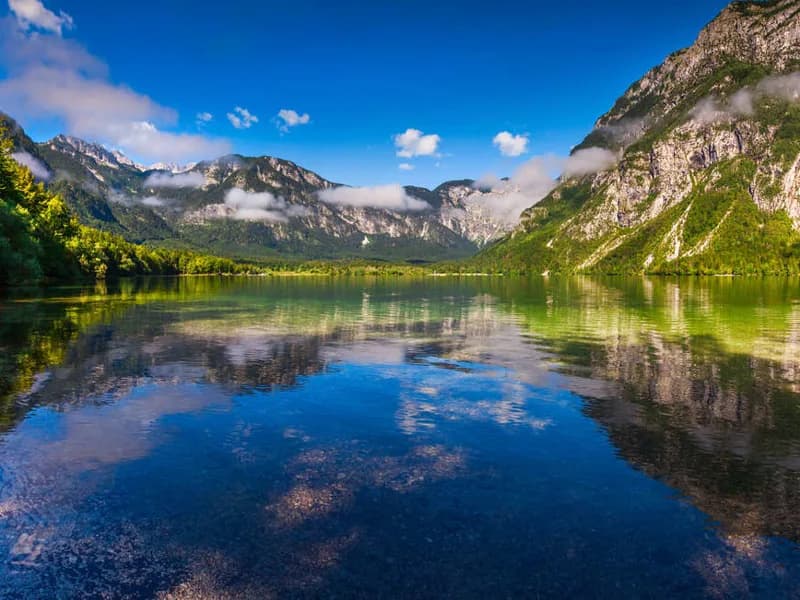
Lake Bohinj lies about half an hour's drive further into the mountains, inside Triglav National Park. It is larger than Bled, the largest permanent lake in Slovenia, and it feels much wilder. The mountains rise steeply from its shores, there are few buildings, and motor boats are banned. Its water is cold and so clear that you can see the stones on the bottom far from the shore.
At the eastern end of the lake, by a stone bridge, stands the small church of St John the Baptist, with frescoes dating back several centuries. From the western end, a path climbs through forest to the Savica waterfall, which drops in a single stream from a cave in the mountainside and is the source of one branch of the Sava, Slovenia's longest river. A cable car climbs Mount Vogel, on the southern side, for one of the best views over the lake and across to Triglav.
Seeing both is the point.
The gorges
Two short walks near the lakes are especially good. The Vintgar Gorge, a few kilometres from Bled, is a narrow canyon cut by the Radovna river, followed on wooden walkways fixed to the rock above the rushing water. The Mostnica Gorge, near Bohinj, is wilder and less visited, with the river running through polished rock and deep green pools, and a path that continues up the valley.
The walking holidays
Explore Worldwide's Walking in Slovenia, seven nights, is based around the lakes. It starts in Ljubljana and walks around Bohinj and Bled, the Vintgar and Mostnica gorges, the hamlet of Brode, Bohinjska Bistrica and the Pokljuka plateau. It runs in May, September and October.
Explore's Alpine Lakes of Slovenia, seven nights, takes in Ljubljana, Škofja Loka, Bled and Bohinj and Triglav National Park, then crosses the country to Nova Gorica, the Škocjan Caves, Predjama Castle in its cliff, and the coastal towns of Izola and Piran. It runs from May to September.
Travelsphere's Scenic Slovenia & Lake Bled, seven nights, a touring holiday, adds the high road through Kranjska Gora, the Trenta valley, the Soča river and Bovec to Ljubljana, Bled and the Vintgar Gorge.
Late spring and September are the best walking months: the paths are clear, the weather is usually settled and the lakes are quieter than in July and August, when Bled in particular is very busy. In the evening, when the day visitors have gone, Bled is at its best.
By Walter Pellow, the name Atlas & Passage’s editorial team writes under. Prices and dates in the trips below come from the operators and can change.