History
Carthage, Dougga and Sidi Bou Said, Tunisia in a week
Tunisia packs three thousand years into a small country: the Carthage that challenged Rome, the Roman towns that replaced it, the Islamic holy city of Kairouan and a blue-and-white village on a cliff above the sea. A week shows a surprising amount of it.
By Walter Pellow2 November 20264 min read
Tunisia is the smallest country in North Africa, and one of the easiest to visit, with a long Mediterranean coast, a good road network and a history that has left its mark on every corner. Phoenicians, Romans, Vandals, Byzantines, Arabs, Ottomans and the French have all ruled here, and their cities, mosques, amphitheatres and markets are close together. In a week, you can see the ruins of Carthage in the morning and a Roman amphitheatre in the afternoon, and sleep in a medina.
Carthage
Carthage was founded, according to tradition, in the ninth century BC by Phoenician settlers from Tyre, on a promontory near what is now Tunis. It grew into the capital of a great trading empire that dominated the western Mediterranean, and in the third and second centuries BC it fought three long wars with Rome, the Punic Wars. In the second, its general Hannibal famously led an army with elephants over the Alps into Italy. In 146 BC, at the end of the third, the Romans destroyed the city.
A century later, the Romans built a new Carthage on the same site, and it became one of the largest cities of their empire. What survives today is mostly Roman: the great Antonine Baths on the shore, villas, a theatre and cisterns, along with the Punic ports, once a circular naval harbour, and the tophet, a Punic sanctuary. The ruins are scattered among the villas of a modern suburb, and the whole is a UNESCO World Heritage Site.
Tunis itself is worth a day. Its medina, one of the best preserved in the Arab world and a UNESCO World Heritage Site, is a maze of covered souks around the Zitouna Mosque, each lane once given over to a single trade, from perfume and gold to the red felt caps called chechias. On the edge of the city, the Bardo Museum, in a former palace of the beys, holds one of the finest collections of Roman mosaics in the world, gathered from sites all over the country: sea gods, hunting scenes, Virgil with two muses, and daily life in Roman Africa in astonishing detail.
Sidi Bou Said
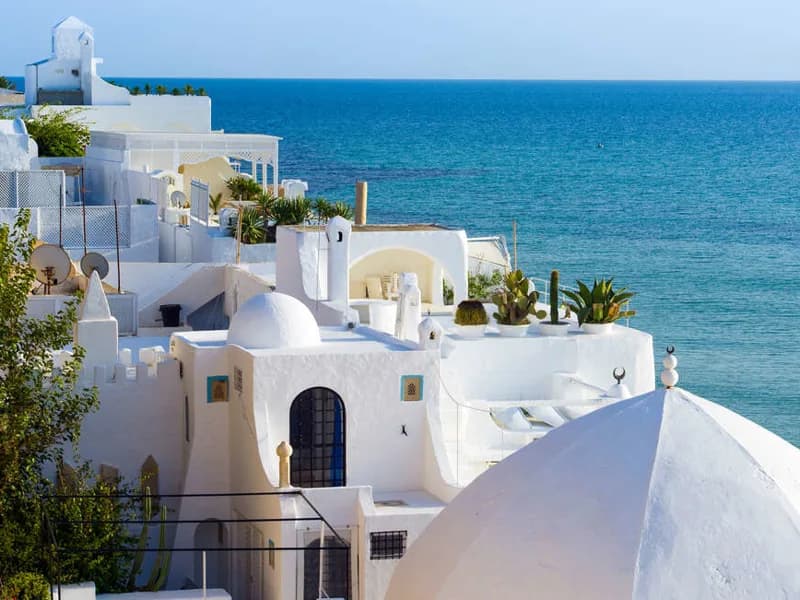
Next to Carthage, on a cliff above the Gulf of Tunis, stands Sidi Bou Said, a village of whitewashed houses with blue doors, blue shutters and blue window grilles, and bougainvillea climbing over the walls. Its colours have been protected since the early twentieth century, and it has long been a favourite of artists and writers. Its cafés, especially the Café des Délices, with its terraces looking down over the bay, are a good place to drink mint tea with pine nuts and watch the sun go down.
Dougga, El Djem and the south
Inland, in the hills to the west, Dougga is one of the best preserved Roman towns in North Africa, a whole city of temples, a theatre, baths, houses and streets on a hillside above olive groves. Its capitol, a temple with tall columns, stands almost complete, and the town also has a rare Punic and Libyan mausoleum from before the Romans arrived.
On the plain to the south-east, at El Djem, the Romans built one of the largest amphitheatres in the world, in the third century AD. It could hold perhaps thirty-five thousand spectators, and it is remarkably well preserved, standing high above the low houses of the modern town. Its arena and the passages beneath it can still be explored.
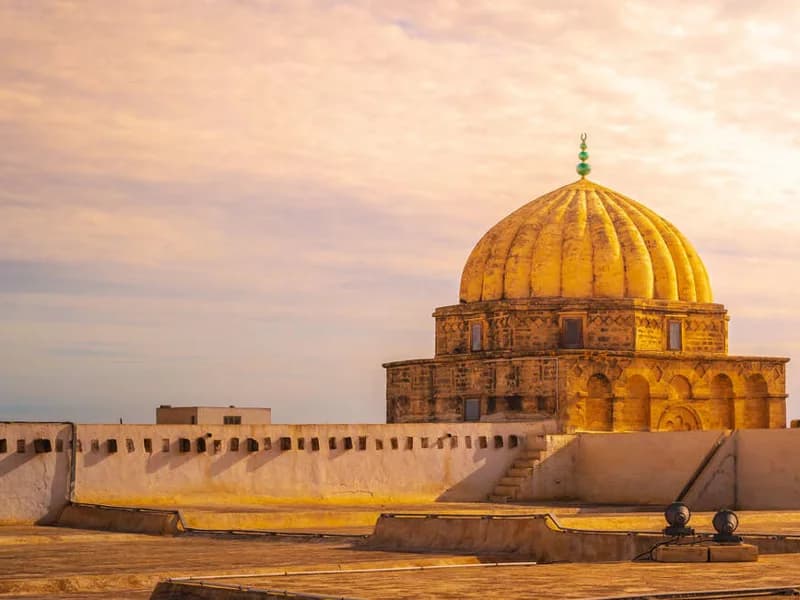
Kairouan, founded in the seventh century by the Arab conquerors of North Africa, is one of the holiest cities of Islam. Its Great Mosque, with its square minaret and vast courtyard, is one of the oldest mosques in Africa. Further south, beyond the salt lake of the Chott el Djerid, lie the oases of Tozeur and Nefta, and the Berber troglodyte village of Matmata, whose cave houses appeared in the Star Wars films.
The tours
Explore Worldwide's Best of Tunisia, nine nights, starts in Tunis and visits Dougga, Testour and Carthage, then travels south through Kairouan to Tozeur and Nefta, Sfax and Matmata, and then El Djem, Sousse and Uthina. It runs in January, from March to May and from September to November.
Explore's Tunisian Coast and Ancient Carthage in Summer, eight nights, visits Tunis, Carthage, Sidi Bou Said, Dougga, Testour and Uthina, then the coast at El Djem, Mahdia, Monastir and Sousse, and Kairouan. It runs from May to September.
Spring and autumn are the best times for sightseeing, when the weather is warm but not too hot. The coast is pleasant in summer, though the inland sites are very hot.
By Walter Pellow, the name Atlas & Passage’s editorial team writes under. Prices and dates in the trips below come from the operators and can change.