History
Córdoba, Seville, Granada, and the long goodbye of al-Andalus
For nearly eight centuries much of Spain was ruled by Muslim dynasties. Three Andalusian cities tell the story in order, from its height to its last sigh.
By Arthur Penhallow26 September 20265 min read
In 711 a Berber commander called Tariq ibn Ziyad crossed the narrow strait from Africa with a small army and landed beneath a great rock that still bears a version of his name: Jabal Tariq, the mountain of Tariq, Gibraltar. Within a few years most of the Iberian peninsula was under Muslim rule, and it would take the Christian kingdoms of the north the better part of eight hundred years to take it back. The Arabic name for the Muslim lands was al-Andalus, and it survives, worn smooth, in the name of Spain's southern region, Andalucía.
The story is long and complicated, and the best way to understand it is not in a book but in three cities, visited in the right order. Córdoba shows al-Andalus at its height, Seville shows it changing hands, and Granada shows its last, most beautiful century. Most tours of the region link all three, and it is well worth paying attention to the sequence.
Córdoba: the city at the centre of the world
In the tenth century Córdoba was, by most estimates, one of the largest and most sophisticated cities in Europe. Its rulers were Umayyads, the survivors of a dynasty overthrown in Damascus, who had rebuilt their fortunes at the far western edge of the Islamic world and in 929 declared themselves caliphs in their own right. The city had paved streets, public baths and libraries, and it produced, a little later, both the Muslim philosopher Averroes and the Jewish philosopher Maimonides, whose influence on medieval thought in Europe is hard to overstate.
Its great monument is the Mezquita, the mosque begun in the late eighth century and enlarged over the next two hundred years into a forest of more than eight hundred columns, joined by double arches striped in red brick and cream stone. Walking into it is like walking into a grove of stone palms. The surprise, and it is a real one, comes in the middle: after Córdoba fell to the Christians in 1236 the mosque became a cathedral, and in the sixteenth century a soaring Renaissance nave was built into the heart of it. The Emperor Charles V, who had approved the work without seeing the site, is said to have regretted it when he did. Visitors have been arguing about it ever since.
Walking into the Mezquita is like walking into a grove of stone palms.
Seville: the handover
By the time Seville fell to Ferdinand III of Castile in 1248, the caliphate at Córdoba had long since broken up into rival kingdoms, and a succession of North African dynasties had tried to hold the line. The last of them, the Almohads, left Seville its great mosque, whose minaret is now the Giralda, the bell tower of the cathedral that replaced it. The lower two-thirds are Almohad brickwork; the belfry on top is Renaissance. It is the whole history of the city in a single tower.
The Real Alcázar, the royal palace, makes the same point more subtly. Much of it was built in the fourteenth century for a Christian king, Pedro I of Castile, by craftsmen who worked in the Islamic style, with tiled walls, carved stucco and water running through courtyards. This is Mudéjar, the art of Muslims living under Christian rule, and it shows how long the two cultures overlapped, borrowed from each other and admired each other's work, even while they were fighting.
Granada: the last sigh
When the other Muslim cities fell, Granada survived, as a small, mountainous kingdom under the Nasrid dynasty, paying tribute to Castile and balancing on a diplomatic knife-edge for two and a half centuries. Its rulers spent a surprising proportion of that time building, and the result is the Alhambra, the red fortress on its hill above the city.
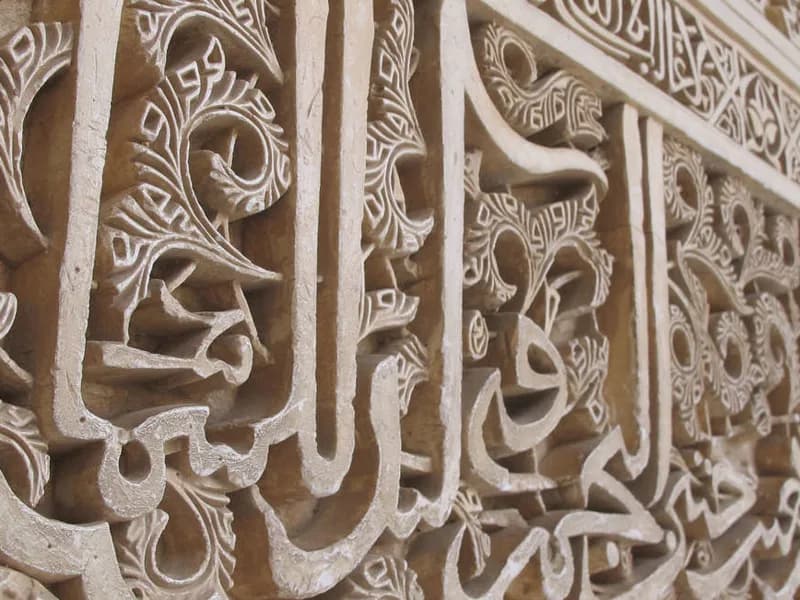
Most of what visitors come to see is fourteenth century: the Nasrid palaces, with their Court of the Myrtles and Court of the Lions, walls carved as finely as lace and inscribed with poetry, ceilings of honeycomb plaster, and everywhere the sound of water. Beyond them lie the gardens of the Generalife, and beyond those the Sierra Nevada, often snow-capped until late spring. Entry to the palaces is by timed ticket and numbers are limited, which is a nuisance to arrange and a blessing once you are inside.
On 2 January 1492 the last Nasrid sultan, known to the Spanish as Boabdil, handed over the keys of the city to Ferdinand and Isabella. A mountain pass on the road south is still called the Sigh of the Moor, where, the story goes, he turned for a last look at the city and wept, and his mother told him not to weep like a woman for what he had failed to defend like a man. It is almost certainly a later invention. It has survived because it feels true.
Seeing it in the right season
Andalucía in July and August is fiercely hot; Córdoba and Seville regularly pass forty degrees in the afternoon, and the old stones hold the heat into the night. The better months are March to May, when the orange trees are in blossom and the courtyards are full of flowers, and October and November, when the light turns gold and the crowds thin. In spring you will want to book the Alhambra early. At any time of year, go to the Mezquita as soon as it opens, before the tour groups, and let the columns do the talking.
By Arthur Penhallow, the name Atlas & Passage’s editorial team writes under. Prices and dates in the trips below come from the operators and can change.