History
Florence, and the city the Medici paid for
For three centuries one family of bankers shaped Florence: its churches, its palaces, its art and its politics. Walk the city with the Medici in mind and it starts to make sense.
By Walter Pellow2 November 20264 min read
There are cities shaped by kings, by bishops and by armies. Florence was shaped by a bank. In the fifteenth century the Medici family, merchants turned bankers, built one of the most powerful banking houses in Europe, with branches from London to Rome, and they spent a great deal of what they made on their home city. They paid for churches and chapels, for palaces and gardens, for sculptors, painters and architects, and, not by coincidence, for the goodwill of their fellow citizens. In time they went from first citizens of a republic to grand dukes of Tuscany, and for three centuries their story and Florence's were the same.
You can walk the city with them in mind, and it is the best way to understand it.
San Lorenzo and the palace on the Via Larga
Start at San Lorenzo, the Medici parish church, near the market. Cosimo de' Medici, known as Cosimo the Elder, the man who turned the family fortune into political power, paid for its rebuilding by Brunelleschi, and he is buried beneath the floor in front of the high altar. Behind the church are the Medici Chapels: the grand, domed mausoleum of the later grand dukes, lined in coloured marble, and Michelangelo's New Sacristy, with his tombs for two younger Medici and the reclining figures of Night and Day, Dawn and Dusk.
A few steps away, on what was then the Via Larga, stands the Palazzo Medici Riccardi, the family palace Cosimo commissioned from Michelozzo in the 1440s: a fortress of rough stone on the ground floor, more refined above, a model for Florentine palaces for a century afterwards. Upstairs, its little chapel holds Benozzo Gozzoli's fresco of the Journey of the Magi, in which the procession winds through a Tuscan landscape and several of the riders are Medici in their finery.
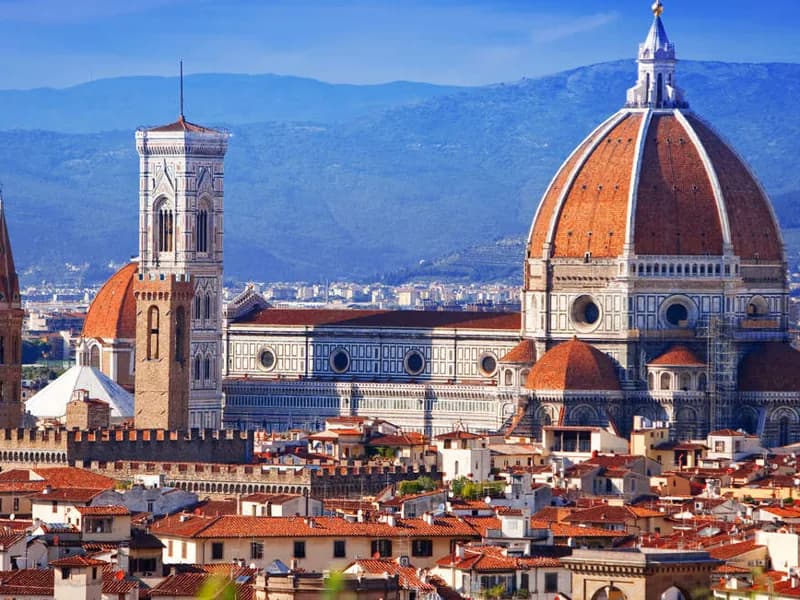
The great dome of the cathedral, which you see from everywhere, is the exception that proves the rule. It was the responsibility not of the Medici but of the wool guild, which was in charge of building the cathedral.
They paid for churches and palaces, sculptors and painters, and, not by coincidence, for the goodwill of their fellow citizens.
The grand dukes' city
After a turbulent century of exiles and returns, the Medici came back for good in the sixteenth century, and Cosimo I, the first grand duke, set about remaking the city as a capital. He moved into the Palazzo Vecchio, the old town hall, and then commissioned Giorgio Vasari to build the Uffizi beside it, from 1560, as offices for the state's administration; the name means offices. Its top floor, later turned into a gallery for the family's collections, became the Uffizi Gallery of today, with Botticelli's Birth of Venus and Primavera among its treasures.
The family bought the Palazzo Pitti on the far side of the Arno in the mid-sixteenth century, and Vasari linked it to the Palazzo Vecchio with a private, elevated corridor, running along the top of the Uffizi, over the shops of the Ponte Vecchio and on to the Pitti, so that the grand duke could cross the city without meeting his subjects. Behind the Pitti, the Boboli Gardens climb the hill in terraces, grottoes and avenues.
Why the art stayed
The last of the Medici line, Anna Maria Luisa, left one gift that matters more than all the rest. In 1737, as the dynasty came to an end and Tuscany passed to the house of Lorraine, she signed an agreement leaving the family's collections to the new rulers on condition that they never be removed from Florence and that they be kept for the benefit of the public. That is why the Uffizi, the Pitti and the rest are still here.
Tours that go there
Travelsphere's seven-night Treasures of Tuscany & Florence includes Florence, Pisa, Vinci, the town Leonardo took his name from, Chianti, Montecatini Terme and Lucca.
Just You's seven-night Highlights of Tuscany, for solo travellers, covers Pisa, the Fattoria Il Poggio, Florence, Montecatini Terme, Siena and Lucca.
Explore's seven-night Tuscany Walking and Wine walks through the countryside of San Gimignano, Castellina in Chianti, Siena, Pienza, Montalcino and San Quirico d'Orcia, with Pisa and Florence. It departs in May, June, September and October.
Book the Uffizi ahead, and give Florence at least one unhurried day of its own. The Medici took three centuries over it; you can spare a morning.
By Walter Pellow, the name Atlas & Passage’s editorial team writes under. Prices and dates in the trips below come from the operators and can change.