Journeys
Helsinki, the Baltic capital on a granite shore
Helsinki was founded by a Swedish king, made a capital by a Russian tsar and built, in its heart, on the bare granite of the Baltic shore. It is a city of sea, stone and light, and a good start to Finland.
By Walter Pellow2 November 20264 min read
Helsinki sits on a peninsula and a scatter of islands at the edge of the Gulf of Finland, and the first thing you notice about it is the rock. Everywhere, the city's pale granite bedrock breaks through the surface: in the parks, between the apartment blocks, along the shore, smooth and grey and rounded by the ice. Finns like to sit on it in summer, as if it were a beach. The city was built on it and around it, and in one famous case, into it.
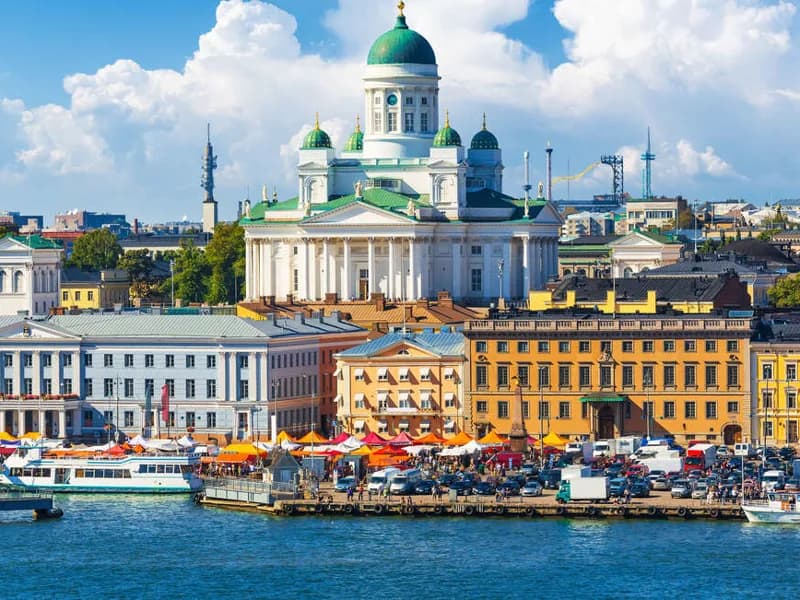
The second thing you notice is the sea. Ferries leave the market square for the islands, icebreakers lie at their moorings in summer, and in winter the bays freeze hard enough to walk on.
A Swedish town, a Russian capital
Helsinki was founded in 1550 by King Gustav Vasa of Sweden, which then ruled Finland, as a trading town to rival Tallinn across the gulf. For two centuries it stayed small. What changed it was war. In the eighteenth century the Swedes built a great sea fortress on the islands at the mouth of the harbour, and in 1809 Finland passed from Sweden to the Russian Empire, as an autonomous Grand Duchy. In 1812 Tsar Alexander I made Helsinki its capital, moving the seat of government from Turku, which was too close to Sweden for Russian comfort.
The new capital needed a centre to match, and it got one. The German architect Carl Ludvig Engel designed the monumental Senate Square, with the white Lutheran cathedral on its steps above, the government palace on one side and the university on the other, all in a severe, pale neoclassical style that makes the square look rather like a smaller St Petersburg. Close by, on a rock above the harbour, the red-brick Uspenski Cathedral, Orthodox and gold-domed, looks across the water at the Lutheran one. Between them, they tell you most of Finland's history in two buildings.
Suomenlinna
The sea fortress is Suomenlinna, the Castle of Finland, built from 1748 by the Swedes across a cluster of islands at the entrance to the harbour, to guard the coast against Russia. It was one of the reasons the Russians, having taken it, chose Helsinki as their capital. Today it is a UNESCO World Heritage Site, inscribed in 1991, and a district of the city, with several hundred residents, a few museums and cafés, and long walls and bastions overgrown with grass and wild flowers.
A ferry from the market square takes about a quarter of an hour, and the islands make a fine half day: walk the walls, sit on the granite on the seaward side, and watch the ferries to Stockholm and Tallinn sail out past you through the narrow channel.
Finns like to sit on the rock in summer, as if it were a beach.
The church in the rock
The building that sums up Helsinki is the Temppeliaukio Church, the Church of the Rock, designed by the brothers Timo and Tuomo Suomalainen and completed in 1969. Rather than build on a granite outcrop in a residential square, they hollowed it out, and the church is inside: rough rock walls, still showing the marks of the drills, under a great copper dome resting on a ring of glass. Light falls in round the edge of the roof. It is a working parish church and, because of its acoustics, a popular concert hall.
Holidays that start here
Explore's nine-night Walking in Finland and Sweden begins in Helsinki and walks westward along the coast: Nuuksio National Park, the Tulliniemi peninsula and the old resort of Hanko, Turku, the wooden houses of Old Rauma, and the Bronze Age burial cairns of Sammallahdenmäki, before crossing to Mariehamn in the Åland Islands and on to Stockholm and Björnö. It departs from June to September.
Travelsphere's nine-night Grand Baltic Explorer starts in Helsinki and crosses to Tallinn, then travels south through Latvia, by way of Turaida Castle, Sigulda, Riga and Rundāle Palace, and Lithuania, with Šiauliai, Vilnius, Druskininkai and Grūtas Park, to finish in Warsaw.
By sea, Fred. Olsen's thirteen-night Nine Nations of Northern Europe sails from Newcastle in May, with the Lysefjord, Rønne, Gdańsk, Klaipėda, Ventspils, Helsinki, Tallinn, Warnemünde and Lysekil in its list.
Helsinki is a summer city in the sense that its summers are a festival of light: in June the sun barely sets, and the whole city is outdoors, on the rocks, the islands and the terraces. Late spring and early autumn are quieter and often bright. Winter is dark, cold and, on a clear frozen day, very beautiful, with the sea ice white to the horizon and the saunas, which are a serious part of Finnish life, at their most welcome. Whatever the season, take a boat at least once. Helsinki was made by the sea, and it looks best from the water.
By Walter Pellow, the name Atlas & Passage’s editorial team writes under. Prices and dates in the trips below come from the operators and can change.