Culture
Lewis, of the stones, the tweed and the quiet Sunday
The Isle of Lewis is where Gaelic comes first on the road signs, where tweed is still woven in sheds behind the house, and where a circle of stones has stood on a ridge for five thousand years.
By Arthur Penhallow26 September 20265 min read
The first thing to know about Lewis is that it is not quite an island. Lewis and Harris are two parts of one landmass, joined by a range of mountains rather than divided by the sea, and the people on each side have always considered them separate places. Lewis, the northern part, is mostly low and wide, a great sweep of peat moorland scattered with small lochs; Harris, to the south, is rocky and mountainous, with white beaches on its western shore that look as though they belong somewhere much warmer. Stornoway, the only town of any size in the Outer Hebrides, is on the east coast of Lewis, and it is where the ships come in.
The second thing to know is that this is a different Scotland from the one on the shortbread tins. It is the heartland of Scottish Gaelic, the place where the language is still most widely spoken at home, in the shops and in church, and the road signs give the Gaelic name first. Culture here is not a performance for visitors. It is simply the way things are done.
Stones on the ridge
On the west coast of Lewis, at Calanais, a group of tall, thin stones stands on a low ridge above a sea loch. They were put up about five thousand years ago, and they are arranged in a pattern unlike any other: a small circle around a single tall stone, with avenues and rows leading away from it roughly north, south, east and west, so that from the air the whole thing looks something like a Celtic cross. What it was for, nobody knows for certain. Theories about the movements of the moon have been proposed and argued over for decades, and the stones have kept their counsel.
They are made of Lewisian gneiss, one of the oldest rocks in Europe, grey and striped and full of glinting crystals, and they have a presence that photographs do not quite convey. Like much of Lewis, they are best seen in the long light of a summer evening, which a day call from a ship will not give you, but even in the middle of the day they are well worth the drive across the moor.
Lewis gave up a more portable treasure too. In 1831, a hoard of carved chess pieces was found in the sand dunes at Uig, on the west coast: kings, queens, bishops and knights, and warders biting the tops of their shields, carved from walrus ivory in the twelfth century, probably in Norway. The Lewis chessmen are now divided between the British Museum and the National Museum of Scotland, with a few back on the island on loan, and their glum, wide-eyed faces are among the most recognisable objects of the Middle Ages.
Tweed, and a quiet Sunday
Harris Tweed is the only fabric in Britain protected by its own Act of Parliament. Under the Harris Tweed Act of 1993, it must be handwoven by islanders in their own homes in the Outer Hebrides, from pure wool dyed and spun in the islands, and only then can it carry the orb trademark. In practice this means that the looms are in sheds and outbuildings across Lewis and Harris, and that a jacket made from the cloth has passed, at one stage, through the hands of someone working in a shed within sight of the Atlantic. The colours of the cloth, the heathery browns, the lichen greens, the sudden flecks of bright yellow and blue, are the colours of the island.
Religion shapes the week here more than almost anywhere else in Britain. The Presbyterian churches of Lewis keep the Sabbath seriously, and Sunday on the island is quiet: many shops close, and it was only in 2009 that a Sunday ferry service to Stornoway began, amid much local debate. Visitors are not expected to observe anything, but it is worth knowing, and worth respecting, particularly if a ship's call falls on a Sunday.
In Stornoway, look out across the harbour to Lews Castle, a Victorian mansion built for Sir James Matheson, who made a fortune in the China trade and bought the whole island in the 1840s. Look out, too, for the memorial to the Iolaire, the yacht carrying sailors home from the First World War that struck rocks at the harbour entrance in the early hours of New Year's Day 1919. More than two hundred men were drowned within sight of the town, and the loss is still felt on the island.
Getting there by sea
Several sailings round the British Isles include a day in Stornoway. Ambassador's British Isles Explorer, ten nights from London Tilbury in April 2028, calls at Stornoway between Kirkwall and Cobh, and then at the Isles of Scilly and Guernsey on the way back south.
Ambassador's Northern Isles Explorer, seven nights from Dundee to Liverpool in August 2028, calls at Runavik in the Faroes, Lerwick, Kirkwall and Stornoway. From Newcastle, Fred. Olsen's Wild Beauty of the Scottish Isles in August 2027 ends its tour of the islands at Stornoway after the sail-bys of Loch Hourn and Staffa.
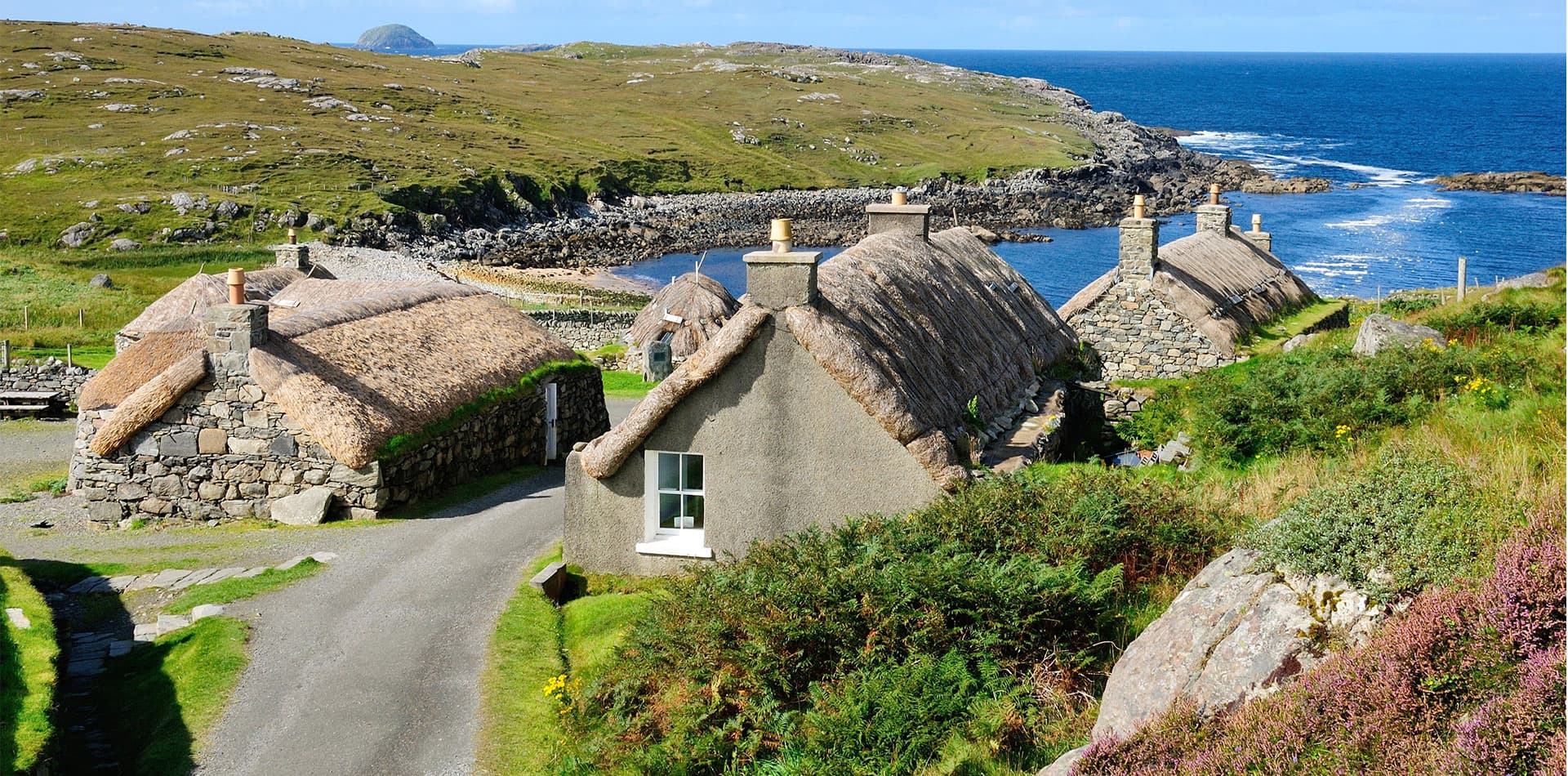
A day is short for Lewis. It is enough for Calanais, or for a drive across the moor to the blackhouses at Arnol or Gearrannan, the old thatched stone dwellings where families and their animals once lived under one roof. It is not enough for Harris's beaches, which will have to wait for another visit. Many people who have seen the island once find that they want another.
By Arthur Penhallow, the name Atlas & Passage’s editorial team writes under. Prices and dates in the trips below come from the operators and can change.