Cruise
The Isles of Scilly by short cruise from Southampton
Scilly is an archipelago of low granite islands twenty-eight miles beyond Land's End, and a short cruise is one of the easiest ways to reach it. The ship anchors offshore, and the islands come to you by tender.
By Walter Pellow2 November 20264 min read
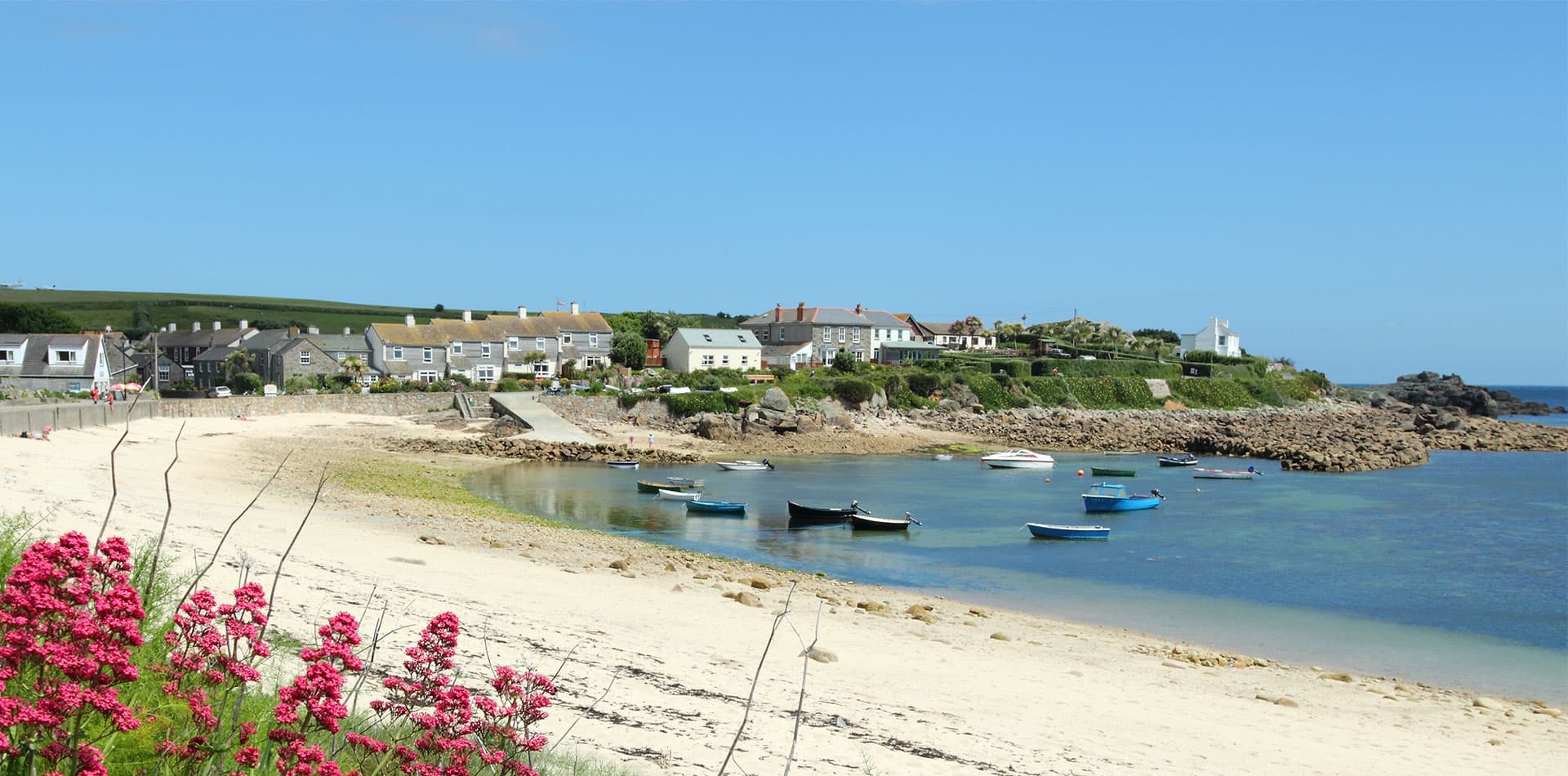
The Isles of Scilly are not where most people expect England to end. Twenty-eight miles out into the Atlantic beyond Land's End, they are a scatter of low granite islands, rocks and ledges, around a hundred and forty of them, with white sand beaches, turquoise shallows and a climate mild enough for palms and agapanthus to grow wild. Only five of the islands are inhabited, and the largest of them, St Mary's, is about the size of a small parish on the mainland.
Getting there normally means a ferry from Penzance, a small plane from Land's End or Newquay, or a helicopter. A cruise is the other way, and for a first look it has a lot to recommend it: no early train to Cornwall, no crossing in a small boat on a lively sea, and a ship that is still there at the end of the day.
How a call works
There is no quay in Scilly big enough for a cruise ship. Ships anchor offshore, in St Mary's Roads or Crow Sound, and their passengers go ashore by tender, a short ride into the harbour at Hugh Town, the islands' small capital, which grew up around its quay in the shelter of the Garrison, the walled headland above.
That has two consequences worth knowing. The first is that a tender call depends on the weather: if the swell is too high for the boats to work safely, the ship may have to sail on without stopping, and on any Atlantic coast that is a real possibility. The second is that, once ashore, you are in a very small place, and it is easy to see a good deal of it in a day.
Hugh Town grew up around its quay, in the shelter of the walled headland above.
A day ashore on St Mary's
Hugh Town sits on a narrow neck of sand between two bays, so that its main street has a beach at either end. From the harbour, the Garrison walls make a fine first walk: a circuit of the headland past the old batteries and Star Castle, built in the reign of Elizabeth I in the shape of an eight-pointed star, with views across the water to the off-islands.
Beyond the town, the coast path runs all the way round St Mary's, past sandy coves, prehistoric burial chambers and headlands of weathered granite. A strong walker could get round the whole island in a day, but there is no need. Many people walk out to a beach, buy lunch and walk back.
The other choice is to take one of the small local boats that leave the quay in Hugh Town for the off-islands: Tresco, with its Abbey Garden, laid out on the site of an old priory and full of plants from the southern hemisphere; St Martin's, with its long white beaches; Bryher and St Agnes, smaller and quieter still. Timetables depend on the tides, and you will need to make sure you are back in time for the last tender, but on a calm day it is a hard thing to resist.
The sailings
The search that brings many people here is for a four-day cruise from Southampton, and the closest thing in the catalogue is Fred. Olsen's five-night Coast of Cornwall & the Isles of Scilly. It sails from Southampton in August, and its ports are St Mary's and Falmouth: one call in Scilly, one in Cornwall's great harbour town, and the Channel either side.
Two Ambassador sailings from London Tilbury also call. The seven-night Historic Harbours of Britain and France, in March, goes to Cobh in Ireland, St Mary's, Plymouth and Cherbourg. The twelve-night Celtic Capitals & Coastal Charms, in May, is longer and more northern: Brest, St Mary's, Cobh, Holyhead on Anglesey, Belfast, Tobermory on Mull and Lerwick in Shetland.
When to go
Scilly has a long season, and each part of it has its charm. Spring, when the islands' flower farms are in bloom and the birds are arriving, is quieter than high summer; May and June are often bright and settled; August brings the warmest water and the busiest beaches. A March sailing is the most exposed to the weather, and the most likely to miss its call, but if it does get in, you will have the place almost to yourself.
Wherever you go, pack for the sea: a warm layer for the tender, flat shoes for the steps at the harbour and a waterproof, because the Atlantic does not check the forecast before it changes its mind. And if the ship does reach its anchorage on a clear morning, with the islands laid out across the water in their granite and white sand, be on deck early. It is one of the finest arrivals in British waters.
By Walter Pellow, the name Atlas & Passage’s editorial team writes under. Prices and dates in the trips below come from the operators and can change.