Solo travel
Morocco alone, and rarely eating alone
A country built around riads, souks and shared tables is not an obvious place to feel isolated, but the logistics of getting between its cities, mountains and desert alone still favour company.
By Arthur Penhallow26 September 20264 min read
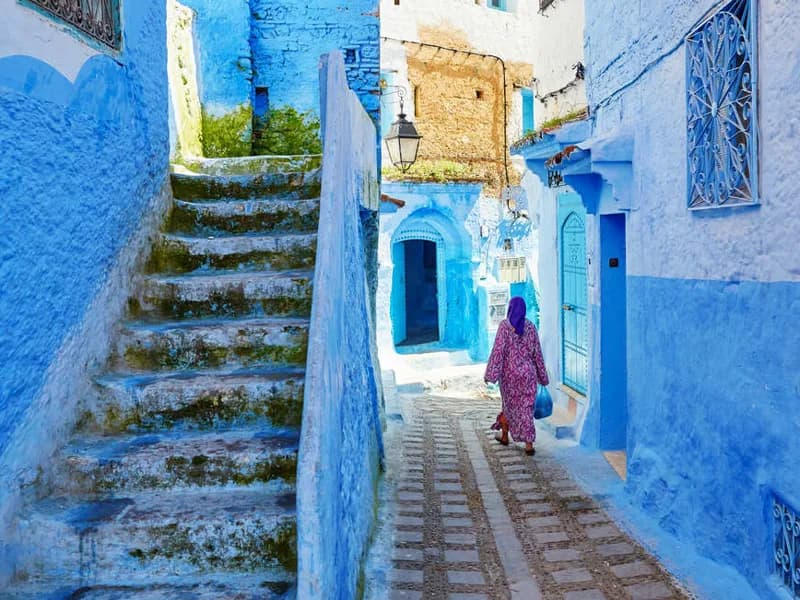
Morocco's medinas are not designed for easy independent navigation. The old cities of Fes and Marrakech, in particular, grew organically over centuries into a dense weave of unmarked alleys, and getting genuinely lost within the first hour is less a risk than something close to a rite of passage. None of this makes solo travel here unworkable; guides are plentiful, and getting lost in a covered souk is rarely dangerous, only disorienting. It does make a strong case for a trip built specifically around solo travellers, where someone else has already worked out the route between Fes's tanneries, Meknes's granaries and the dunes beyond Merzouga, and where the logistics of desert camps and mountain passes are handled rather than improvised.
What a solo-designed trip changes
Operators that build tours specifically for solo travellers, rather than simply waiving a single supplement on a trip designed for couples, tend to structure the days around shared experience: communal meals rather than tables for one, a pace with room for both organised sightseeing and time to wander a medina independently, and a group small enough to become familiar within the first couple of days. Morocco suits this particularly well, since so much of its social life happens around food, mint tea served as a matter of course to guests and travellers alike, a shared tagine at the end of a day's driving, and a solo traveller on one of these trips is rarely eating alone even when they are, technically, travelling by themselves.
The route this kind of trip tends to follow
A solo-focused circuit through Morocco typically follows the same imperial-cities-to-desert shape as the country's best-known itineraries: Casablanca and Rabat on arrival, Fes for the medina and its tanneries, a crossing into the pre-Saharan valleys towards Erfoud, and a night at a desert camp near the dunes before finishing in Marrakech and its Atlas foothills. The desert camp night, in particular, tends to be a highlight for solo travellers specifically, since sitting under a genuinely dark sky with a small group of people who arrived the same way is a different, and often warmer, experience than the same night spent entirely alone.
A solo traveller on one of these trips is rarely eating alone even when they are, technically, travelling by themselves.
It is worth being honest about the one genuine hazard of independent movement through a Moroccan medina, which is not danger so much as disorientation. Fes el Bali in particular is often cited as one of the largest car-free urban areas in the world, a genuine maze of alleys with no consistent street pattern to fall back on, and even residents occasionally admit to taking a wrong turn. On an organised trip this stops mattering almost entirely, since a guide or a fixed meeting point removes the one variable that makes solo navigation here properly stressful, leaving the getting-lost part, which most visitors quite enjoy in retrospect, without the getting-properly-stuck part that can follow it.
Small-group tours built for anyone
Not every operator running trips through Morocco packages them specifically for solo travellers; several small-group tours cover much of the same imperial-cities route without being solo-exclusive, running instead as a general mix of couples, friends and people travelling on their own. They still offer the practical advantages of a guided itinerary and a fixed group, though without the same guarantee of a table built for one to join easily.
People choose a solo-designed trip for reasons that vary as much in Morocco as anywhere else: a partner unable or unwilling to travel, a gap between commitments, or simply a preference for setting off without coordinating anyone else's calendar. What they tend to share is a readiness to ask questions, of a guide, of a shopkeeper, of each other, and Morocco, with its layered history and its genuinely different regions within a short drive of one another, gives a curious traveller a great deal to ask about. A group built around that instinct rather than around an existing pair or family tends to make for warmer company at the end of a long day's driving, not thinner.
When to go
Spring and autumn suit a solo circuit through Morocco for the same reasons they suit any first visit: comfortable temperatures in the cities and the Atlas, and desert nights cold rather than bitter. Booking ahead matters more here than for a standard tour, since solo-specific departures run with deliberately small groups and tend to fill early.
By Arthur Penhallow, the name Atlas & Passage’s editorial team writes under. Prices and dates in the trips below come from the operators and can change.