History
Tangier, the city at the mouth of the Mediterranean
Tangier looks across the Strait of Gibraltar at Spain, and for thirty years it belonged to nobody in particular. Spies, bankers, painters and writers made it a legend; the modern city is busier, cleaner and still a little mysterious.
By Walter Pellow2 November 20264 min read
Tangier sits on a curving bay at the north-western tip of Africa, where the Atlantic narrows into the Strait of Gibraltar and the Mediterranean begins. At its narrowest the strait is only about fourteen kilometres wide, and on a clear day the mountains of Spain stand up across the water, close enough to make out the villages. For as long as there have been ships in these waters, whoever held Tangier held a door between two seas and two continents, and the city has been fought over, bargained for and coveted by most of the powers that ever sailed past it.
It has been Phoenician, Roman, Vandal, Byzantine, Arab, Portuguese, Spanish and, for a while, English: it came to Charles II as part of the dowry of Catherine of Braganza, and the English held it for about twenty years before giving it up. But the period that made Tangier famous came in the twentieth century.
The International Zone
By the early 1900s the European powers were scrambling for Morocco, and none of them would let another have Tangier. The solution was a compromise. Under a convention signed in Paris in December 1923, Tangier and the land around it became an international zone, neutral and demilitarised, run jointly by a group of foreign powers. It came into force in 1925, and apart from an interruption during the Second World War, when Spain occupied it, it lasted until 1956, when Morocco became independent and the city was returned to it.
In those decades Tangier was like nowhere else. It had no exchange controls, low taxes and a host of foreign banks; it had currency dealers, smugglers, spies and refugees, and a reputation for tolerating almost anything. Writers and artists came for the light, the freedom and the cheapness: Paul Bowles settled here and stayed for the rest of his life, and William Burroughs wrote much of Naked Lunch in its cheap hotels. The legend of Tangier, a little louche, a little dangerous, entirely cosmopolitan, was made in those years, and it has never quite gone away.
The American Legation
One building tells the city's diplomatic story better than any other. In 1821 the Sultan of Morocco gave the United States a house in the medina, and it became the American Legation, the first property the United States owned abroad. Morocco had been one of the first countries to recognise the new American republic, and the legation served as a diplomatic post for about 140 years, the longest that any building abroad has been used as one by the United States. Today it is a museum and research institute, with a collection of paintings, maps and old photographs of the city. It is one of the quieter and more surprising places to spend an hour in Morocco.
The medina and the Kasbah
Tangier's medina climbs the hill above the port, a tangle of white and pastel lanes, smaller and easier to find your way around than the great medinas of Fes or Marrakech. At its heart is the Petit Socco, a small square of cafés that was the centre of the international city's gossip. Below it, the Grand Socco is the busy gateway between the old city and the new.
At the top of the hill, the Kasbah has the old sultan's palace, now a museum, and a gate in the walls opening onto a terrace with a view across the strait. Look out from there in the evening, with the lights of the ships passing between two continents, and the old legend becomes easy to believe.
How to go
Tangier is both a cruise port and the northern start of many Moroccan tours, and the modern city has been much tidied in recent years, with a new marina and promenade along the bay.
Fred. Olsen's twelve-night Colours & Cultures of Morocco sails from Southampton in February, with Cádiz, Tangier, Ceuta, Casablanca and Matosinhos in its list.
Ambassador's thirteen-night Jewels of the Iberian Coast and Moroccan Souks sails from London Tilbury in March, with Leixões, Lisbon, Casablanca, Tangier, Ceuta, Vigo and Santiago de Compostela among its places.
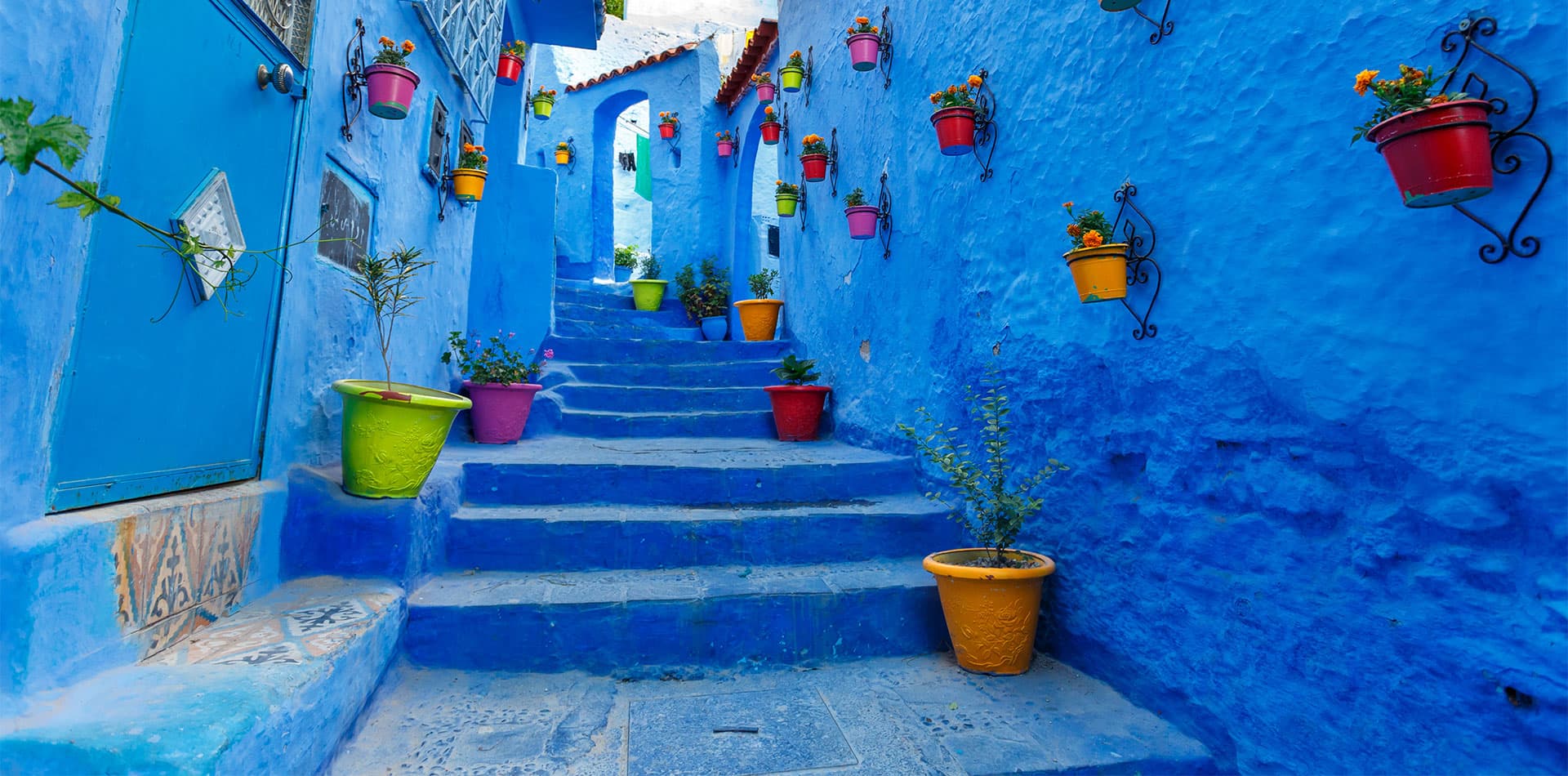
On land, G Adventures' six-night Morocco Northern Discovery starts in Tangier and travels to Tétouan, Chefchaouen, the blue-washed town in the Rif mountains, Ouazzane, Fès, the Roman ruins of Volubilis, Meknes and Casablanca. It departs in November and December.
Whichever way you arrive, give Tangier time to show itself. It is a city that reveals itself slowly, in cafés, on terraces and in the view across the water. Sit at a café on the Petit Socco with a glass of mint tea, and watch the city go by. It has been watching the world go by for a very long time.
By Walter Pellow, the name Atlas & Passage’s editorial team writes under. Prices and dates in the trips below come from the operators and can change.