First time
New Zealand for the first time, North Island and South
New Zealand packs volcanoes, geysers, fiords, glaciers and beaches into two long islands about the size of Britain. A first visit of three weeks can see both, from the warm, Māori-shaped north to the mountains and sounds of the south.
By Walter Pellow20 October 20264 min read
New Zealand is a long way from Britain, about as far as it is possible to go, and many people who visit do so only once. It rewards those who take the time to see both its main islands. They are quite different in character, and together they hold an extraordinary range of landscapes in a country with only around five million people. Distances are not great by Australian standards, but the roads are winding and the scenery demands frequent stops, so three weeks is a sensible minimum for a first visit that covers both.
The country was the last major land mass on earth to be settled by people. Polynesian voyagers, the ancestors of the Māori, arrived by canoe only around seven or eight hundred years ago, and Europeans came in numbers only from the nineteenth century. Māori culture is a strong and visible part of national life, and the te reo Māori language is everywhere, in place names, greetings and official signs.
The North Island
Most visits begin in Auckland, the largest city, spread across a narrow isthmus between two harbours and dotted with the grassy cones of extinct volcanoes. North of it, the Bay of Islands is a beautiful drowned coastline of islands and inlets, and the home of Waitangi, where the founding treaty between the British Crown and Māori chiefs was signed in 1840.
In the centre of the island lies the volcanic plateau. Rotorua is a town of geysers, boiling mud and hot springs, and a centre of Māori culture. Lake Taupō, the largest lake in the country, fills the caldera of an ancient supervolcano. Beyond it, the volcanoes of Tongariro National Park include the Tongariro Alpine Crossing, often described as one of the finest day walks in the world. Underground at Waitomo, caves glitter with the lights of thousands of glow-worms. On the east coast, Napier was rebuilt in Art Deco style after an earthquake in 1931. At the southern tip, Wellington, the capital, sits around a fine harbour, and its national museum, Te Papa, is one of the best in the country.
The South Island
A ferry crosses the Cook Strait from Wellington to Picton, in the drowned valleys of the Marlborough Sounds, one of the loveliest sea crossings in the world. The South Island is larger, emptier and wilder than the North, its spine formed by the Southern Alps, which rise to more than three and a half thousand metres at Aoraki, Mount Cook.
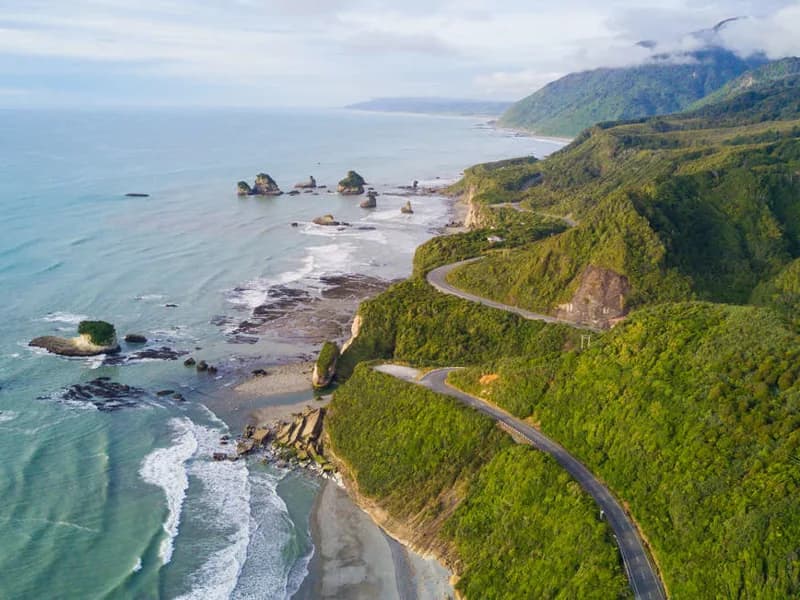
Around Nelson, at the top of the island, Abel Tasman National Park has golden beaches and coastal walks. The West Coast, wet and wild, runs past the layered Pancake Rocks at Punakaiki to the glaciers of Franz Josef and Fox, which descend from the Alps towards the rainforest, though they have retreated a long way in recent decades. Over the mountains lie Queenstown, on Lake Wakatipu, the country's adventure capital, and Te Anau, the gateway to Milford Sound, the great fiord of Fiordland. Christchurch, on the east coast, is being rebuilt after the earthquakes of 2010 and 2011. Dunedin, further south, has a strong Scottish heritage and albatrosses nesting on the Otago Peninsula.
Wellington, the capital, sits at the southern tip of the North Island around a deep harbour, with houses climbing the steep green hills behind the waterfront. A cable car runs up from the business district to the botanic garden, with views over the city. Te Papa, the national museum, on the waterfront, tells the story of the country's land and people, from its geology and wildlife to Māori treasures and the history of settlement.
The tours
Travelsphere's Discover New Zealand, twenty-one nights, covers both islands. In the North its places include Auckland, Paihia in the Bay of Islands, Rotorua and Wellington. In the South they include Picton, Christchurch, Arthur's Pass, Franz Josef Glacier, Queenstown, Milford Sound, Te Anau and Dunedin.
Explore Worldwide's New Zealand Explorer, eighteen nights from November to March, includes Auckland, Matamata, the Bay of Plenty, Taupō, Napier and Wellington, then Picton, Nelson and Abel Tasman National Park, Hokitika and Fox Glacier. Just You's seventeen-night New Zealand tour for solo travellers includes Auckland, Rotorua, Waitomo, Napier and Wellington, Christchurch, Arthur's Pass, Franz Josef Glacier, Queenstown, Milford Sound, Te Anau and Omarama.
The southern summer, from about November to March, is the best time to visit, with long days and the warmest weather. The South Island's weather can change quickly at any time of year, and a waterproof is essential.
By Walter Pellow, the name Atlas & Passage’s editorial team writes under. Prices and dates in the trips below come from the operators and can change.