History
Orkney, where the Stone Age left its furniture
Five thousand years ago, the most sophisticated place in the British Isles was not in the south. It was on a treeless archipelago off the north coast of Scotland, and it is still there.
By Arthur Penhallow26 September 20265 min read
In the winter of 1850 a great storm stripped the grass from a sand dune on the Bay of Skaill, on Orkney's west coast, and uncovered a village. When it was eventually excavated, the houses turned out to have their furniture in them: stone beds, stone hearths and, against the back wall of each house, a stone dresser with two shelves, facing the door, exactly where you would put the best china. The village was Skara Brae, and it had been lived in some five thousand years earlier. It is older than the great stones of Stonehenge and older than the pyramids at Giza.
This is the thing about Orkney that takes a while to absorb. We tend to think of the far north of Britain as the edge of things, a place the story reached late. In the Neolithic it was nearer the centre. Some of the ideas that shaped monuments across Britain, the grooved pottery, the great stone circles, may well have begun here and travelled south. The islands have no trees to speak of, which is why the people built in stone, and why so much of what they built is still standing.
A landscape of circles
A few miles inland from Skara Brae, two lochs almost meet, separated by a narrow neck of land. On either side of it stand stone circles. The Stones of Stenness are among the oldest in Britain; only a few of the tall, thin slabs remain, and they look less like a monument than like a group of people who have stopped in the middle of a conversation. The Ring of Brodgar, a short walk to the north-west, is larger: a near-perfect circle of about sixty stones originally, of which a couple of dozen still stand, enclosed by a ditch cut into the rock.
Between them lies the Ness of Brodgar, where excavations over the past two decades have uncovered a complex of large stone buildings that nobody knew was there. What it was for is still argued over (a temple, a meeting place, something we have no modern word for), but it has changed the way archaeologists think about the whole area. Together with Skara Brae and the great chambered tomb of Maeshowe, these sites make up the Heart of Neolithic Orkney, which has been on UNESCO's World Heritage List since 1999.
Maeshowe adds a later twist. In the twelfth century, Norse visitors broke into the tomb and covered its walls with runic graffiti, some of it boastful, some of it about treasure, and some of it the sort of thing people have always written on walls. It is one of the largest collections of runic inscriptions outside Scandinavia, and a reminder that the islands' second great age was Norse.
The Norse earldom and its cathedral
Orkney and Shetland were ruled from Norway for the best part of six centuries, and passed to the Scottish crown only in the 1460s, as security for the dowry of a Danish princess who married James III. The Norse earls left the islands their place names, their saga (the Orkneyinga saga, which is full of murder, feuding and remarkably precise sailing directions) and their cathedral.
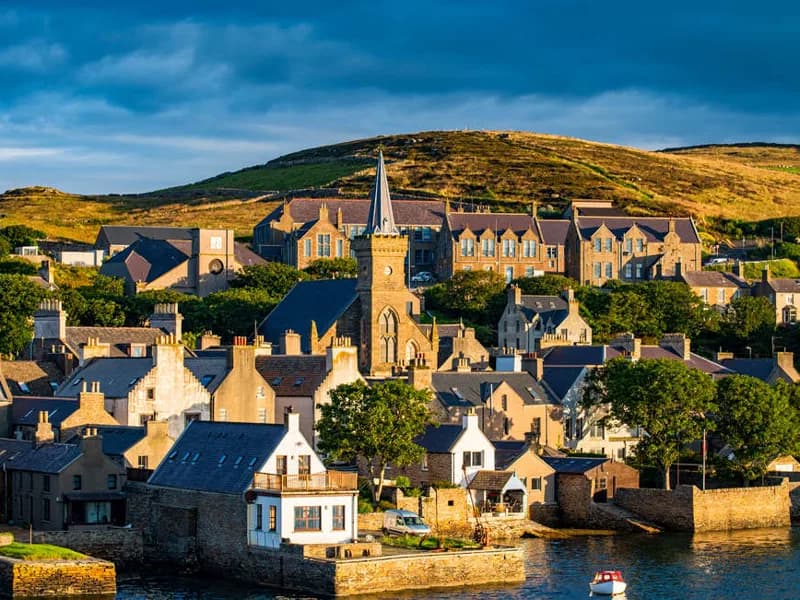
St Magnus Cathedral in Kirkwall was begun in 1137 by Earl Rognvald in memory of his uncle Magnus, who had been killed by a rival earl and was venerated as a saint. It is built of red and yellow sandstone, laid in bands, and it is surprisingly large for a town of Kirkwall's size, which is the point: it was built to announce that Orkney mattered. For a ship's passengers, it is usually the first thing to see, a short walk from the harbour.
Orkney's twentieth century left its marks too. Scapa Flow, the great natural harbour enclosed by the southern islands, was the main base of the Royal Navy's fleet in both world wars, and in 1919 the interned German fleet was scuttled there by its own crews. On the small island of Lambholm, Italian prisoners of war who were building the Churchill Barriers across the eastern approaches turned two Nissen huts into a chapel, painted inside with such care that it has become one of the best-loved buildings in the islands.
On foot, or from the harbour
There are two good ways to see Orkney, and they suit different people. The slower one is to walk it. Explore's small-group walking trip spends six nights on the islands, covering the Neolithic sites on Mainland, Stromness and Kirkwall, and crossing to Rousay, which has so many chambered cairns it is sometimes called the Egypt of the north, and to Westray, with the ruin of Noltland Castle. Departures run from May to September.
The quicker way is by ship. Several cruises round the north of Scotland call at Kirkwall for a day, which is enough for the cathedral and, with an organised excursion or a hired car, one or two of the Neolithic sites. A day is not enough for Orkney, but it is enough to know whether you want to come back. One five-night sailing links Liverpool, Belfast, Kirkwall and Invergordon before finishing in Dundee, which makes a neat introduction to the north.
Whichever way you go, go between May and September. In June the days in Orkney are very long, and the light in the evening, low and golden across the lochs and the stones, is the best reason of all to be there. Take a windproof jacket whatever the month. There is almost nothing between Orkney and the Atlantic to stop the weather, which is presumably why the people of Skara Brae built their houses half underground.
By Arthur Penhallow, the name Atlas & Passage’s editorial team writes under. Prices and dates in the trips below come from the operators and can change.