First time
Rome in four days, and the order to see it in
Four days is not enough for Rome, and never will be. But it is enough to see the ancient city, the Vatican and the Baroque centre properly, if you take them one at a time and in a sensible order.
By Walter Pellow2 November 20264 min read
The mistake most people make in Rome is trying to see everything at once. The city is dense, the distances between the great sights are short, and it is tempting to rush from the Colosseum to the Trevi Fountain to the Vatican in a single sweaty afternoon. It is far better to give each part of the city a day of its own, walk it at Roman pace, and leave time for lunch. Four days, taken that way, will show you the outline of the place, and make you want to come back for the rest.
This is one sensible order. It begins at the beginning, with ancient Rome, and works forward in time.
Day one: the ancient city
Start at the Colosseum, early, with a ticket booked in advance. The great amphitheatre was opened in AD 80, held tens of thousands of spectators, and is still the building everyone comes for. The ticket usually covers the Roman Forum and the Palatine Hill next door as well, and the order matters: the Colosseum first, while the queues are short, then up onto the Palatine, where the emperors built their palaces and the view over the Forum is best, and finally down into the Forum itself, the centre of Roman public life for centuries, a valley of broken temples, arches and columns.
End the day on the Capitoline Hill, in Michelangelo's square, and look back over the Forum from the terrace behind the town hall. At sunset, with the columns catching the last light, it is a view to remember.
Day two: the Vatican
Give the Vatican a whole day and book the Vatican Museums ahead; the queues without a ticket are long. The museums are enormous, and the route leads, eventually and unavoidably, to the Sistine Chapel, where Michelangelo painted the ceiling between 1508 and 1512 and the Last Judgement on the altar wall two decades later. Look up, then go and sit on the benches round the edge and look up again.
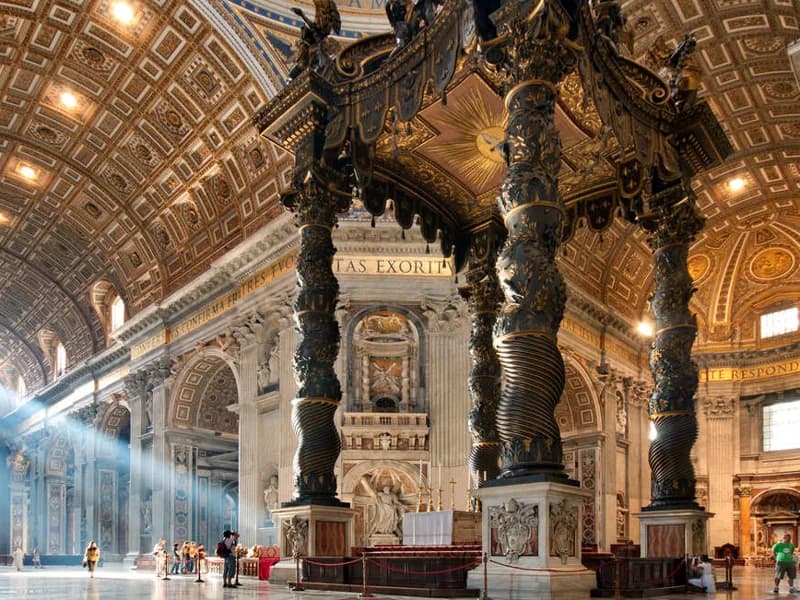
St Peter's Basilica is next door, and it is worth climbing to the top of its dome, which Michelangelo designed, for the view down over the great curved colonnade of the piazza and across the rooftops of the city. Dress for a church: shoulders and knees covered.
Give each part of the city a day of its own, walk it at Roman pace, and leave time for lunch.
Days three and four: the centre, and across the river
The third day belongs to the old centre in the bend of the Tiber, and it is best on foot, with no plan beyond a few fixed points. The Pantheon is the place to begin, a Roman temple rebuilt under Hadrian in the second century AD and still roofed by its original concrete dome, with the open eye at the top letting in the sky. It now has a small charge for entry, and it is worth every cent.
From there it is a few minutes to Piazza Navona, laid out on the site of an ancient stadium and still the shape of one, with Bernini's Fountain of the Four Rivers in the middle; then across to the Trevi Fountain, best seen early or late, before or after the crowds; and up to the Spanish Steps. In between are churches with Caravaggios on their walls, small squares, and plenty of ice cream.
On the last day, cross the river. Trastevere, on the west bank, is the old working quarter, a tangle of cobbled lanes, ivy and washing lines, with the golden mosaics of Santa Maria in Trastevere at its heart. Above it, the Janiculum hill has a wide view over Rome, the whole city spread out below with its domes and bell towers, and it is a good place to say goodbye. If you have energy to spare, the Borghese Gallery, with its Berninis and Caravaggios, needs a timed booking and repays it.
Tours that include Rome
Explore's six-night Venice to Rome by Rail travels down Italy by train, from Venice by way of Bologna, Florence and Pisa to Rome. It departs in March, April, May, June, July, September and October.
Explore's seven-night Rome, Sorrento and the Amalfi Coast pairs Rome with the south: Mount Vesuvius and Pompeii, Ravello, Maiori, Minori, Amalfi and Positano, Sorrento and Capri. It departs in April, May, June, July, September and October.
Travelsphere's fourteen-night Grand Tour of Italy takes in most of the country, from Venice, Bologna, Pisa and Florence to Orvieto and Rome, then south to Montecassino Abbey, Pompeii, the Sorrento peninsula, Calabria and Messina in Sicily.
Check how many nights each one spends in Rome, and add nights at the start or the end to make up four days if you can. Rome rewards every extra day.
By Walter Pellow, the name Atlas & Passage’s editorial team writes under. Prices and dates in the trips below come from the operators and can change.