History
Rouen, and the trial that made a teenager a saint
Joan of Arc was nineteen when she was burned in Rouen's market square. It took the Church five centuries to change its mind about her, and the city has never stopped arguing about what it did.
By Arthur Penhallow26 September 20263 min read
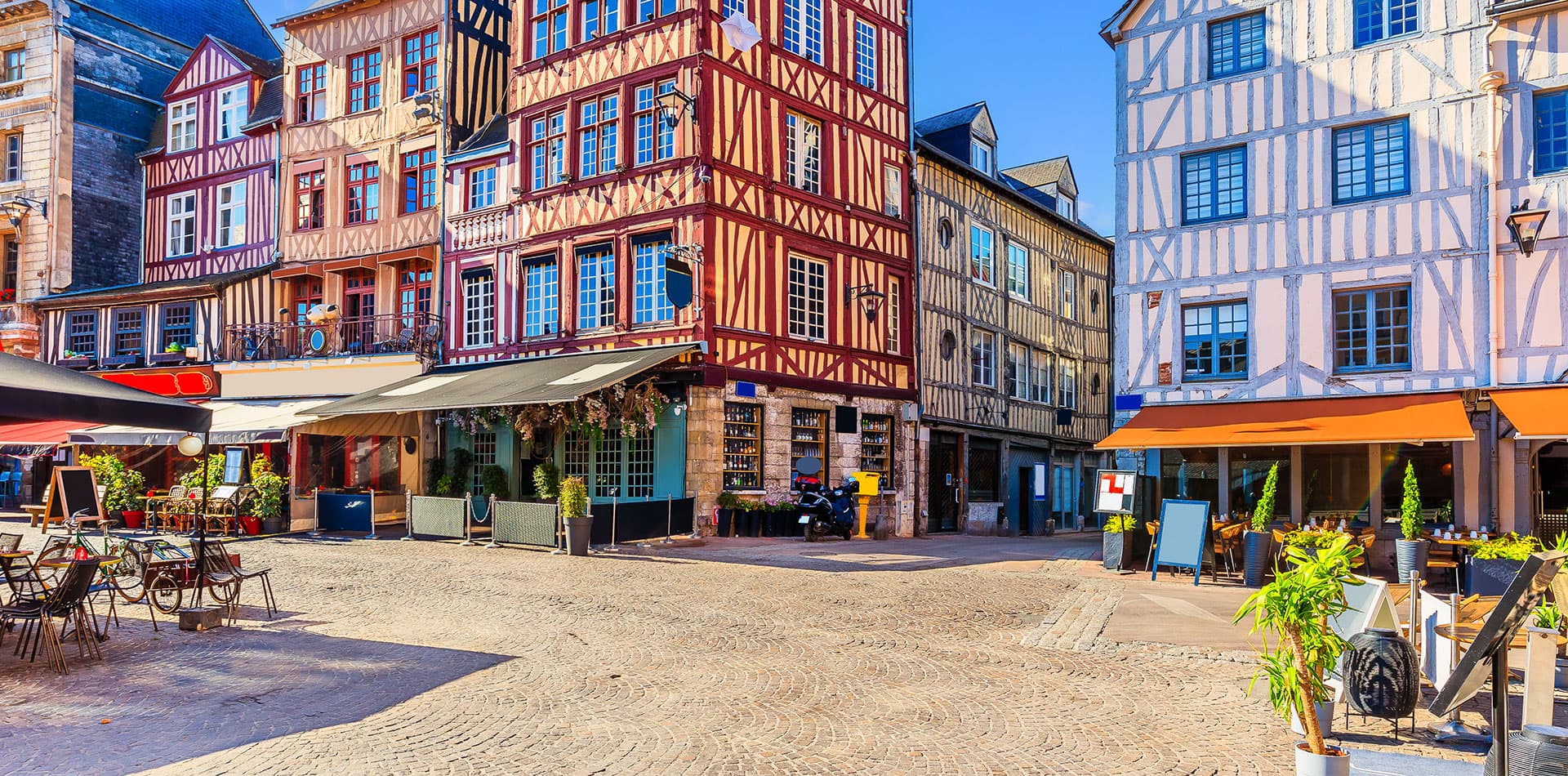
The Place du Vieux-Marché in Rouen is, on an ordinary day, a market square like a great many others in northern France: half-timbered buildings, café tables, a covered market selling cheese and fish. A tall, angular modern church stands at one end, deliberately unlike anything else in the old town, and it marks the spot where, on the 30th of May 1431, a nineteen-year-old peasant girl from Lorraine was burned at the stake after a trial that even the judges who conducted it would, twenty-five years later, help to overturn.
A trial conducted to order
Joan of Arc had led French forces to a series of victories against the English and their Burgundian allies during the Hundred Years' War, culminating in the relief of Orléans in 1429, before being captured by Burgundian troops in 1430 and sold to the English. Rather than execute her outright, the English arranged for her to be tried by an ecclesiastical court on charges of heresy, a process conducted in Rouen, then under English control, by French clergy sympathetic to the English cause and presided over by Bishop Pierre Cauchon. The charges centred on her claim to have received visions from saints instructing her to save France, and on her habit of wearing men's clothing, both framed by the court as evidence of heresy and diabolical influence rather than the military necessity Joan herself argued they were.
The verdict was rarely in doubt. Joan was convicted and burned in the Vieux-Marché, her ashes scattered in the Seine to prevent any relics being collected. In 1456, twenty-five years later and with France's political fortunes reversed, a second trial, ordered by Pope Callixtus III at the request of Joan's mother, examined the original proceedings and annulled them, finding the first trial to have been conducted improperly and its verdict void. She was formally canonised by the Catholic Church only in 1920, nearly five hundred years after her death, by which point she had become, for entirely different reasons, a symbol of French national identity that transcended the religious question that had first been used to condemn her.
Twenty-five years later, a second trial annulled the first, finding the original verdict void.
A cathedral Monet could not stop painting
Rouen's other great landmark, the cathedral that dominates the old town a short walk from the market square, has its own claim on visitors' attention. Notre-Dame de Rouen was, for a period at the end of the nineteenth century, taller than any other building in the world, and its west front became the subject of one of Claude Monet's best-known series: over thirty canvases, painted from a room across the square between 1892 and 1894, recording the same façade in different light and weather, from the flat grey of an overcast morning to the gold of late afternoon. Monet was not especially interested in Gothic architecture for its own sake; the cathedral was, for his purposes, simply a very large, very stable object against which changing light could be measured.
Sailing to Rouen
Rouen sits far enough up the Seine that only river-capable ships and specialist tours reach it directly, which is part of its appeal: this is not a call added to a coastal itinerary in passing, but a destination a cruise is often built specifically to reach. Just You's Cruising the Seine, seven nights and solo-friendly throughout, sails from Paris down to Le Havre and back, taking in Rouen along with Vernon, the gateway to Monet's garden at Giverny.
Fred. Olsen's European Cities & Scenic Rivers, fourteen nights from Newcastle, reaches Rouen from the sea before continuing up the Seine towards Paris, while the France & Belgium Easter Break from Southampton pairs a Seine passage to Rouen with a call at Antwerp.
The Vieux-Marché and the cathedral are a short walk apart in the old town, close enough that both fit easily into a single day ashore, which is roughly as much time as most itineraries allow, and rather more than either story strictly needs to make its point.
By Arthur Penhallow, the name Atlas & Passage’s editorial team writes under. Prices and dates in the trips below come from the operators and can change.