Cruise
Santander, the Cantabrian port and its belle époque bay
Santander is a working port on the north coast of Spain that once spent its summers with a king. A fire took its old town, but the bay, the palace on the headland and the beaches of El Sardinero are the city the royal summers made.
By Walter Pellow2 November 20264 min read
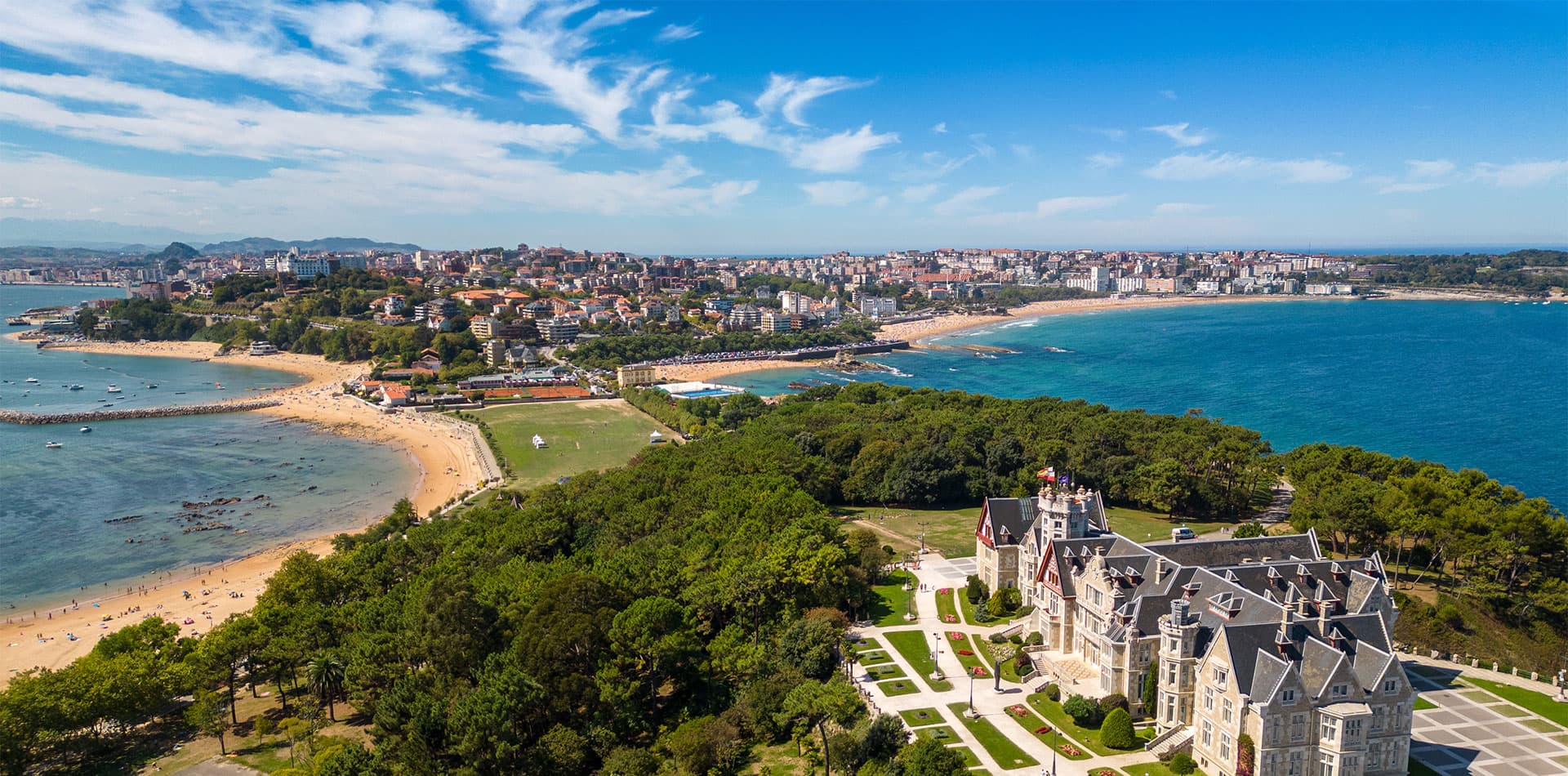
Arriving by sea is the right way to see Santander. The ship comes in past the headland of La Magdalena, with its palace on the green ridge above the rocks, into a broad, sheltered bay with sandbanks and beaches on the far side and the mountains of Cantabria rising behind. The city lies along the northern shore, facing south across the water, which gives it a sunny, open look on a good day. It is a working port, with ferries from Britain and cargo quays, but the face it shows the sea is that of a resort, and an old-fashioned one.
The king's summer
Santander's career as a resort began in the nineteenth century, when sea bathing became fashionable among Spain's wealthy and the long, sandy beaches of El Sardinero, on the open coast just round the headland from the port, began to fill with bathing huts, hotels and villas. What made the city's name was the royal family. In the early twentieth century the people of Santander, by public subscription, paid for a palace on the Magdalena peninsula and gave it to King Alfonso XIII as a summer residence.
The Palacio de la Magdalena was built between 1908 and about 1912, in an eclectic style that owes a good deal to English houses; the queen, Victoria Eugenie, was a granddaughter of Queen Victoria, and she is said to have loved it because it reminded her of Britain. The royal family first came to stay in August 1913 and returned each summer until 1930, and where the court went, Madrid society followed. For a couple of decades the bay was one of the fashionable places in Spain to be seen in summer, and the villas, hotels and promenades of El Sardinero still carry the look of those years.
The face it shows the sea is that of a resort, and an old-fashioned one.
The monarchy fell in 1931, and the palace passed out of royal hands. The city bought back the palace and the peninsula in 1977, and both are now open. The grounds of La Magdalena make one of the best walks in Santander: through the woods and along the clifftops of the headland, with views out to the open sea and back over the bay to the city. The palace itself hosts summer courses and events, and its rooms can be visited.
The fire and the city that followed
Santander's old centre is mostly missing, and the reason is a single night and day in February 1941. A fire broke out in the Calle de Cádiz, near the harbour, and a violent south wind drove it through the narrow streets of the medieval quarter. It burned for about two days and destroyed most of the old town, and the cathedral was badly damaged. By the usual account, one person died, a firefighter who had come from Madrid to help. The centre was rebuilt in the years after the war on a new plan, which is why the city around the cathedral looks so much more mid-century than medieval.
The cathedral itself survived and was restored. Along the waterfront in front of the centre, the Paseo de Pereda is lined with the grand nineteenth-century buildings that escaped the fire, and in the middle of the gardens on the water's edge is the newest arrival, the Centro Botín, an arts centre designed by the Italian architect Renzo Piano and opened in 2017. Its pale, shimmering bulk sits right at the water's edge, and its terraces are worth the climb even for those who skip the galleries.
A day in port
The geography of Santander suits a day ashore. From the cruise terminal it is a short walk to the Paseo de Pereda and the centre, and the whole curve of the bay can be walked from there, along the waterfront and round the Magdalena peninsula to the first beach of El Sardinero, with buses back when your legs give out. The Gran Casino del Sardinero, the white building facing the beach, is the set piece of the old resort, and the gardens and promenades either side of it are where the belle époque is easiest to imagine.
Lunch, in this part of Spain, is a serious matter. Cantabria is a fishing coast with green dairy country behind it, and the bars of the centre do a good line in pintxos and raciones for a long, unhurried lunch.
Cruises that call at Santander
Three cruises from British ports include a call at Santander, on itineraries along the north coast of Spain.
Fred. Olsen's nine-night Flavours of France & Northern Spain sails from Newcastle in October, with Honfleur, Gijón, Santander and Pauillac, the Médoc wine port, among its calls.
Ambassador Cruise Line's nine-night Northern Spain Explorer sails from London Tilbury in July, with El Ferrol for Santiago de Compostela, Gijón, Santander, and Getxo for Bilbao on its itinerary.
Fred. Olsen's ten-night Cultures & Flavours of Northern Spain sails from Newcastle in April, with La Coruña, Gijón, Santander, Getxo for Bilbao, and Honfleur on the way home.
With one day, walk the bay. Start at the Centro Botín, go round La Magdalena, finish on the sand at El Sardinero, and have a late lunch before the ship's horn. It is how the royal household spent its summers, more or less, without the court.
By Walter Pellow, the name Atlas & Passage’s editorial team writes under. Prices and dates in the trips below come from the operators and can change.