History
Sicily, where every empire wanted the same island
Greeks, Romans, Arabs, Normans and Spaniards all ran Sicily in turn, and each left something standing rather than pulling down what came before. The result is a single island where the architecture keeps changing its mind.
By Arthur Penhallow26 September 20263 min read
Sicily sits close enough to North Africa to be reached from Tunisia in a day's sailing and close enough to mainland Italy to be reached from Calabria in a few hours, at the exact point where the western and eastern Mediterranean meet. For anyone building an empire around that sea, from the Phoenicians onward, it was not optional. Whoever held Sicily could watch and largely control the sea lanes that everyone else needed. The island changed hands more often, and more thoroughly, than almost anywhere else in Europe, and unusually, each new ruler tended to build on top of what was there rather than erase it.
The Greeks arrived first among the civilisations that left real evidence, from around the eighth century BC, founding cities including Syracuse that briefly rivalled Athens in wealth and influence. The temples they built at Agrigento and Selinunte, in the Doric style familiar from the Parthenon, are among the best-preserved Greek temples anywhere, in several cases better preserved than their equivalents in Greece itself, because later builders on Sicily generally found it easier to build somewhere new than to quarry an existing temple for stone.
Two conquests that agreed to share
Rome took Sicily as its first overseas province after the First Punic War, and treated it largely as a grain store, which is not a glamorous role but did leave the island's agricultural infrastructure and road network in reasonable order for whoever came next. What came next, across the ninth to eleventh centuries, was an Arab emirate based at Palermo, which introduced citrus fruit, sugar cane, cotton and a sophisticated irrigation system to the island, along with an architectural style of horseshoe arches and geometric decoration that outlasted Arab rule by centuries.
The Normans conquered Sicily in the late eleventh century, and did something almost nobody else in medieval Europe managed: rather than replacing the Arab and Byzantine administrators, craftsmen and scholars they found, they kept them on and built a court culture that combined all three traditions. The Cappella Palatina in Palermo, the private chapel of the Norman kings, has a wooden ceiling carved by Arab craftsmen in the Islamic style, mosaics made by Byzantine Greek artists in the Christian style, and an overall design commissioned by a Norman French king, all in the same small room. It is usually described as Arab-Norman architecture, which undersells quite how strange and successful the combination is.
Etna, the Spanish centuries and a baroque rebuilding
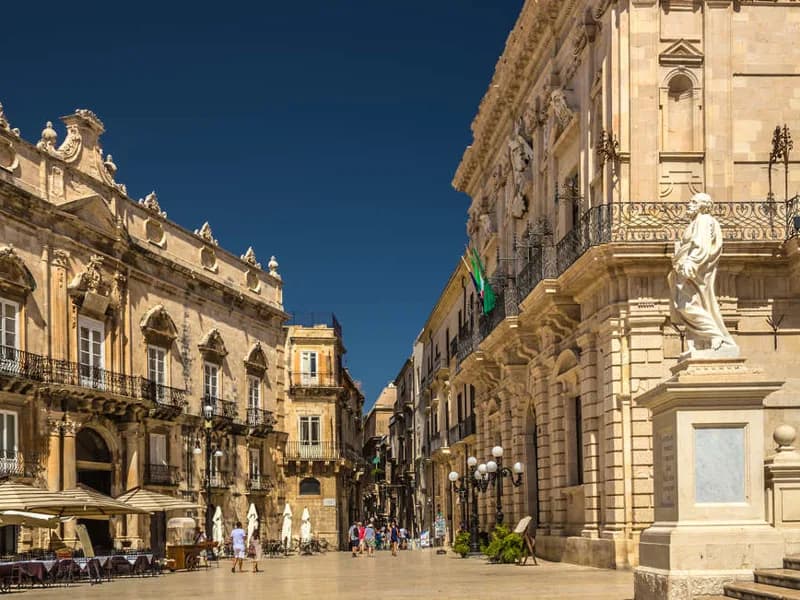
After the Normans came the Hohenstaufens, the Angevins, and eventually several centuries of Spanish rule, which left its own mark chiefly through the baroque towns of the south-east. Noto, Ragusa and Modica were largely rebuilt in an exuberant, unified baroque style after a catastrophic earthquake levelled much of the region in 1693, giving this corner of Sicily an architectural coherence that owes more to disaster and reconstruction than to any single ruling power.
Looming over much of the island's eastern side, and periodically rearranging its own foundations, is Mount Etna, one of the most active volcanoes in the world and still, after everything, the reason the surrounding soil grows some of the island's best wine and produce. Sicilians have farmed its slopes for as long as anyone has kept records, moving their vineyards and orchards when the lava demands it and moving back when it cools.
A tour that takes in the Greek temples of Agrigento and Syracuse, the Arab-Norman monuments of Palermo and Monreale, and the baroque towns of the south-east covers roughly two and a half thousand years of the island rewriting itself without ever quite starting over. A trip led by a specialist historian goes further still into how the layers actually connect.
Go in spring or early autumn: Sicilian summers are genuinely hot, and the temple sites in particular offer very little shade for a July afternoon.
By Arthur Penhallow, the name Atlas & Passage’s editorial team writes under. Prices and dates in the trips below come from the operators and can change.