Culture
Skopje, the capital rebuilt in statues
An earthquake flattened Skopje in 1963, a Japanese architect planned the new city, and half a century later a government covered its centre in statues and classical facades. North Macedonia's capital is one of the strangest in Europe, and one of the most interesting.
By Walter Pellow2 November 20264 min read
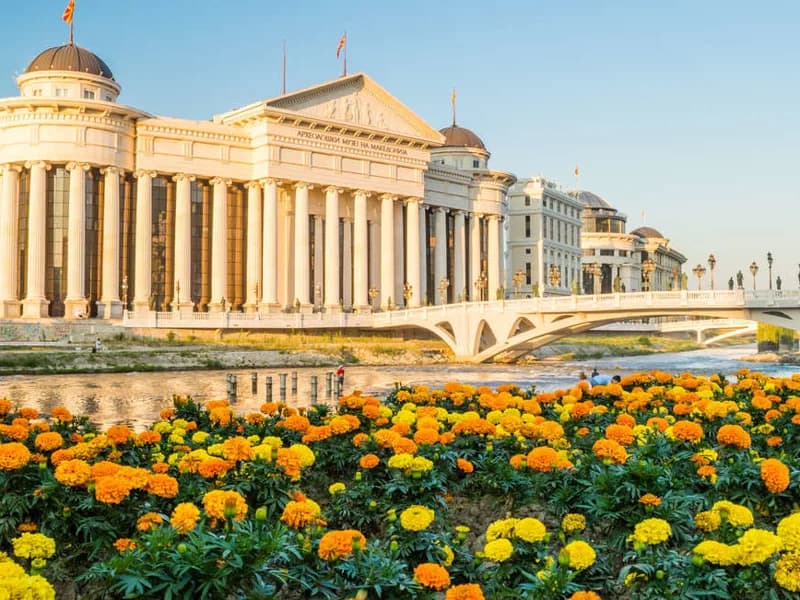
Stand in Macedonia Square, in the middle of Skopje, and you are surrounded by bronze. In the centre, on a tall column above a fountain, a warrior on a rearing horse raises his sword. Around him, in every direction, there are more statues: kings, saints, revolutionaries, writers, soldiers, lions. Across the river stand buildings with columns, domes and pediments that look as if they have been there for two centuries and were, in fact, finished in the last fifteen years. Skopje's centre is a stage set, and it was meant to be. To understand why, you have to go back to a summer morning in 1963.
The earthquake
At 5:17 in the morning on 26 July 1963, a magnitude 6.1 earthquake struck directly beneath Skopje. Most of the city was destroyed, including most of its housing; more than a thousand people were killed. The clock on the old railway station stopped at the moment of the quake, and the ruined station, with its clock, has been kept as a memorial, now the city museum.
The rebuilding became an international project. Help came from both sides of the Cold War, and the United Nations organised a competition for the plan of the new city centre. The Japanese architect Kenzo Tange won the largest share of the prize, and his ideas shaped the city that followed: a ring of long apartment blocks, the City Wall, around the centre, and in the years that followed came bold concrete buildings by Macedonian and Yugoslav architects, among them the central post office and the university's campus. By about 1980, most of the rebuilding was done. Skopje became, for a while, a showpiece of modernist architecture, and some of its concrete buildings are now admired by a new generation of enthusiasts.
Skopje 2014
Then, from 2010, the government of what was then the Republic of Macedonia launched a project called Skopje 2014, to give the capital a new, grander centre. Statues and monuments went up by the dozen. New public buildings appeared, in a heavy neoclassical and baroque style, and some of the modernist ones were given new classical facades. The river acquired new bridges lined with statues, and mock galleons were moored on it as restaurants.
The Warrior on Horseback in Macedonia Square is the centrepiece: a bronze rider some twelve metres high, on a ten-metre pedestal with a fountain. He is officially just a warrior, but most people take him for Alexander the Great, which was part of a long and bitter dispute with Greece over the name Macedonia, settled in 2019, when the country took the name North Macedonia. The project was controversial at home too, for its cost and its taste, and Skopje's people argue about it still. For a visitor, it is impossible to ignore, and fascinating to walk through, as long as you keep a sense of humour.
Skopje's centre is a stage set, and it was meant to be.
The old city across the river
Cross the Stone Bridge, the Ottoman-era bridge over the Vardar that is the city's emblem, and you are in a different world. The Old Bazaar, the Čaršija, is one of the largest old bazaars in the Balkans: a maze of lanes, small shops, coppersmiths, tailors, mosques, a covered market, Ottoman inns and teahouses, which survived the earthquake better than the modern city. Above it, the fortress, Kale, looks out over the river. This is where Skopje keeps its long past, Byzantine, Serbian and Ottoman, and where much of its Albanian population lives and trades.
Back on the other bank, near the square, is the Memorial House of Mother Teresa. She was born in Skopje on 26 August 1910, the daughter of an Albanian family, and the memorial stands close to the site of the church where she was baptised.
Beyond Skopje
Most visitors pass through Skopje on a wider tour of the country or the Balkans, and the city's best day trip is the Matka Gorge, a steep, wooded canyon a short drive from the centre, with a lake, old monasteries and boats to explore it.
Explore's fourteen-night Ancient Macedonia comes from Sofia in Bulgaria, by way of the Saint Joakim Osogovski Monastery and Kratovo, to Skopje and the Matka Gorge, then south-west to Lake Ohrid, the Saint Jovan Bigorski Monastery, Vevchani, Ohrid and Struga. It departs in May, June, August, September and October.
Explore's thirteen-night Undiscovered Balkans begins in Tirana in Albania, crosses to Struga and Lake Ohrid, Saint Naum, the Galicia National Park and Lake Prespa, then goes north to Skopje before continuing into Kosovo for Pristina, Peja, Boga and the White Drin waterfall. It runs from April to October.
Just You's twelve-night Balkan Explorer, for solo travellers, passes through Skopje on its way from Bulgaria to Serbia.
Give Skopje two days if you can: one for the statues and the square, one for the bazaar and the gorge. You will leave unsure what you think of it. That, perhaps, is the point.
By Walter Pellow, the name Atlas & Passage’s editorial team writes under. Prices and dates in the trips below come from the operators and can change.