History
Syracuse and Ortygia, the Greek city on an island
Greek settlers founded Syracuse on the little island of Ortygia nearly 2,800 years ago, and it grew into a city that rivalled Athens. The island is still the heart of it, and its cathedral is still a Greek temple.
By Walter Pellow2 November 20264 min read
Walk into the cathedral of Syracuse and look at the walls. Down both sides of the nave, half buried in the masonry, stand massive fluted columns: Doric columns, from a temple of Athena built here in the fifth century BC. When the Christians made the temple into a church, they did the practical thing and walled up the gaps between the columns rather than pull them down, and so the cathedral of Syracuse is, quite literally, a Greek temple wearing later clothes. Its Baroque front, added after an earthquake in 1693, hides the fact from the square. Inside, it is impossible to miss.
That is Syracuse in a sentence: a place where layers of history are built into one another, and the oldest are often the most visible.
The island at the heart
The city began on Ortygia, a small island off the south-east coast of Sicily, with a sheltered harbour on either side of it. Settlers from Corinth founded it in the 730s BC, and in the following centuries Syracuse grew into one of the largest and richest cities of the Greek world. It saw off an Athenian invasion in 413 BC, in one of the great disasters of Athenian history, and later Cicero, visiting under Roman rule, called it the largest and most beautiful of Greek cities. Its most famous citizen was Archimedes, who designed engines to defend it against the Romans and was killed when they finally took it, in 212 BC.
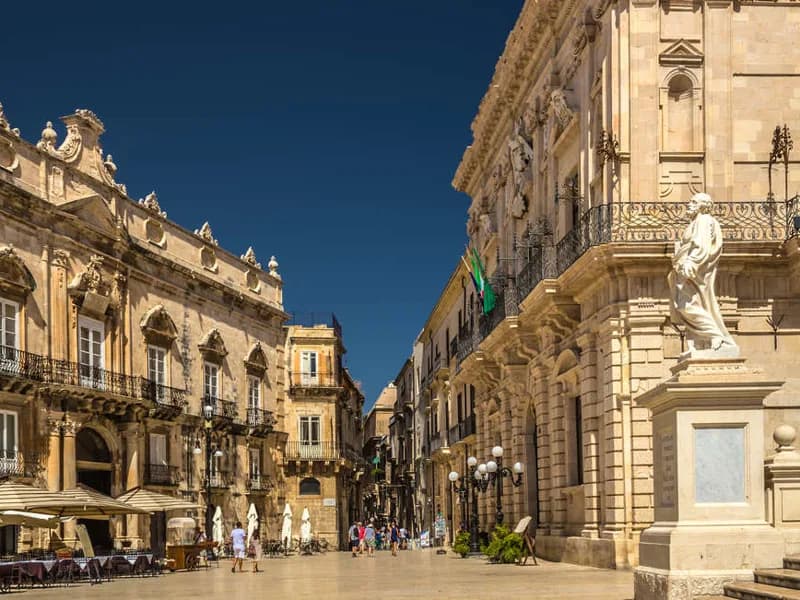
Ortygia is still the heart of Syracuse, joined to the mainland by short bridges, and it is a delight to walk. Narrow lanes run between Baroque palaces and churches, out onto sea walls and down to the waterfront. At the island's north end are the ruins of the Temple of Apollo, from the early sixth century BC, among the oldest Doric temples in Sicily. On the western shore is the Fountain of Arethusa, a freshwater spring a few steps from the sea, planted with papyrus and named after the nymph who, in Greek myth, fled under the sea from Greece and surfaced here. The Piazza Duomo, the long pale square in front of the cathedral, is the island's grand set piece, and at its far end the church of Santa Lucia alla Badia holds Caravaggio's Burial of Saint Lucy, painted for the city in 1608.
The cathedral of Syracuse is, quite literally, a Greek temple wearing later clothes.
The Neapolis and beyond
On the mainland, in the archaeological park of the Neapolis, the Greek theatre is cut into the hillside, its tiers of seats looking out towards the sea; plays are still staged in it in summer. Nearby is the Ear of Dionysius, a tall, curving cave in an old quarry with remarkable acoustics. Legend says the tyrant Dionysius used it to listen to his prisoners; Caravaggio, visiting in 1608, is said to have given it its name.
Syracuse also makes a base for the south-east corner of Sicily, where several towns were rebuilt in an exuberant Baroque style after the earthquake of 1693. Noto, a short drive away, is the best known, a town of golden stone built in one go; Ragusa, Modica and Scicli are in the same valley country, and the late Baroque towns of this Val di Noto are a World Heritage Site, as is Syracuse itself.
Tours that go there
Explore's seven-night A Taste of Sicily - Palermo to Syracuse crosses the island from Palermo, with Monreale and Corleone, to Agrigento, then through the Baroque south-east, by way of Modica, Scicli and Noto, to Syracuse and Ortygia. It departs in May, September and October.
Just You's seven-night Secret Sicily, for solo travellers, keeps to the south-east, from Catania to Marina di Ragusa, Ispica, Scicli, Ragusa Ibla and Palazzolo Acreide, and on to Syracuse, Ortigia, Noto and the fishing village of Marzamemi.
For more depth, Explore's fourteen-night Sicily in Depth with Historian Antonio Marretta takes in Syracuse and Ortygia, Noto and Ragusa, the Villa Romana at Piazza Armerina, the Greek city of Morgantina, Enna, Agrigento, the Stair of the Turks, Selinunte and Marsala. It departs in April, May, June, September and October.
Give Ortygia an evening as well as a day. When the light goes and the stone of the Piazza Duomo turns gold, the island feels very old and very much alive.
By Walter Pellow, the name Atlas & Passage’s editorial team writes under. Prices and dates in the trips below come from the operators and can change.