First time
Tallinn, Riga and Vilnius, three Baltic capitals in a week
Estonia, Latvia and Lithuania are usually spoken of together, but their capitals could hardly be more different: a Hanseatic port, an Art Nouveau city and a baroque one. A week is enough to see all three, and to see why they resent being lumped together.
By Walter Pellow2 November 20264 min read
To outsiders, the three Baltic states are a set: three small countries on the eastern shore of the Baltic Sea, occupied by the Soviet Union in 1940, independent again in 1991, members of the European Union and NATO since 2004. To the people who live there, the differences matter more. Estonian is a Finnic language, close to Finnish and unrelated to its neighbours. Latvian and Lithuanian are Baltic languages, among the oldest surviving forms of Indo-European speech. Estonia and Latvia were shaped by German merchants and Swedish kings, Lutheran and northern; Lithuania was for centuries a great power in its own right, joined to Poland, and is Catholic.
Their capitals show the differences clearly, and they are only a few hours apart by road, which makes them easy to see in a week.
Tallinn
Tallinn's old town is one of the best preserved medieval towns in northern Europe, a tight knot of cobbled lanes, merchants' houses, church spires and red roofs within a city wall that still has most of its towers. It grew rich as a member of the Hanseatic League, the German trading network that dominated the Baltic in the Middle Ages, and its Town Hall Square, with its Gothic town hall, has been the heart of the city since then.
The old town is in two parts: the lower town, of merchants and craftsmen, and Toompea, the hill above it, where the nobles and the bishops lived, and where Estonia's parliament now sits in a pink baroque palace. From the viewing platforms on Toompea, the roofs of the lower town spread out below, with the sea beyond.
Riga
Riga is the largest of the three cities, and the grandest. It has a medieval old town of its own, with the House of the Blackheads, a lavish guild hall rebuilt after its destruction in the Second World War, and the tall spire of St Peter's Church. But its real glory is its Art Nouveau architecture. In the decades around 1900, Riga was a booming port in the Russian Empire, and its new districts were built in the fashionable style of the day. A large share of the buildings in its centre are Art Nouveau, one of the greatest concentrations anywhere, with facades of stone faces, flowers, peacocks and towers, especially along Alberta iela.
Riga's Central Market, housed in five huge hangars originally built for Zeppelins, is one of the largest in Europe.
A Hanseatic port, an Art Nouveau city and a baroque one.
Vilnius
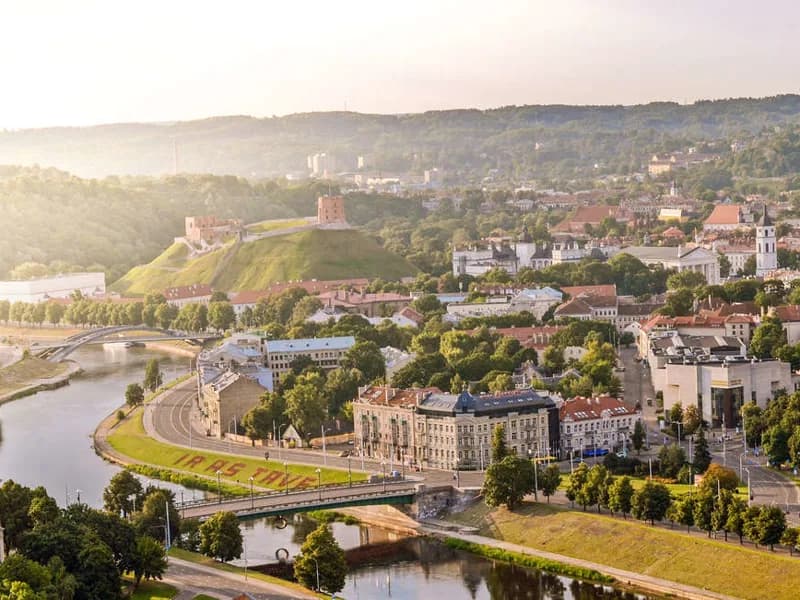
Vilnius feels different again: more southern, more Catholic, with an old town of baroque churches, courtyards and winding streets, one of the largest in eastern Europe. It was the capital of the Grand Duchy of Lithuania, which in the fourteenth and fifteenth centuries stretched from the Baltic almost to the Black Sea. It was also, before the Second World War, one of the great centres of Jewish life and learning in Europe, known as the Jerusalem of the North, a community almost entirely destroyed in the Holocaust.
Uzupis, a bohemian district across a small river from the old town, declared itself an independent republic in 1997, with its own constitution, posted on a wall in many languages, which includes the right of a dog to be a dog.
Between the capitals, and the tours that link them
The roads between the three cities pass some memorable sights. In Lithuania, Trakai has a red-brick island castle on a lake, and in the north, near Šiauliai, the Hill of Crosses is covered in tens of thousands of crosses, left by pilgrims and visitors over generations. In Latvia, Rundāle Palace is a baroque palace built by the architect of the Winter Palace in St Petersburg, and Sigulda and Turaida lie in the Gauja valley.
Explore Worldwide's Baltic Capital Cities, seven nights, starts in Vilnius and travels north through Trakai, Kaunas, Pakruojis and the Hill of Crosses to Riga, then by the seaside resort of Pärnu to Tallinn. It runs through most of the year, from spring to autumn and in December.
Just You's Baltic Treasures: Estonia, Latvia & Lithuania, nine nights, for solo travellers, starts in Tallinn and adds the Latvian coast at Liepāja and Kuldīga and the Curonian Spit at Klaipėda and Nida before finishing in Vilnius.
Travelsphere's Grand Baltic Explorer, nine nights, begins across the water in Helsinki, then covers Tallinn, Sigulda, Turaida, Riga, Rundāle Palace, Vilnius and Druskininkai, and ends in Warsaw.
Late spring and summer are the best seasons, when the days are long and warm, and the white nights of June barely darken at all. December is cold, but the Christmas markets in all three old towns are among the best in northern Europe.
By Walter Pellow, the name Atlas & Passage’s editorial team writes under. Prices and dates in the trips below come from the operators and can change.