Cruise
The Baltic by ship, and the Kiel Canal as the way in
The Baltic is a sea of old trading ports, Hanseatic towns and capital cities built on the water. A cruise from Britain reaches it by the Kiel Canal or round the tip of Denmark, and calls at ports that a road trip would take weeks to link.
By Walter Pellow2 November 20264 min read
For centuries, the Baltic was one of the great trading seas of Europe. Its ports exchanged grain, timber, furs, amber, salt fish and wax, and in the Middle Ages the German merchants of the Hanseatic League bound them into a network that ran from London to Novgorod. Many of those ports are now capitals and cities of countries that did not exist a century and a half ago, but their old towns still face the water, and arriving by sea is the most natural way to see them.
From Britain, there are two ways into the Baltic. A ship can sail north round the tip of Denmark and down through the Kattegat, or it can take the short cut, through the Kiel Canal, which crosses the base of the Jutland peninsula in northern Germany.
The way in
The Kiel Canal, opened in 1895, runs for nearly a hundred kilometres from Brunsbüttel, at the mouth of the Elbe, to Kiel on the Baltic. It saves a long voyage round Denmark, and it is the busiest artificial waterway in the world by the number of ships that use it. Passing through it is a pleasure in itself: the ship moves slowly between green fields and woods, so close to the banks that passengers can wave to people on the towpath, beneath high bridges, past ferries crossing from one bank to the other.
The ports
Gdańsk, on the Polish coast, was one of the greatest of the Hanseatic ports, and its old town, rebuilt after the destruction of 1945, has rows of tall, gabled merchants' houses along the Long Market, and the huge medieval crane on the waterfront. It was also here, at the shipyards, that the Solidarity movement began in 1980, a story told in a museum on the site.
Klaipėda is Lithuania's port, a gateway to the Curonian Spit, with its moving dunes. The town itself, known for centuries by its German name of Memel, has a small old town of timber-framed warehouses on the river Danė. In Latvia, ships call at Riga, the largest of the Baltic capitals, with a medieval old town and a famous collection of Art Nouveau buildings, and at Ventspils, a small, tidy port town with a castle of the Livonian Order on the river.
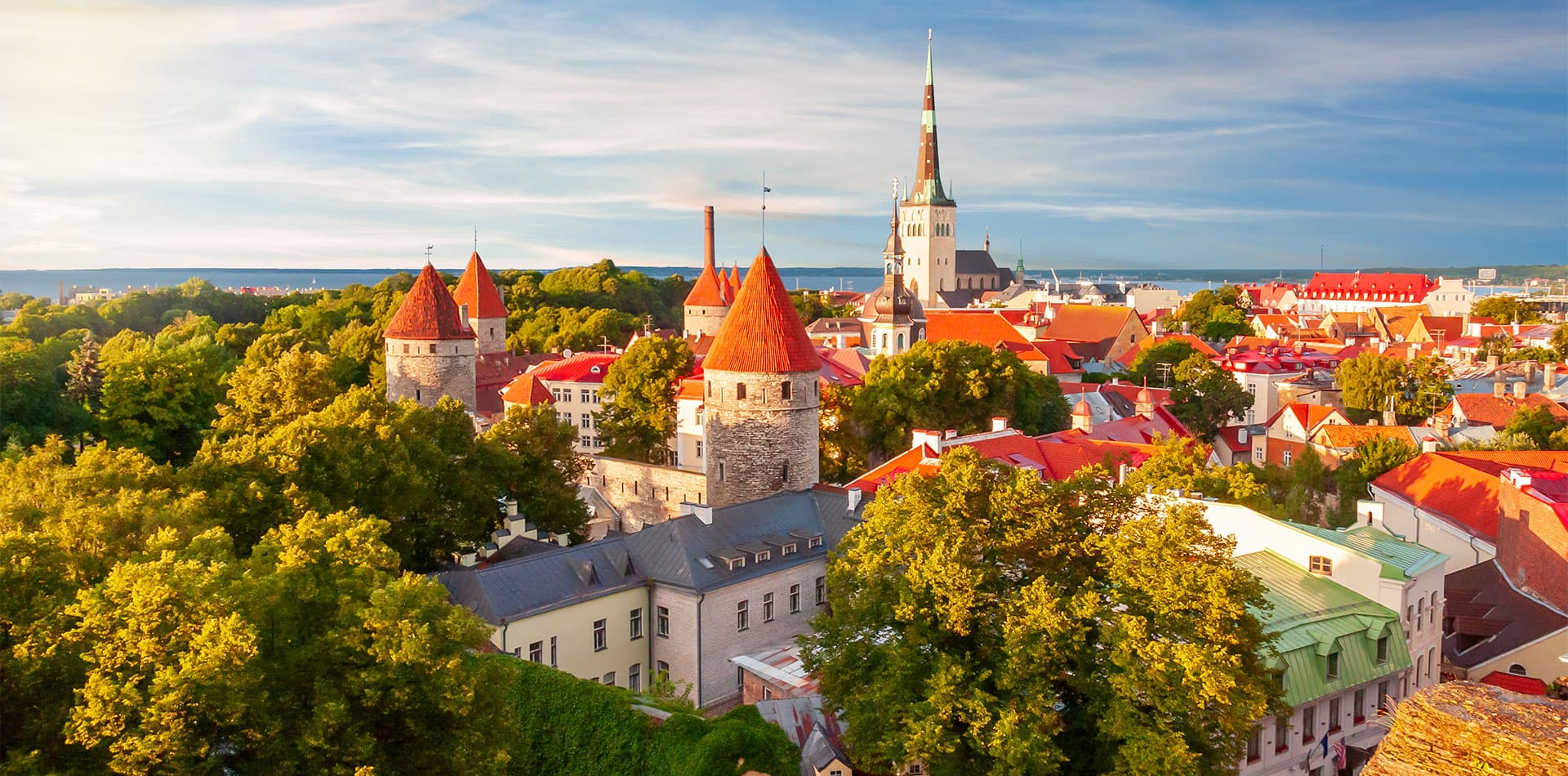
Tallinn, the Estonian capital, has one of the most complete medieval old towns in northern Europe, with its walls, towers and the hill of Toompea, and is best seen by walking straight up into it from the harbour. Saaremaa, Estonia's largest island, is a quieter call, with its windmills, juniper and the bishop's castle at Kuressaare.
Some sailings reach further. Helsinki, the Finnish capital, has a harbour-front market, a white Lutheran cathedral above its main square and the island fortress of Suomenlinna at the mouth of the harbour, built by the Swedes in the eighteenth century. Copenhagen, the Danish capital, with its canals, palaces and the coloured houses of Nyhavn, is often the last call on the way home. Bornholm, the Danish island in the middle of the Baltic, is known for its round churches, medieval buildings with thick white walls that doubled as refuges in times of raids.
Their old towns still face the water, and arriving by sea is the most natural way to see them.
The sailings
Fred. Olsen Cruise Lines' Discovering the Baltic with the Kiel Canal, eleven nights, sails from Rosyth on the Firth of Forth in June and calls at Gdańsk, Ventspils, Riga, Saaremaa and Tallinn, with a passage through the Kiel Canal.
Fred. Olsen's Countries & Cultures of Northern Europe, ten nights, sails from Southampton in September by way of Brunsbüttel and Kiel, at either end of the canal, and calls at Trelleborg in Sweden, Gdańsk, Ventspils, Klaipėda and Copenhagen.
Fred. Olsen's Nine Nations of Northern Europe, thirteen nights, sails from Newcastle in May and visits the Lysefjord in Norway, Rønne on the Danish island of Bornholm, Gdańsk, Klaipėda, Ventspils, Helsinki, Tallinn, Warnemünde and Lysekil on the Swedish coast.
The Baltic cruise season runs from late spring to early autumn. May and June bring the longest days, and in the northern Baltic the light barely leaves the sky at midsummer. September is quieter, and the old towns are often at their best in its soft, low light.
By Walter Pellow, the name Atlas & Passage’s editorial team writes under. Prices and dates in the trips below come from the operators and can change.