Walking
The last hundred kilometres to Santiago
Pilgrims have been walking to Santiago de Compostela for more than a thousand years. You do not need a month or a vow to join them for the final stretch.
By Arthur Penhallow26 September 20265 min read
Some time in the early ninth century, according to the story, a hermit in the hills of Galicia saw strange lights over a field and went to investigate. What was found there was declared to be the tomb of St James the Apostle, who had, by a route the legend does not trouble to explain in detail, been carried by boat from Jerusalem to the far north-western corner of Spain. A church was built over the grave, then a larger one, then a city around it, and within a couple of centuries people were walking there from all over Christendom. They have not really stopped since.
The Camino de Santiago is not one road but many, a web of routes that start in France, in Portugal, along the northern coast and across the middle of Spain, and converge on the cathedral in Santiago de Compostela. The most famous, the Camino Francés, runs about eight hundred kilometres from the Pyrenees. Very few people have five weeks to spare. Fortunately, the pilgrims' office in Santiago takes a practical view: walk the last hundred kilometres and you have earned your Compostela, the certificate that says you have made the pilgrimage.
From Sarria, on the old French road
The town of Sarria, in Galicia, lies just over a hundred kilometres from the cathedral, which is why it is the most popular starting point on the Camino and why its pavements in summer are thick with new boots. From there the route runs west through a green, small-scale country of stone walls, oak woods, dairy farms and granite villages, with a waymark shaped like a scallop shell every few hundred metres. The shell has been the pilgrims' badge since the Middle Ages; the grooves are said to represent the many roads leading to one place, which is a tidier explanation than most.
Along the way there are places with good stories. Portomarín stands above a reservoir that drowned the old village in the 1960s; the Romanesque church was taken down stone by stone and rebuilt on the hill, and the numbers painted on its stones can still be picked out. Melide is known up and down the Camino for its octopus, boiled, sliced and dusted with paprika, a dish that seems improbable a long way from the sea until you remember how Galicians feel about octopus. By Monte do Gozo, the Hill of Joy, the towers of the cathedral come into view, and the last few kilometres are walked through the suburbs, which is the one part nobody writes poems about.
Or up from Porto, along the coast
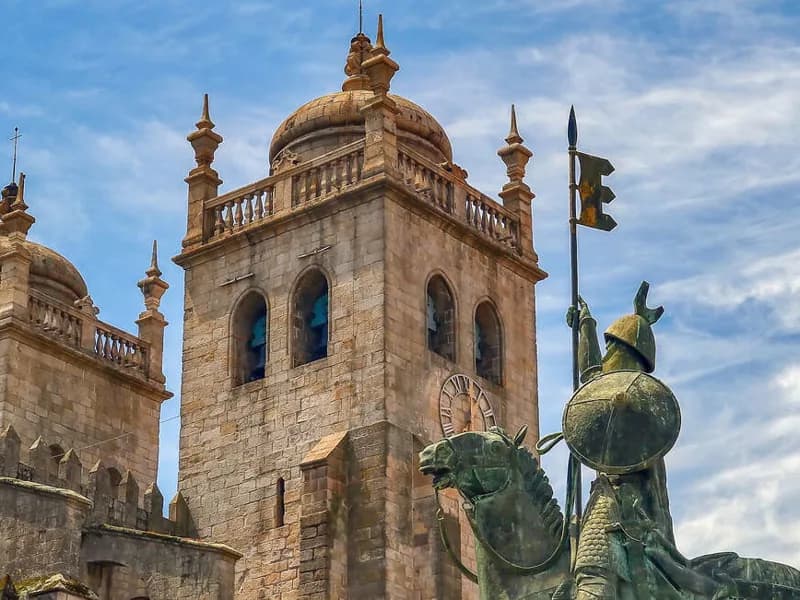
The Portuguese Camino is the second most walked route, and in some ways the more varied. It begins in Porto, follows the Atlantic coast north past Viana do Castelo and Caminha, crosses the River Minho into Spain, and then turns inland through Pontevedra, whose old town is one of the pleasantest in Galicia, to Padrón. Padrón is where, by tradition, the boat carrying the apostle's body came ashore, and it has also given its name to the small green peppers served fried and salted all over Spain, of which it is said that some are hot and some are not. There is no way of telling in advance. This is, in its way, also a lesson of the Camino.
Walk the last hundred kilometres and you have earned your Compostela.
Arriving in Santiago
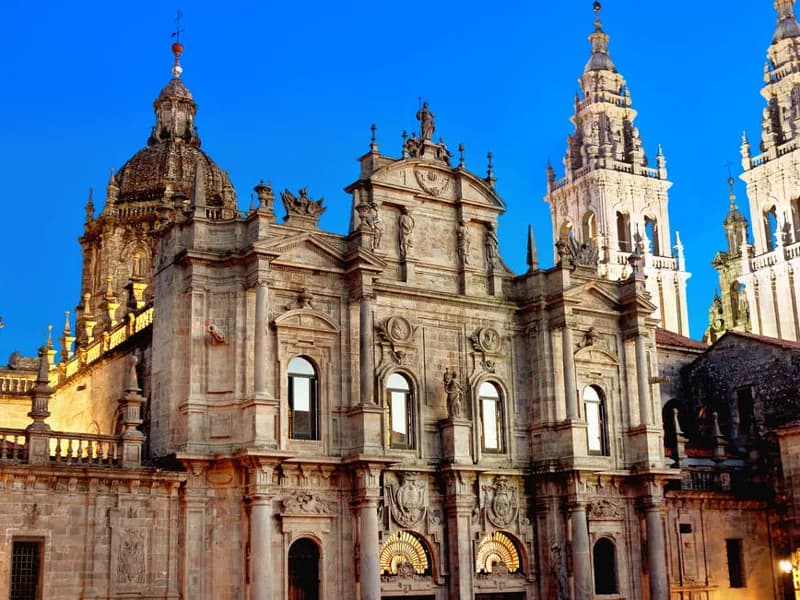
Everyone arrives, eventually, in the Praza do Obradoiro, the great square in front of the cathedral's western façade. It is worth a few minutes simply to stand and watch: people sitting on their packs, people in tears, people taking photographs of their feet. Inside, the Portico of Glory, carved in the twelfth century by a master called Mateo, is one of the finest pieces of Romanesque sculpture anywhere. On certain occasions the botafumeiro, a silver-plated censer the size of a small person, is swung on ropes across the transept by a team of men, trailing incense almost to the roof. It began, it is often said, as a way of sweetening the air in a church full of unwashed pilgrims, and it remains a remarkable thing to watch.
Many walkers then continue to Fisterra, on the coast, which the Romans thought was the end of the world, and where the sun sets over nothing at all until America.
When to go, and 2027
Spring and early autumn are the best seasons: long enough days, cool enough walking, and Galicia's famous rain in moderation rather than in earnest. Midsummer is warm and much busier, especially in the last hundred kilometres. It is also worth knowing that 2027 is a Holy Year, which happens whenever St James's feast day, 25 July, falls on a Sunday. In Holy Years the cathedral's Holy Door is opened and the numbers of pilgrims climb considerably, so book beds early.
Not everyone wants to walk every step. For those travelling on their own who would rather see the whole length of the Camino Francés, from the vineyards of Rioja to Burgos, Astorga and the Iron Cross on the mountain pass above it, where pilgrims leave a stone brought from home, there is a gentler way of following the road.
A week on foot will not make you a medieval pilgrim. But the path is the same one, the villages are the same villages, and the feeling of walking into that square is, by most accounts, much the same as it ever was.
By Arthur Penhallow, the name Atlas & Passage’s editorial team writes under. Prices and dates in the trips below come from the operators and can change.