Slow travel
The Tuscany you reach on foot
The hill towns of Chianti and the Val d'Orcia were built where a cart could barely climb. Walking between them, rather than driving, turns out to be the more practical option as well as the better one.
By Arthur Penhallow26 September 20264 min read
Tuscany's hill towns sit where they do for a reason that has nothing to do with the view, appealing as it now is. Siena, San Gimignano, Montalcino and dozens of smaller places occupy high ground because, through the long, unsettled centuries of the Middle Ages, high ground was defensible and low ground was not. Walls went up around the highest available point, the streets inside them narrowed and climbed in whatever pattern the slope allowed, and the surrounding hillsides, too steep and thin-soiled for much else, were given over to olives and vines that needed comparatively little from the ground to thrive.
The result, eight centuries later, is a landscape built at walking pace and still best understood at it. The roads that connect the hill towns today mostly follow the old droving and pilgrim routes, looping around contours that a car takes at speed and a walker takes at the pace the land actually dictates. San Gimignano's fourteen surviving medieval towers, built by rival merchant families each trying to out-build the last, are far more legible from the footpath approaching across the fields than from a car park at the town's edge.
Chianti, and the wine the land made necessary
Chianti, the hill country between Florence and Siena, produces the wine because the alternative uses for the land were limited. The soil is thin and stony, poor for grain but well suited to the deep, searching roots of a vine, and the classic Sangiovese grape of the region ripens on slopes too steep for easy mechanisation even now. Further south, around Montalcino, the same logic produces Brunello, and around Montepulciano, Vino Nobile: different towns, different soils, the same underlying arrangement of a landscape too awkward for large-scale farming turned instead to something that rewards patience.
Walking through this country puts the wine in its landscape rather than just in a glass. A morning's route between Radda in Chianti and Castellina, or through the Val d'Orcia between Pienza and Montalcino, crosses working vineyards and olive groves rather than skirting them, and arrives at each town's gate the way its builders expected visitors to arrive: on foot, a little tired, ready for lunch.
Florence, at the end of the walk
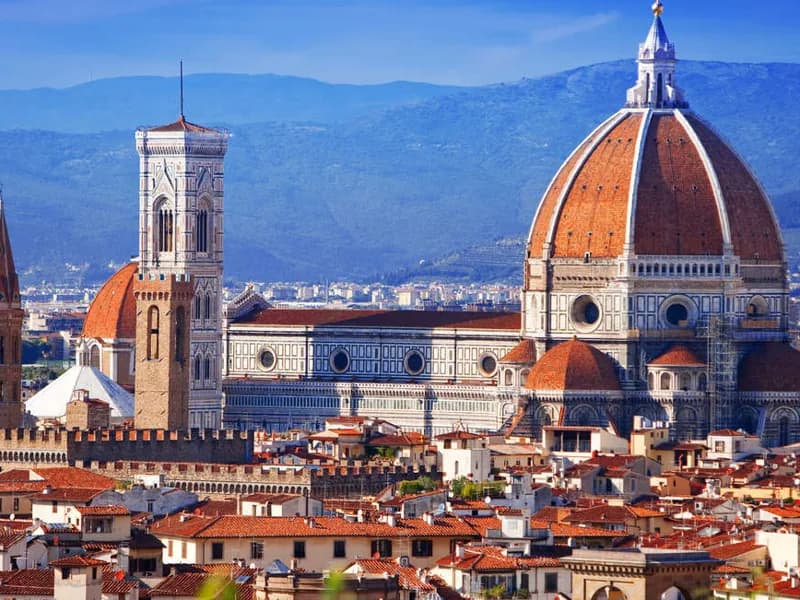
Florence sits at the northern edge of this country, and it makes sense as a finish rather than a start: a city of bankers and popes who spent the wealth that Tuscany's countryside generated on Brunelleschi's dome, the Uffizi's collections and more churches per square mile than seems entirely necessary. Arriving there after several days among the hill towns gives some sense of the relationship between the two, Florence as the capital that the smaller towns' wool, wine and olive oil helped to build.
A tour built around Val d'Orcia's hilltop towns and vineyards, or one that pairs the walking with a stay near Florence and Lucca, gives roughly the same landscape from a slightly different angle, and either makes a reasonable case that this is a region better covered slowly, on foot, than fast, by road.
The Val d'Orcia in particular, the long valley south of Siena that runs towards Monte Amiata, has been protected as a UNESCO World Heritage cultural landscape since the early 2000s specifically because of how deliberately it was shaped: the cypress-lined roads, the geometric fields and the towns sited to be seen from a distance are not accidents of farming but the result of a fifteenth-century Sienese ideal of an ordered, cultivated countryside, laid out to look exactly as good as it now photographs. Pienza, at its centre, was largely rebuilt in the 1450s on the orders of a pope who wanted his home village turned into a model Renaissance town, and it remains small enough to see on foot in an afternoon, which was rather the point.
Go between April and June or in September, when the vines are either flowering or heavy with fruit and the summer heat has not yet made an afternoon's walk a test of endurance rather than a pleasure.
By Arthur Penhallow, the name Atlas & Passage’s editorial team writes under. Prices and dates in the trips below come from the operators and can change.