History
The war fought above the snow line
For three winters, Italian and Austro-Hungarian troops dug trenches through solid ice and fought at altitudes that killed as many men through cold as through combat. The paths they cut for supplies are now some of the finest walking routes in the Dolomites.
By Arthur Penhallow26 September 20264 min read
When Italy entered the First World War in 1915, it did so against Austria-Hungary along a front that ran, for a significant stretch, through some of the highest and most inhospitable terrain in Europe: the peaks of the Dolomites, where the pre-war border between Italy and the Austro-Hungarian Empire happened to run along the watershed. For the next three years, soldiers on both sides fought a war unlike almost any other in the conflict, dug into positions at altitudes above three thousand metres, in a landscape of rock, ice and near-vertical drops that made ordinary trench warfare close to impossible.
What developed instead has come to be called, in Italian, the Guerra Bianca, the White War. Troops carved tunnels and barracks directly into glaciers and rock faces, strung telegraph wire and supply lines across sheer cliffs, and in a few documented cases dug artillery positions into the ice itself. More soldiers on this front are thought to have died from avalanches, frostbite and falls than from enemy fire, a grim distinction that set the Dolomites campaign apart even within a war already defined by unprecedented casualties. On one catastrophic day in December 1916, avalanches triggered partly by artillery fire killed hundreds of soldiers on both sides within hours, a single disaster that had nothing directly to do with the fighting at all.
The routes the war left behind
To move troops and supplies across terrain that had previously been the preserve of a handful of mountaineers, army engineers on both sides fixed cables, ladders and iron rungs directly into the rock, creating protected climbing routes that let ordinary soldiers, not just specialists, cross ground that would otherwise have been impassable. These fixed-rope routes are the direct ancestors of the via ferrata, "iron path", now found throughout the Alps and used recreationally by walkers and climbers rather than armies. Many of the original wartime routes through the Dolomites, restored and re-equipped with modern safety cable, are still walked today, among them routes across the Tofane, the Marmolada and the Lagazuoi, where a network of Italian tunnels still runs directly through the mountain.
Walking through a battlefield that healed itself
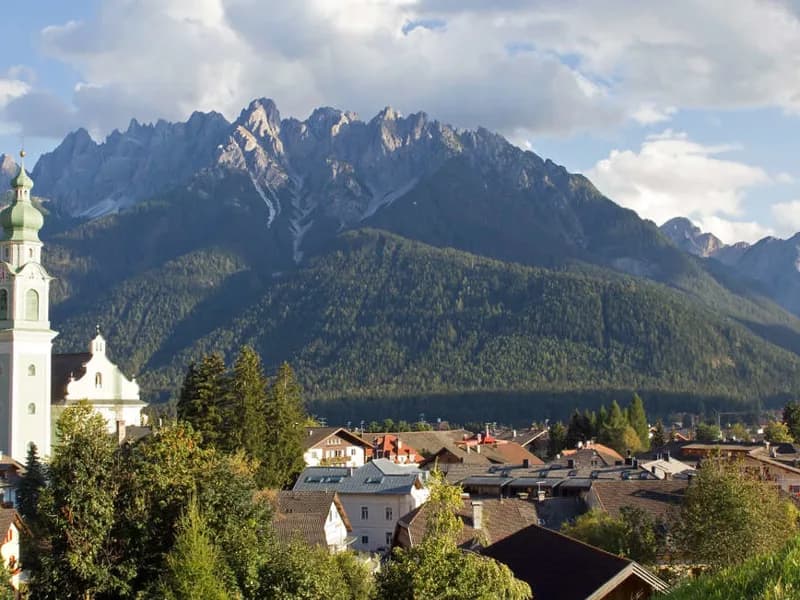
A century on, the Dolomites have largely reclaimed their wartime scars: the rock faces are climbed for pleasure, the valleys that once moved munitions now move walkers between mountain refuges, and the war is present mostly in the form of small, well-kept museums, plaques and the occasional preserved trench line rather than any visible damage to the landscape. Sesto, Cortina d'Ampezzo and the area around the Tre Cime di Lavaredo, one of the range's most photographed formations, all sit close to sections of the old front and are common starting points for walks that pass wartime remains alongside some of the most dramatic scenery in the Alps.
The irony that this brutal, largely forgotten mountain war produced the walking infrastructure now drawing thousands of hikers each summer is not lost on the guides who lead trips through it. The Dolomites reward the walk regardless of the history; knowing it simply adds weight to the silence at the top of a pass that, a century ago, would have been anything but quiet.
Some sections keep the history closer to the surface than others. Near Cinque Torri, an open-air museum preserves a reconstructed Italian defensive position much as it stood a century ago, with trenches, gun emplacements and shelters cut into the rock, walkable in an hour or two and a useful orientation before tackling one of the longer routes nearby. Further north, the Great War museum at the Marmolada's Punta Serauta sits at nearly three thousand metres, inside the very mountain that saw some of the bitterest and coldest fighting of the whole campaign, reachable today by cable car in a fraction of the time it once took a laden soldier to climb.
Go between June and September, once the higher passes have cleared of snow and the mountain refuges, which supply much of the food and shelter along the longer routes, are open for the season.
By Arthur Penhallow, the name Atlas & Passage’s editorial team writes under. Prices and dates in the trips below come from the operators and can change.