History
Tipaza and Cherchell, Algeria's Roman coast
West of Algiers, Roman ruins stand above the Mediterranean among pines and wild flowers, in a setting Albert Camus loved. Algeria has some of the finest Roman remains in the world, and very few visitors to see them.
By Walter Pellow2 November 20264 min read
Algeria is the largest country in Africa, and for most of the last few decades one of the least visited. Its civil war in the 1990s kept travellers away, and it has never courted mass tourism. Yet it has extraordinary riches: a long Mediterranean coast, the mountains of the Atlas and the Kabylie, the oases of the Sahara, and some of the best preserved Roman sites anywhere, several of them UNESCO World Heritage Sites.
The Romans ruled this part of North Africa for centuries, and it was one of the richest provinces of their empire, exporting grain, olive oil and wine to Italy. Its cities were grand, and because many were abandoned rather than built over, their ruins survive in remarkable condition.
Tipaza
Tipaza lies on the coast about seventy kilometres west of Algiers. It was a Punic trading post before it became a Roman town, and its ruins are spread across a headland and along the shore: a forum, temples, an amphitheatre, baths, villas with mosaics, and early Christian basilicas, among them the large Great Basilica, built in the fourth century, with a view over the sea.
What makes Tipaza memorable is its setting. The ruins stand among umbrella pines, cypresses and wild flowers on rocks above a clear blue sea, with the Chenoua mountain rising beyond. The writer Albert Camus, born in Algeria, wrote one of his best known essays, Nuptials at Tipasa, about the place, celebrating the sun, the sea and the smell of absinthe plants among the stones, and a simple stone monument to him stands among the ruins, inscribed with a line from his work.
Its ruins stand among umbrella pines, cypresses and wild flowers on rocks above a clear blue sea.
Cherchell
Cherchell, a little further west, was once the city of Iol Caesarea, the capital of the kingdom of Mauretania under Juba II, a Berber king who was educated in Rome and married Cleopatra Selene, the daughter of Cleopatra and Mark Antony. They made their capital a centre of learning and art, and the city was later the capital of the Roman province of Mauretania Caesariensis. Much of the ancient city lies beneath the modern town, but Cherchell's museum holds a superb collection of Roman sculpture and mosaics found there.
Between Cherchell and Algiers, on a hilltop, stands the Royal Mausoleum of Mauretania, a huge circular stone tomb with a stepped cone roof, built around the first century BC and often associated with Juba II and Cleopatra Selene. Its exact purpose and occupants are still debated.
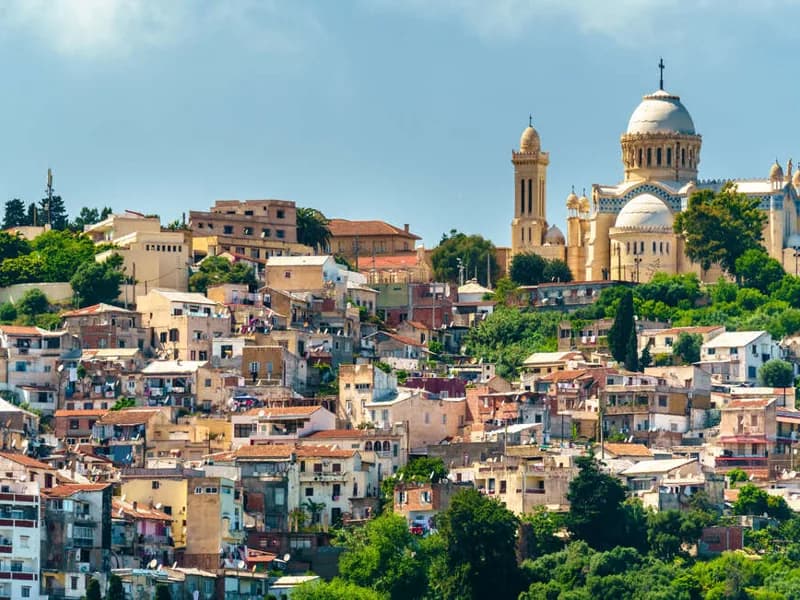
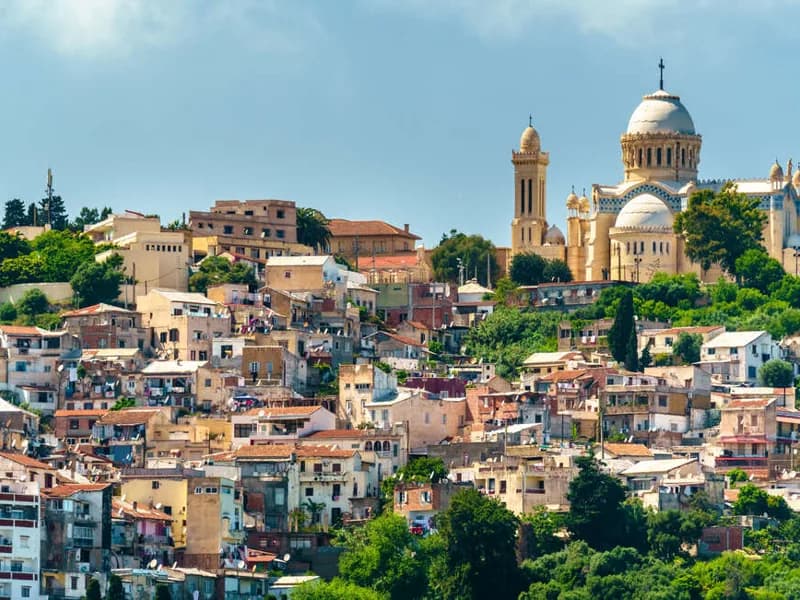
Most journeys start in Algiers, a city of white buildings climbing the hills above its bay. Its Casbah, the old Ottoman citadel and medina, is a UNESCO World Heritage Site, a steep maze of lanes, mosques and palaces, some of them restored, and on a headland above the city stands the basilica of Notre-Dame d'Afrique, built in the nineteenth century, with a view across the sea.
The great inland cities
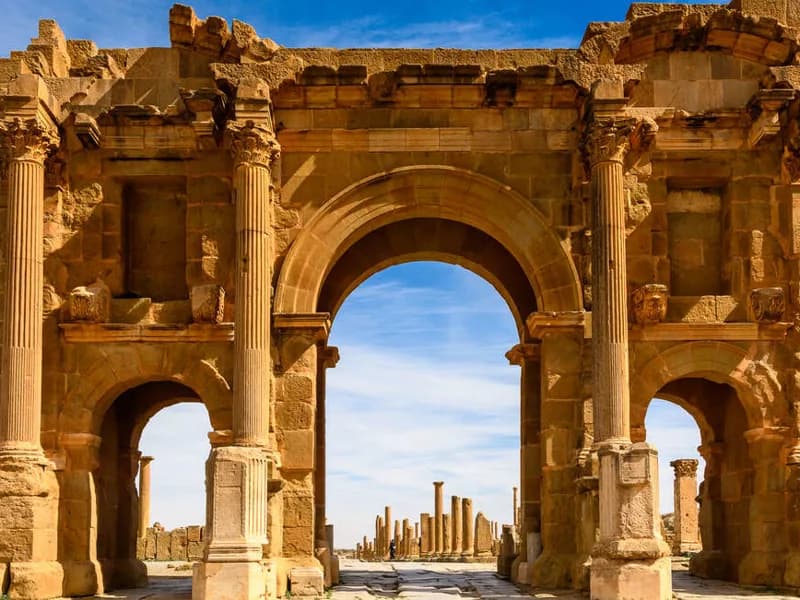
Further east, in the high plains, lie two of the most complete Roman cities in the world. Djemila, in the mountains near Sétif, is a town of temples, arches, a forum and a theatre, laid out along a narrow ridge between two ravines. Timgad, near Batna on the edge of the Aurès mountains, was founded by the emperor Trajan as a colony for veterans, and it was laid out on a perfect grid, its streets paved, its triumphal arch still standing, the whole city visible from the hill above as if on a plan.
The tours
Explore Worldwide's Ancient Algeria and the Sahara Desert, fifteen nights, begins with Algiers, Cherchell and Tipaza, then travels south to the M'Zab valley at Ghardaïa and its fortified towns of Beni Isguen, Melika and El Atteuf, the desert towns of Ouargla and Touggourt, and Batna, the Ghoufi Canyon and Timgad. It runs in January, March and from October to December.
Explore's Wonders of Ancient Algeria and the M'Zab Valley, nine nights, covers a similar route, with Algiers, Cherchell, Tipaza, Ghardaïa and the M'Zab, Ouargla, Touggourt, Batna, Biskra and the Ghoufi Canyon. Explore's Wonders of Ancient Algeria Eclipse Tour, nine nights, in August, visits the Royal Mausoleum of Mauretania, Cherchell, Tipaza, Sétif, Djemila, Batna, Timgad, Constantine, Tiddis and the ruins of Hippo Regius at Annaba, where St Augustine was bishop.
Spring and autumn are the best times for the coast and the Roman sites, when the weather is warm and the countryside green. In spring, the ruins at Tipaza are covered in flowers, as Camus described them.
By Walter Pellow, the name Atlas & Passage’s editorial team writes under. Prices and dates in the trips below come from the operators and can change.