History
Turkestan, the shrine that made a Kazakh city sacred
In the south of Kazakhstan, on the old Silk Road, Timur built a vast blue-domed mausoleum over the grave of a twelfth-century Sufi poet, and never finished it. It made the city of Turkestan a place of pilgrimage, and it still is.
By Walter Pellow2 November 20263 min read
From a distance, across the flat land of southern Kazakhstan, you see the dome first: a great turquoise dome, ribbed and glazed, rising above the walls of an old citadel. Then the building beneath it, a vast, sand-coloured block of fired brick, its front a towering portal that looks oddly bare, as if the decorators packed up and left halfway through the job. They did. This is the Mausoleum of Khoja Ahmed Yasawi in the city of Turkestan, begun on the orders of Timur, the great conqueror, and left unfinished when he died.
It is a building of the first rank, and a sacred one.
The poet and the shrine
Khoja Ahmed Yasawi was a Sufi master and poet of the twelfth century, who lived and taught in Turkestan and died in 1166. He wrote his verses in a Turkic language rather than Arabic or Persian, so that ordinary people could understand them, and he became a revered figure in the spread of Islam among the Turkic peoples of the steppe. His grave, marked at first by a small mausoleum, became a place of pilgrimage.
Two centuries later, in 1389, Timur ordered a far grander building to be raised over it. It was to be a complex of halls and rooms under a single great roof, with the tomb at its heart. Work stopped in 1405, when Timur died on campaign, and it was never completed. The great main portal still lacks its finished facing, and the two minarets planned for it were never built, but the rest of the building, with its glazed tilework and its domes, is magnificent.
In 2003 it was inscribed as a UNESCO World Heritage Site.
Its front looks oddly bare, as if the decorators packed up and left halfway through the job.
Inside
The building is entered through the great portal into a domed hall, and in its centre stands one of its treasures: a huge bronze cauldron for holy water. Around the hall, passages lead to a mosque, a library, meeting rooms, wells and kitchens, and to the tomb chamber of Yasawi himself, under the turquoise dome. Pilgrims come to pray there, many of them from across Kazakhstan, Uzbekistan and further afield. Visitors should dress modestly and behave as they would in any place of worship.
Take your time in the great hall. The scale of it, and the quiet, are as much a part of the place as any single object in it, and a guide can point out the details of the brickwork and the glazed tiles that are easy to miss.
Around the mausoleum, inside the restored walls of the old citadel, are smaller tombs, a bathhouse and an underground mosque, and outside them, the modern city has grown. From the sixteenth century to the eighteenth, Turkestan was the capital of the Kazakh khans.
Southern Kazakhstan
Turkestan lies in the south of the country, on the old caravan routes between the steppe and the oases of Central Asia. Shymkent, the region's main city, is a few hours to the south-east, and Taraz, another old Silk Road town, lies beyond it. Near Turkestan are the ruins of Otrar, the city whose governor provoked Genghis Khan by killing his merchants.
Tours that go there
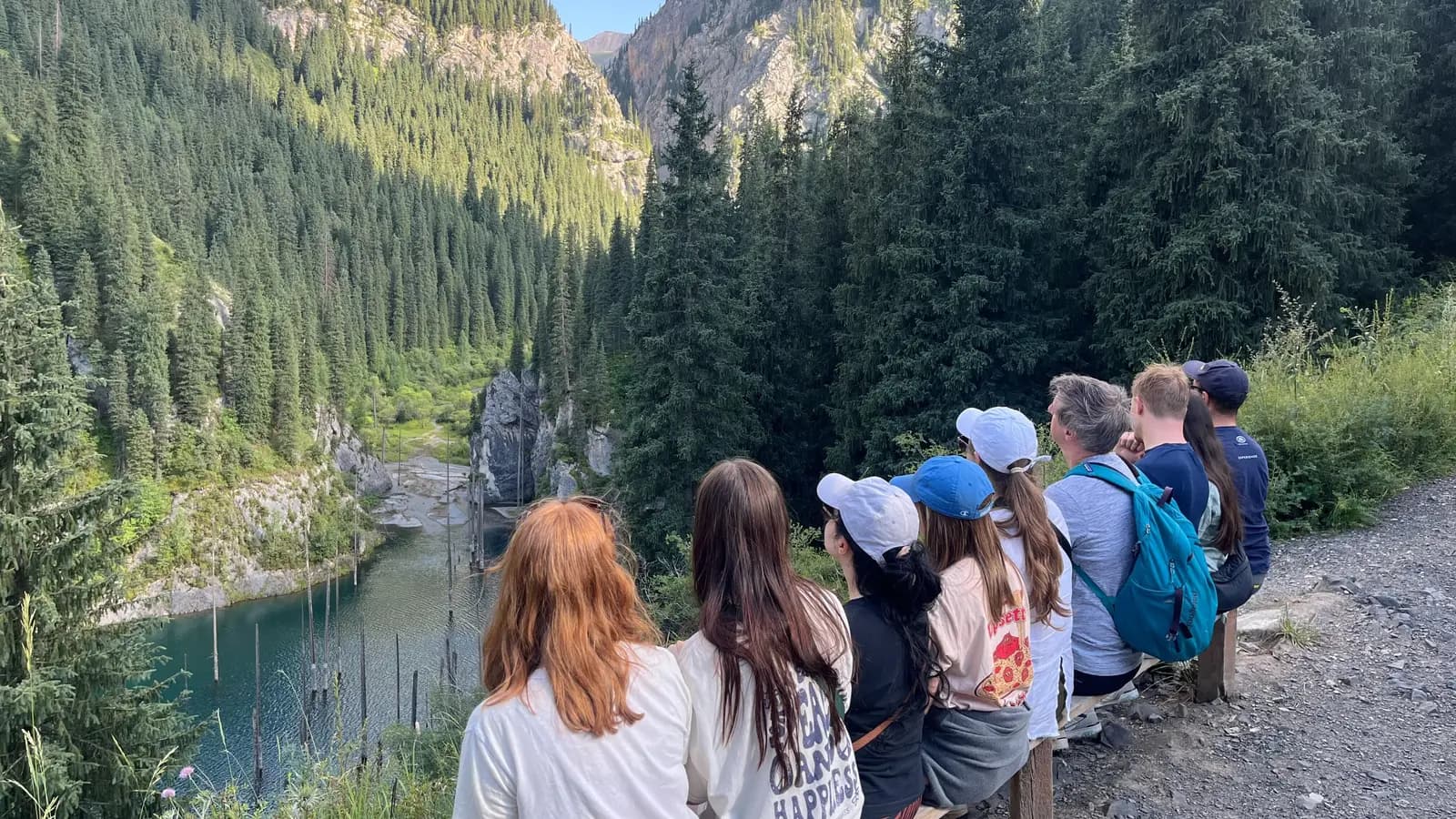
Explore's fourteen-night The Three Stans of The Silk Road comes from the mountains of Kyrgyzstan and the Kazakh south-east, with the Kolsai Lakes, Charyn Canyon and Almaty, and then goes west to Turkestan and Shymkent before crossing into Uzbekistan. It departs from April to October.
G Adventures' fourteen-night Central Asia: Uzbekistan, Tajikistan, Kazakhstan & Kyrgyzstan travels from Tashkent, Khiva, Bukhara and Samarkand to Panjakent and the Marguzor Lakes in Tajikistan, then into Kazakhstan for Shymkent, Sayram Su Lake and Taraz. G Adventures' twenty-five-night The Stans: The Ultimate Adventure through the Silk Road follows the same route and continues into Kyrgyzstan, with Bishkek, the Burana Tower and Iskra Village in its list. Both depart in April and May.
Spring and autumn are the best seasons for southern Kazakhstan, which is very hot in summer. Arrive at the mausoleum in the late afternoon, when the light warms the brick and turns the dome a deeper blue, and stay as the pilgrims come and go. It is a building made to be approached slowly, across open ground, as travellers have approached it for six hundred years.
By Walter Pellow, the name Atlas & Passage’s editorial team writes under. Prices and dates in the trips below come from the operators and can change.