Journeys
Kyrgyzstan, Issyk Kul and the high pastures
Kyrgyzstan is a country of mountains, where herders still take their flocks up to the high summer pastures and live in felt yurts beside alpine lakes. Its great lake, Issyk Kul, lies among snow peaks, and its nomadic traditions are among the most alive in Central Asia.
By Walter Pellow20 October 20264 min read
Kyrgyzstan is one of the most mountainous countries in the world. Most of its land lies in the Tian Shan, the "heavenly mountains", a great range that stretches across Central Asia into China, with peaks of more than seven thousand metres. Its people were nomads for centuries, moving with their herds of horses, sheep and yaks between winter quarters in the valleys and summer pastures, the jailoo, high in the mountains. The Soviet period forced most of them to settle on collective farms. But the old ways have not disappeared, and every summer many families still take their animals up to the high pastures and live in yurts there until the autumn.
For visitors, Kyrgyzstan offers a rare chance to see nomadic life at close quarters, in spectacular mountain scenery, in a country that has been open to tourism for only a few decades.
Issyk Kul
Issyk Kul, in the north-east of the country, is a vast lake about a hundred and eighty kilometres long, ringed by snow-capped mountains. It lies at an altitude of about sixteen hundred metres and is one of the largest mountain lakes in the world. It is slightly salty, and its name means "warm lake", because it never freezes, even in the hard Kyrgyz winter.
On its northern shore, at Cholpon-Ata, an open-air museum of boulders is carved with petroglyphs, ancient images of ibex, deer and hunters, some of them thousands of years old. Karakol, at the eastern end, is a quiet, leafy town of wooden houses. It has a Russian Orthodox cathedral built of wood, and a remarkable mosque built by Dungan Chinese Muslims in the style of a Chinese temple. Nearby, the valley of Jeti-Oguz has red sandstone cliffs, and on the southern shore, at Bokonbayevo, eagle hunters demonstrate the ancient art of hunting with golden eagles.
The high pastures
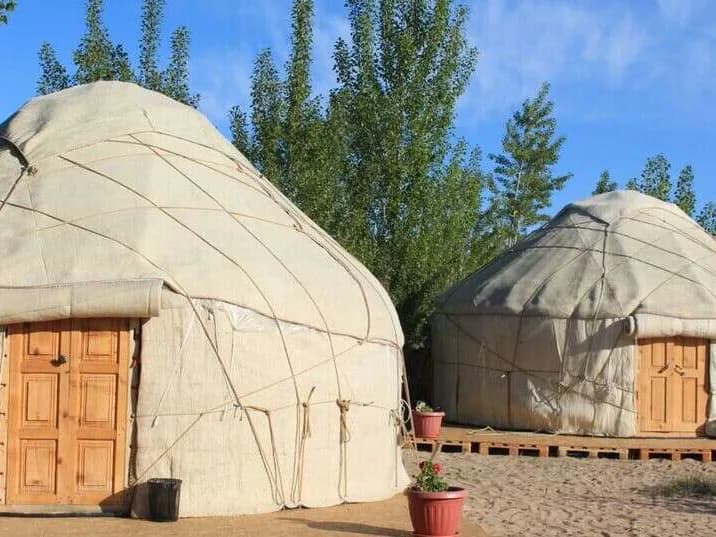
South of Issyk Kul, the road climbs to Song Kul, a high lake at about three thousand metres, surrounded by rolling grassland and mountains. In summer the pastures around the lake fill with herders and their yurts, and visitors can stay in yurt camps, ride horses and share a meal with the families. Kumis, fermented mare's milk, slightly sour and fizzy, is the drink of the summer pastures, and an acquired taste.
The town of Kochkor is known for its felt-making. The colourful felt carpets of Kyrgyzstan, called shyrdak, are made by women using traditional methods, and the craft is recognised by UNESCO. In the village of Kyzyl-Tuu, families have long made the wooden frames of yurts.
Every summer many families still take their animals up to the high pastures and live in yurts there until the autumn.
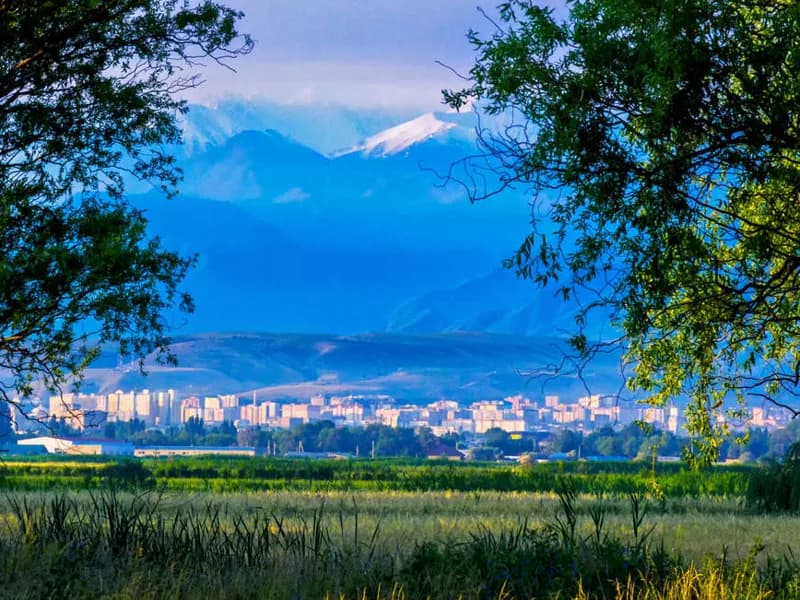
Bishkek, the capital, is a green, Soviet-planned city of wide streets and parks, with the snow peaks of the Kyrgyz range rising to the south. To the east, near Tokmok, the Burana Tower is the stump of an eleventh-century minaret, all that stands of Balasagun, a city of the Karakhanid rulers. It can be climbed by a steep inner staircase, and from the top there is a wide view over the valley. Around it, a field of balbals, ancient stone grave markers carved with human faces, has been gathered from across the region. The traditional Kyrgyz games, played on horseback, are a reminder of how central the horse remains to life in the mountains.
Arslanbob, and the way to Uzbekistan
In the south-west, in the mountains above the Fergana Valley, Arslanbob has one of the largest natural walnut forests in the world. According to local tradition, it was the source of the walnuts that spread to Europe. Kyrgyz and Uzbek villagers harvest the nuts in the autumn, and the forest, with its waterfalls and mountain views, is a beautiful place to walk.
Explore Worldwide's Kyrgyzstan's Silk Road Journey, thirteen nights, includes Bishkek, Issyk Kul, the Burana Tower, Cholpon-Ata, Karakol, Jeti-Oguz, Bokonbayevo, Kochkor, Song Kul, the Suusamyr valley, Jalal-Abad and Arslanbob. The Silk Road of Kyrgyzstan and Uzbekistan, twenty-two nights, includes the same places in Kyrgyzstan and adds Uzbekistan.
Explore Worldwide's The Three Stans of the Silk Road, fourteen nights, includes Bishkek, Tokmok, Kochkor, Issyk Kul, Kyzyl-Tuu, Bokonbayevo and Karakol in Kyrgyzstan. In Kazakhstan it includes the Kolsai Lakes, Charyn Canyon, Almaty, Turkestan and Shymkent, with Uzbekistan as well.
The best time to visit is summer, from about June to September, when the high pastures are green and the yurts are up. Nights at altitude are cold even in summer, so warm layers are essential.
By Walter Pellow, the name Atlas & Passage’s editorial team writes under. Prices and dates in the trips below come from the operators and can change.