History
Khiva, a walled city kept almost whole
On the edge of the desert in western Uzbekistan, Khiva's inner town sits complete within its mud-brick walls: a maze of mosques, madrasas, minarets and palaces in sun-baked clay and blue tile. It was once a feared slave-trading khanate, and it is now one of the most complete old towns in Central Asia.
By Walter Pellow20 October 20264 min read
Khiva lies in the oasis of Khorezm, in the delta of the Amu Darya river, surrounded by the Karakum and Kyzylkum deserts. For centuries it was an outpost on the caravan routes, and from the sixteenth century the capital of an independent khanate. The khanate had a fearsome reputation. Its rulers grew rich on trade and on raids into the surrounding deserts. Its slave market, where captured Persians and Russians were sold, was notorious across Asia, and its reputation kept most European travellers away. In 1873 a Russian army took the city, the slave trade was abolished, and the khanate became a Russian protectorate. It survived in name until 1920.
Itchan Kala
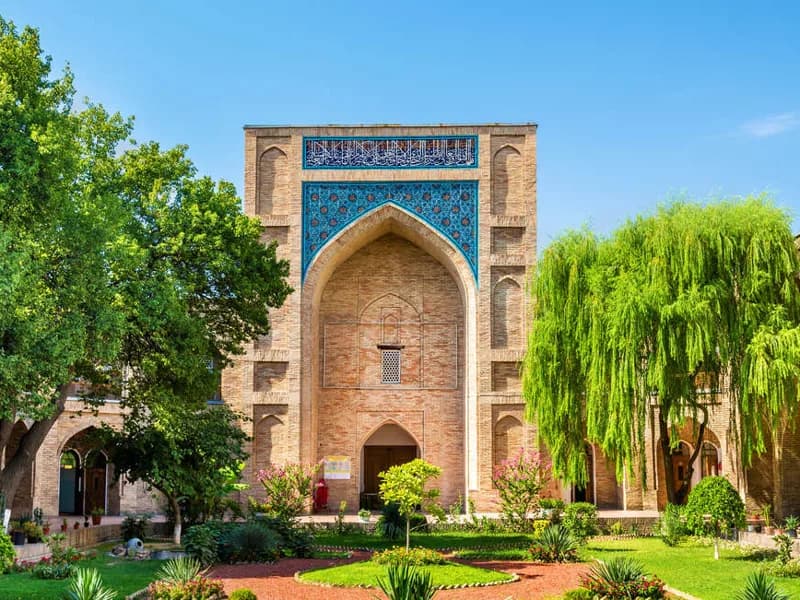
What makes Khiva remarkable is its inner town, Itchan Kala, which survives complete within its walls. Massive walls of mud brick, crenellated and buttressed, ring an area that can be walked across in a quarter of an hour, entered through four gates. Inside, almost every building is historic: mosques, madrasas, minarets, mausoleums, palaces, caravanserais and houses, most of them from the eighteenth and nineteenth centuries, built of the same golden-brown clay brick, with domes and portals covered in blue and turquoise tiles. Itchan Kala was the first site in Central Asia to be inscribed as a World Heritage Site, in 1990.
In the Soviet period, the inner town was restored and turned into a museum city, and many of its residents moved out. Some critics feel it lost a little of its life in the process. In the early morning, before the day visitors arrive, or in the evening, when the walls glow in the setting sun, it is still magical.
The minarets, the mosque and the palaces
The most famous landmark is the Kalta Minor, a short, wide minaret covered entirely in bands of turquoise and green tiles. It was begun in the 1850s by a khan who meant it to be the tallest minaret in the Islamic world, so tall, the story goes, that it would be possible to see Bukhara from the top. He died before it was finished, and it remains a squat, unfinished stump. The Islam Khodja Minaret, built at the beginning of the twentieth century, is the tallest in the town, and it can be climbed for a view over the domes and the desert beyond.
The Juma Mosque is a vast, dim hall with no dome or courtyard, its flat roof supported by a forest of more than two hundred carved wooden columns. Some of them are many centuries older than the building itself, reused from earlier mosques. The Tash Hauli, the palace of the khans, built in the 1830s, has courtyards lined with intricate blue and white tiles and carved wooden pillars, including the harem quarters.
According to legend, Khiva was founded by Shem, the son of Noah, around a well whose water he found sweet, and the well can still be seen in the old town. Its other landmarks are less legendary. The Islam Khodja minaret, built in the early twentieth century, is the tallest in the town, and its striped brick and tile tower can be climbed for a view over the domes and flat roofs of the old town to the desert beyond. The Tash Hauli palace, built for the khan in the 1830s, has courtyards lined with blue and white tiles and tall carved wooden columns, among them the harem, where the khan's wives lived. The Kunya Ark, the old fortress, has a reception hall with a brilliantly tiled iwan, and a watchtower on its walls that gives one of the best views of the town at sunset.
Nukus, and the desert
To the north-west, the city of Nukus, in the autonomous republic of Karakalpakstan, has one of the most surprising museums in Asia. During the Soviet era, the artist and collector Igor Savitsky gathered thousands of works of Russian avant-garde art that had been banned or suppressed in Moscow, hiding them far from the authorities in this remote desert city.
Explore Worldwide's Upgraded Treasures of Uzbekistan, nine nights, includes Khiva and Nukus, with Tashkent, Bukhara and Samarkand.
Explore Worldwide's The Silk Road of Uzbekistan, ten nights, includes Khiva, Urgench, Bukhara and Samarkand. Just You's The Silk Road: Legends of the Five Stans, twenty nights, includes Khiva on a journey across all five Central Asian republics, from Ashgabat and the burning gas crater of Darvaza in Turkmenistan to Almaty in Kazakhstan.
Khiva is at its best in spring and autumn. Summer in the desert is fiercely hot, and winter is cold. Stay inside the walls if you can, and walk them at sunset.
By Walter Pellow, the name Atlas & Passage’s editorial team writes under. Prices and dates in the trips below come from the operators and can change.