First time
Uzbekistan for the first time, by fast train between the Silk Road cities
Samarkand, Bukhara and Khiva were once weeks apart by caravan. Today a fast train links the first two with the capital in a few hours. Uzbekistan has opened up to visitors in the last decade, and a first trip here is one of the great introductions to the Silk Road.
By Walter Pellow20 October 20264 min read
For most of the twentieth century, Uzbekistan was part of the Soviet Union and hard to reach. After independence in 1991, it remained difficult to visit for many years, with complicated visas and a suspicious government. Since the late 2010s, that has changed dramatically. Visa rules have been relaxed, including visa-free entry for British visitors, and the country has invested heavily in tourism. Its great Silk Road cities, among the finest in the Islamic world, are now easy to visit, and the country has become one of the most rewarding new destinations in Asia.
The classic route
A first trip usually follows a classic route through four cities. Tashkent, the capital, is a large, green, modern city, largely rebuilt after an earthquake in 1966 and full of Soviet-era boulevards and buildings. Its underground railway has some of the most ornate stations in the former Soviet Union, decorated with chandeliers, marble and mosaics. Chorsu, its great domed bazaar, is a feast of spices, dried fruits, bread and vegetables. In the Khast Imam complex, a library holds a Quran said to be one of the oldest in the world.
Samarkand, the capital of Timur, has the Registan, its three great tiled madrasas facing each other across a square, along with Timur's mausoleum, the Bibi-Khanym Mosque and the Shah-i-Zinda, an avenue of tiled tombs. Bukhara, the holy city, has its old centre of mosques, madrasas, trading domes and pools, with the great Kalyan Minaret rising above it. Khiva, in the far west, is a walled town of mud-brick mosques and minarets on the edge of the desert, preserved almost whole.
The fast train
One of the pleasures of a modern trip is the railway. In the 2010s, Uzbekistan introduced high-speed trains, the Afrosiyob, named after the ancient site of Samarkand, between Tashkent and Samarkand, and then on to Bukhara. The journey from the capital to Samarkand, which takes several hours by road, now takes about two hours. The trains are clean, comfortable and fast, with views across the cotton fields, steppe and mountains. Further west, the line to Khiva and Urgench has also been improved, though journeys there are longer. It is worth checking how each tour travels between the cities, as some use the trains and some go by road.
Tashkent is often treated as a place to arrive and leave, but it deserves a day. Much of the old city was destroyed by an earthquake in 1966 and rebuilt in the Soviet style, with wide avenues, parks and grand public buildings. Its metro, opened in the 1970s, has stations decorated in very different styles, with chandeliers, carved plaster, marble and mosaics, one of them on the theme of space travel. Chorsu Bazaar, under a great blue-green dome, is the city's main market, piled with spices, dried fruit, nuts, bread and vegetables. In the old quarter, the Hazrati Imam complex keeps a very early manuscript of the Quran, traditionally linked to the caliph Uthman and among the oldest known.
Between the cities, the trains run across a landscape of cotton fields, orchards and desert, and the journey itself is a chance to see something of the countryside and of everyday life.
Food and welcome
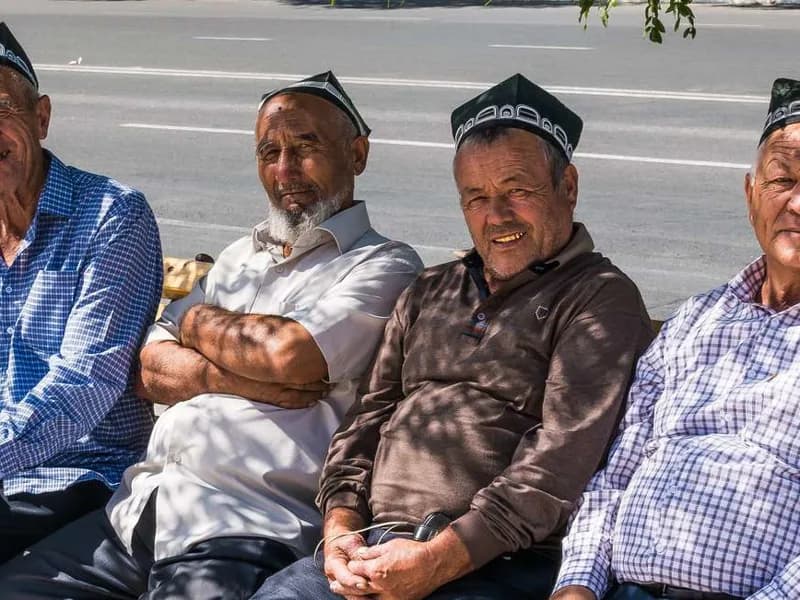
Uzbek food is hearty and generous. Plov, a dish of rice cooked with carrots, onions, lamb and spices in a great iron cauldron, is the national dish. Uzbekistan's plov tradition is recognised by UNESCO, and every region has its own version. Samsa, pastries filled with meat and baked in a clay oven, the round flat breads called non, stamped with patterns, and endless cups of green tea accompany most meals. Uzbek hospitality is famous, and visitors are often offered tea, fruit and bread.
Just You's Uzbekistan and the Silk Road Tour, ten nights for solo travellers, includes Tashkent, Khiva, Bukhara, Samarkand, Urgench and Kagan, near Bukhara, on the railway line.
Travelsphere's Uzbekistan: the Heart of the Silk Route, ten nights, includes Tashkent, Samarkand, Shakhrisabz, Bukhara and Khiva. Explore Worldwide's The Silk Road of Uzbekistan, ten nights from March to November, includes Tashkent, Urgench, Khiva, Bukhara, Gijduvan, Nurata, Hayat village and Samarkand.
Spring, from about April to May, and autumn, from September to October, are the best seasons. Summer is very hot, especially in Khiva and Bukhara, and winters can be cold. Dress modestly at religious sites, and be ready for long, generous meals.
By Walter Pellow, the name Atlas & Passage’s editorial team writes under. Prices and dates in the trips below come from the operators and can change.