History
Samarkand, and the Registan that Tamerlane's heirs built
Samarkand's Registan, three great madrasas facing each other across a square, is one of the most magnificent ensembles of buildings in the Islamic world. It was begun by the grandson of Tamerlane, the conqueror who made the city his capital, and it is only the start of what the city holds.
By Walter Pellow20 October 20264 min read
Few names carry the romance of the Silk Road like Samarkand. It is one of the oldest cities in Central Asia, already a great trading city when Alexander the Great took it in the fourth century BC. For centuries it stood at the crossroads of the routes linking China, India, Persia and the Mediterranean, growing rich on trade in silk, paper, spices and ideas. In 1220 the Mongols under Genghis Khan destroyed it. A century and a half later, it rose again, more splendid than ever, as the capital of one of history's great conquerors.
Tamerlane's capital
Timur, known in the West as Tamerlane, was born in 1336 near Samarkand, in the town of Shakhrisabz. Through decades of ruthless campaigning, he built an empire that stretched from Anatolia to India, and he brought back to Samarkand the craftsmen, architects and riches of the lands he conquered. He intended it to be the most beautiful city in the world. His buildings were vast, their domes covered in turquoise and blue tiles, their portals soaring. Some were built so quickly that they began to fall down within years.
The great mosque of Bibi-Khanym, named after his wife, was one of the largest in the Islamic world when it was built at the turn of the fifteenth century. It began to crumble almost at once, and it has been partly rebuilt. Timur himself lies in the Gur-e-Amir, a mausoleum with a fluted turquoise dome. His tomb is marked by a slab of dark green jade.
The Registan
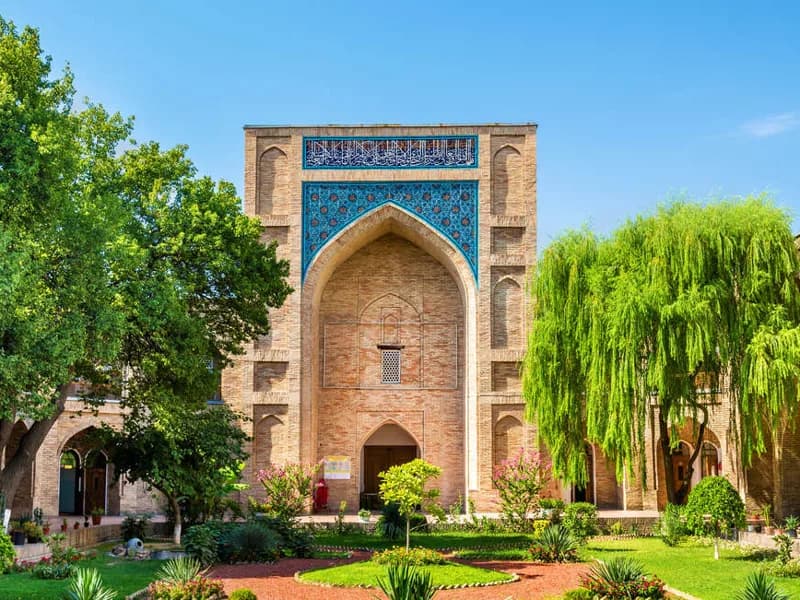
The Registan, whose name means "sandy place", was the commercial and public heart of the medieval city, a great square where people gathered for proclamations and markets. On three sides it is framed by madrasas, religious colleges, facing each other across the square.
The oldest, on the western side, was built in the 1410s and 1420s by Timur's grandson Ulugh Beg, who ruled Samarkand and was one of the great astronomers of his age. The two others came two centuries later. They were built by a governor of the city who matched the first in scale, deliberately completing the composition. The Sher-Dor Madrasa, opposite Ulugh Beg's, has a portal decorated with tigers chasing deer, with human-faced suns rising on their backs, an unusual departure from the Islamic tradition of avoiding images of living things. The Tilya-Kori Madrasa, between them, has a mosque whose interior is covered in gold.
Seen together, in the early morning or when they are lit at night, the three buildings make one of the most striking sights in the Islamic world. Inside, the madrasas' courtyards, once lined with students' cells, now hold craft shops.
Timur himself lies in the Gur-e-Amir, a mausoleum with a great ribbed turquoise dome, built for his grandson and later for the dynasty. His tomb is marked by a slab of dark green jade. According to a well-known story, the Soviet archaeologists who opened it in June 1941 found an inscription warning of disaster if it were disturbed, and Germany invaded the Soviet Union days later.
Shah-i-Zinda and the observatory
On a hillside on the edge of the old city, the Shah-i-Zinda is an avenue of mausoleums built for members of Timur's family and court, each one covered in brilliant tile work of turquoise, cobalt and white, rising one above another along a narrow street. I would call it the most beautiful place in Samarkand, and it is still a place of pilgrimage. On another hill, the remains of Ulugh Beg's observatory, built in the 1420s, include part of a vast curved instrument cut into the rock, used to measure the positions of the stars with remarkable accuracy.
Much of Samarkand's monumental heritage was restored, and in places rebuilt, in the Soviet period and since, sometimes more thoroughly than purists would like. But the scale and colour of the buildings remain overwhelming.
Travelsphere's Uzbekistan: the Heart of the Silk Route, ten nights, includes Samarkand and Shakhrisabz, Timur's birthplace, with Tashkent, Bukhara and Khiva.
Just You's Uzbekistan and the Silk Road Tour, ten nights for solo travellers, includes Samarkand with Tashkent, Khiva, Bukhara, Urgench and Kagan. Explore Worldwide's Upgraded Treasures of Uzbekistan, nine nights, includes Samarkand with Tashkent, Nukus, Khiva and Bukhara.
Spring and autumn are the best seasons. Summer is very hot, and winter can be cold and grey.
By Walter Pellow, the name Atlas & Passage’s editorial team writes under. Prices and dates in the trips below come from the operators and can change.