History
Bukhara, the old city of pools and madrasas
For centuries Bukhara was one of the great centres of Islamic learning, a holy city of mosques, madrasas and bazaars ruled by emirs from a fortress on a hill. Its old centre has survived remarkably intact, and in the evening, around its pool under the mulberry trees, it still feels like a Silk Road city.
By Walter Pellow20 October 20264 min read
Bukhara is more than two thousand years old, and for much of its history it was one of the most important cities in Central Asia. In the ninth and tenth centuries, as the capital of the Samanid dynasty, it was a great centre of Persian culture and Islamic scholarship, home to poets, scientists and scholars. The great physician and philosopher Avicenna was born nearby. Over the centuries it was conquered by Mongols, rebuilt by the descendants of Timur, and then ruled by a line of khans and emirs. They made it a holy city of hundreds of mosques and madrasas, and kept it closed and suspicious of outsiders until the Russian Empire brought it under its protection in the nineteenth century.
Its historic centre is a World Heritage Site and one of the most complete examples of a medieval Central Asian city.
The Samanids and the minaret
The oldest building of note is the mausoleum of Ismail Samani, the founder of the Samanid dynasty, from the tenth century. It is a small cube of baked brick, with walls of extraordinary intricacy, where the bricks themselves are laid in patterns that change as the light moves across them. It survived the Mongol invasion, it is said, because it was buried in sand and silt.
The Kalyan Minaret, built in the early twelfth century, rises more than forty-five metres above the centre of the city, its brickwork decorated in bands of different patterns. According to legend, Genghis Khan was so impressed by it that he ordered it spared when the rest of the city was destroyed. Beside it stand the great Kalyan Mosque and the Mir-i-Arab Madrasa, which still trains students, their turquoise domes making one of the classic views of Central Asia.
The Ark, the domes and the pool
The Ark is a massive fortress on an artificial mound at the western edge of the old city, the seat of the emirs for centuries. In 1842 two British officers, Charles Stoddart and Arthur Conolly, sent to the region during the rivalry between Britain and Russia known as the Great Game, were executed by the emir in the square in front of it, after long imprisonment.
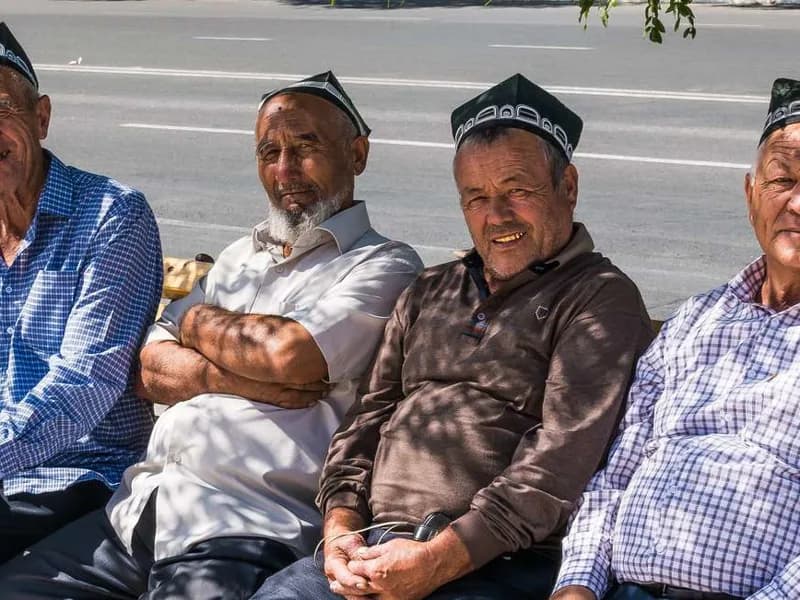
Bukhara's old trading domes, at the crossroads of its main streets, once housed the jewellers, the money changers and the hat-makers, and they are still lined with shops selling carpets, embroidered suzanis, ceramics and knives. Bukhara was once a city of pools, used for water and as places to gather. Most were filled in during the Soviet period because they spread disease. The finest survivor is Lyabi-Hauz, a stone-lined pool from the seventeenth century, shaded by ancient mulberry trees and surrounded by madrasas, teahouses and cafés. One of its madrasas has a mosaic of mythical birds carrying lambs towards a human-faced sun. In the evening, when families gather by the water, it is the heart of the city.
Bukhara has smaller pleasures, too. Chor Minor, tucked away in a residential quarter, is the gatehouse of a vanished madrasa of the early nineteenth century, crowned by four small towers with turquoise domes. Opposite the Ark, the Bolo Hauz Mosque, the emirs' Friday mosque, has a deep porch held up by tall, slender carved wooden columns, reflected in a pool in front of it. On the northern edge of the city, the summer palace of the last emir, Sitorai Mohi-Xosa, mixes Russian and Central Asian styles, with mirrored halls and painted ceilings.
Around Bukhara
Outside the city, the village of Gijduvan is known for its ceramics, made by families of potters over many generations. Nurata, further east, has the ruins of a fortress traditionally attributed to Alexander the Great and a sacred spring full of fish. In the desert beyond, near Lake Aydarkul, there are yurt camps where visitors can spend a night under the stars.
Explore Worldwide's The Silk Road of Uzbekistan, ten nights from March to November, includes Bukhara, Gijduvan, Nurata and Hayat village with Tashkent, Urgench, Khiva and Samarkand.
Travelsphere's Uzbekistan: the Heart of the Silk Route, ten nights, includes Bukhara with Tashkent, Samarkand, Shakhrisabz and Khiva. Just You's Uzbekistan and the Silk Road Tour, ten nights for solo travellers, includes Bukhara and Kagan, with Tashkent, Khiva, Samarkand and Urgench.
Give Bukhara at least two full days. Its old centre is compact and best explored on foot, and its greatest pleasure is the evening by the pool.
By Walter Pellow, the name Atlas & Passage’s editorial team writes under. Prices and dates in the trips below come from the operators and can change.