Journeys
Turkmenistan, the white marble capital and the crater that will not stop burning
Few travellers reach Turkmenistan, and those who do find a strange country: a gleaming capital of white marble, a gas crater that has burned in the desert for decades, and the ruins of two great Silk Road cities.
By Walter Pellow2 November 20263 min read
Few countries are as hard to visit, or as strange when you get there, as Turkmenistan. It lies on the eastern shore of the Caspian Sea, most of it covered by the Karakum, the black sand desert, and it has long kept itself closed, with visas hard to get and independent travel limited. Most visitors come on organised tours, often as part of a longer journey through Central Asia. Those who do find a country of extraordinary contrasts: ancient cities in the desert, a modern capital like no other, and, in the middle of the sands, a hole in the ground that has been on fire for decades.
Ashgabat, the white city
Ashgabat, the capital, sits at the foot of the Kopet Dag mountains near the border with Iran. Since independence in 1991 it has been rebuilt on a grand scale, in white marble. Avenues of white marble apartment blocks, ministries, palaces, mosques and monuments stretch away in every direction, with gold domes, fountains, statues and immaculate parks, and almost no one on the streets. At night, the buildings are lit up in changing colours.
It is a city built as a statement, and walking through it is a surreal experience: grand, gleaming and curiously empty. Photography of government buildings is restricted, and your guide will tell you where you can and cannot point a camera.
On the edge of the city, Old Nisa is something quite different: the ruins of an early capital of the Parthians, the power that rivalled Rome in the east, with mud-brick walls and the foundations of temples and halls on a hill above the plain. It is a UNESCO World Heritage Site.
A hole in the ground that has been on fire for decades.
The Darvaza crater
In the middle of the Karakum, a few hours' drive north of Ashgabat, lies the Darvaza gas crater, known to visitors as the Door to Hell or the Gates of Hell. It is a broad pit in the sand, its floor and walls covered in flames fed by natural gas seeping from below.
Its origins are uncertain. The usual story is that Soviet geologists drilling for gas in 1971 broke into a cavern, the ground collapsed, and the escaping gas was set alight to burn it off, in the expectation that it would burn out in a few weeks. It did not. But that story has never been confirmed, and other accounts date the collapse to the 1950s or 1960s and the fire to later.
The crater is best seen after dark, when the flames glow orange against the black desert and the heat on your face is startling even from the rim. Most tours camp nearby for the night. Turkmenistan's government has announced plans to put the fire out, and recent reports say it has weakened, so it may not burn for ever.
The Silk Road cities
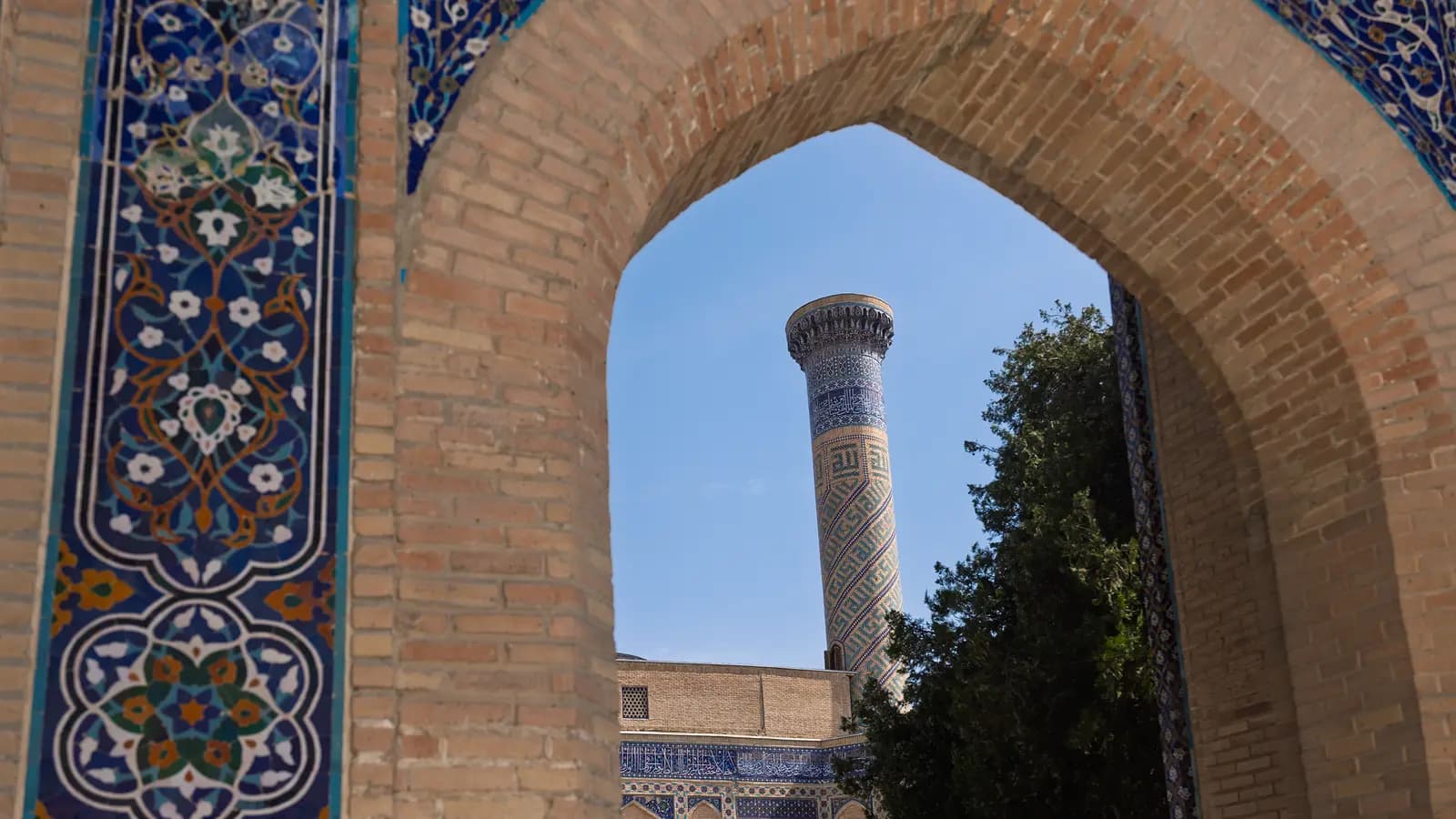
In the north, near the border with Uzbekistan, Kunya-Urgench was once the capital of Khorezm, a rich city of the medieval Islamic world, until it was sacked by the Mongols and then by Timur. Its surviving monuments stand scattered across a quiet landscape of graves and ruins: mausoleums with turquoise domes, and a tall brick minaret. It too is a UNESCO World Heritage Site.
How to go
Explore's twenty-night The Five Stans of The Silk Road begins in Turkmenistan, with Ashgabat, Nisa, Dashoguz and Kunya Urgench, before crossing into Uzbekistan for Nukus, Khiva, Bukhara and Samarkand, then Tajikistan, Kyrgyzstan and Kazakhstan. It departs from May to October.
Just You's twenty-night The Silk Road: Legends of the Five Stans, for solo travellers, starts in Ashgabat and goes to Darvaza, then on through Khiva, Bukhara and Samarkand, Dushanbe and Khujand, Tashkent, Bishkek, Chon Kemin and Karakol, ending in Almaty.
G Adventures' ten-night Journeys: Stories of Uzbekistan & Turkmenistan runs the other way, from Tashkent and Samarkand by way of Konigil Village, Bukhara and Khiva to Kunya-Urgench, Old Nisa and Ashgabat. It departs from April to July.
Turkmenistan requires visas and an approved itinerary, and tours handle the paperwork, which takes time, so book well ahead. Spring and autumn are the best seasons: the desert summer is fiercely hot. Bring patience for the formalities, and an open mind. There are not many places left in the world that feel quite so unlike anywhere else.
By Walter Pellow, the name Atlas & Passage’s editorial team writes under. Prices and dates in the trips below come from the operators and can change.