Walking
Walking in Northern Cyprus, among the castles of the Kyrenia range
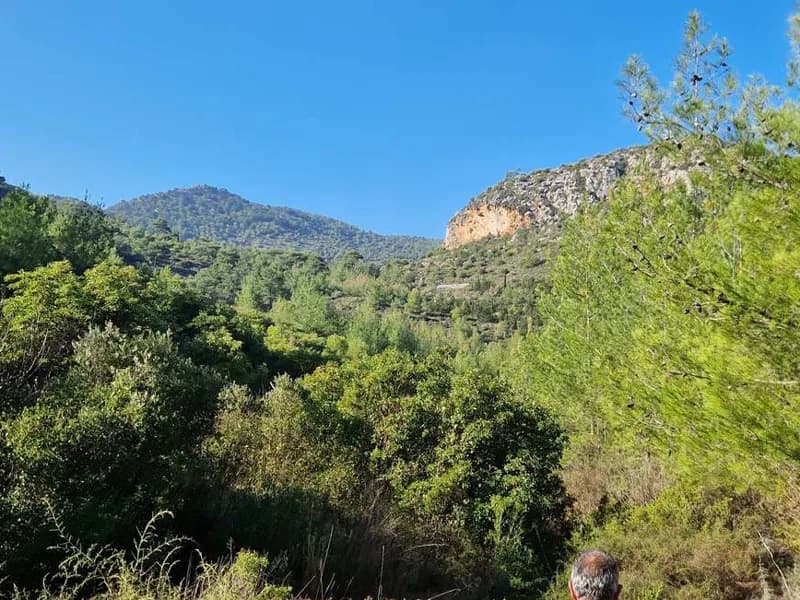
A narrow limestone ridge runs along the north coast of Cyprus, crowned with crusader castles and wrapped in pine and carob woods. In spring it is covered in wild flowers, and its paths, between hill villages and above the sea, make some of the best walking in the eastern Mediterranean.
By Walter Pellow2 November 20264 min read
Cyprus is an island of two mountain ranges. The Troodos, in the south-west, is broad and high and forested. The Kyrenia range, in the north, is quite different: a long, thin spine of limestone that runs for some hundred and sixty kilometres along the north coast, rising abruptly from a narrow coastal strip to jagged crests and pinnacles, with the sea on one side and the wide central plain of the Mesaoria on the other. It is not very high, its summits a little over a thousand metres, but it is steep, and it gives the north coast one of the most dramatic settings in the Mediterranean.
Since 1974, the north of the island has been under Turkish Cypriot administration, divided from the Republic of Cyprus in the south by a line patrolled by the United Nations. The north sees fewer visitors than the south, and its mountains fewer still, which is part of their appeal.
Castles in the air
Along the crest of the range stand three castles, built or strengthened in the Byzantine period and then held by the Lusignan kings, the French crusader dynasty that ruled Cyprus from the late twelfth century. They were placed on the heights to watch the coast and the passes, and they look down on the sea from astonishing positions.
St Hilarion is the most spectacular, a ruin of walls, towers, chapels and royal apartments climbing up a rocky peak above the town of Kyrenia. Its upper ward, reached by a long climb of steps, has a Gothic window known as the Queen's Window, framing a view straight down to the coast. The castle's fairy-tale outline is often said to have inspired Walt Disney's Snow White castle, a story repeated more often than it is proved. Buffavento, further east, is the highest and most remote, a ruin on a summit at nearly a thousand metres, reached by a long climb, and Kantara, near the eastern end of the range, looks over both coasts of the long Karpas peninsula.
Villages and abbeys
Below the castles, on the northern slopes, lies a string of villages among olive, carob and citrus groves, watered by springs. Bellapais is the best known, a village of stone houses around the ruins of a Gothic abbey, built by the Lusignans in the thirteenth and fourteenth centuries, whose cloister and refectory look out over the coast. The writer Lawrence Durrell lived here in the 1950s and wrote about the village and the troubled years of that decade in Bitter Lemons.
Karmi, to the west, is a hillside village of whitewashed houses, many of them restored, with flowered lanes and views down to the sea. Lapta, further along, is known for its springs and its gardens. Paths link them through the woods and along terraces, and on the higher slopes the walking is through pine forest, with orchids, cyclamen and anemones in spring.
In spring it is covered in wild flowers.
The coast and Famagusta
The north coast has some of the quietest beaches on the island. At Alagadi, east of Kyrenia, two sandy bays are protected as a nesting site for green and loggerhead turtles, which come ashore at night in summer to lay their eggs. Incirli Cave, near the eastern villages, is a cave of stalactites in the hills.
On the east coast lies Famagusta, a walled medieval port whose Venetian fortifications enclose the ruins of dozens of churches, among them the Gothic cathedral of St Nicholas, now a mosque, which looks as if it had been transplanted from France. Just outside the walls is Varosha, the modern resort district fenced off and abandoned since 1974, a ghost town of empty hotels, part of which has recently been reopened to visitors. North of Famagusta are the ruins of Salamis, an ancient city with a Roman theatre, gymnasium and baths beside the sea.
The holidays
Explore Worldwide's Walking in Northern Cyprus, seven nights, is based on the north coast. Its places include Kyrenia, the Incirli Cave, Alagadi Turtle Beach, Bellapais and the village of Özanköy, St Hilarion Castle, Karmi, Famagusta, Varosha and Salamis, Lapta and the Geçitköy reservoir. It runs in spring, autumn and early winter, from February to May and from September to December.
Just You's Northern Cyprus Hidden History, seven nights for solo travellers, is a touring holiday that covers Kyrenia, St Hilarion Castle and Bellapais Monastery, Salamis and Famagusta, the Karpas peninsula with Yeni Erenköy, Dipkarpaz, the Apostolos Andreas Monastery and Golden Beach, and Nicosia, the divided capital.
Spring, from March to May, is the classic walking season, with green hills and flowers everywhere. Autumn is warm and settled, and the sea is at its warmest. Summer is too hot for serious walking in the hills, and winter, while mild on the coast, can bring rain and cloud to the summits.
By Walter Pellow, the name Atlas & Passage’s editorial team writes under. Prices and dates in the trips below come from the operators and can change.