History
Armenia, the first Christian kingdom, and its monasteries
Armenia is traditionally held to have been the first country to adopt Christianity as its state religion, early in the fourth century. Its stone monasteries, set in gorges and on clifftops beneath Mount Ararat, are among the most beautiful religious buildings in the world.
By Walter Pellow20 October 20264 min read
According to Armenian tradition, in the year 301 King Tiridates III was converted to Christianity by Gregory, later known as the Illuminator, and made it the official religion of his kingdom. That makes Armenia, by its own reckoning, the first Christian state in the world, a few years before Constantine legalised Christianity in the Roman Empire. Christianity has shaped Armenian identity ever since, through centuries of invasion, foreign rule and, in the early twentieth century, the genocide of Armenians in the Ottoman Empire. The Armenian Apostolic Church remains at the heart of national life. Its churches and monasteries, built of local stone in a distinctive style of their own, are scattered across a landscape of mountains, gorges and high plateaus.
Khor Virap and Echmiadzin
The story begins at Khor Virap, a monastery on a small hill near the Turkish border. Here, tradition says, Gregory was imprisoned for thirteen years in a deep pit before he healed the king and converted him. Visitors can still climb down a ladder into the pit. Behind the monastery, across the border, rises Mount Ararat, the snow-capped double volcano where, according to the Bible, Noah's Ark came to rest. Though it now lies in Turkey, Ararat is the great symbol of Armenia, visible from much of the country on a clear day.
Echmiadzin, near Yerevan, is the spiritual centre of the Armenian Church and the seat of its head, the Catholicos. Its cathedral, founded in the early fourth century and rebuilt over the centuries, is often described as one of the oldest cathedrals in the world. Nearby are the ruins of Zvartnots, a great round cathedral of the seventh century. Echmiadzin and Zvartnots are a World Heritage Site.
Monasteries in the mountains
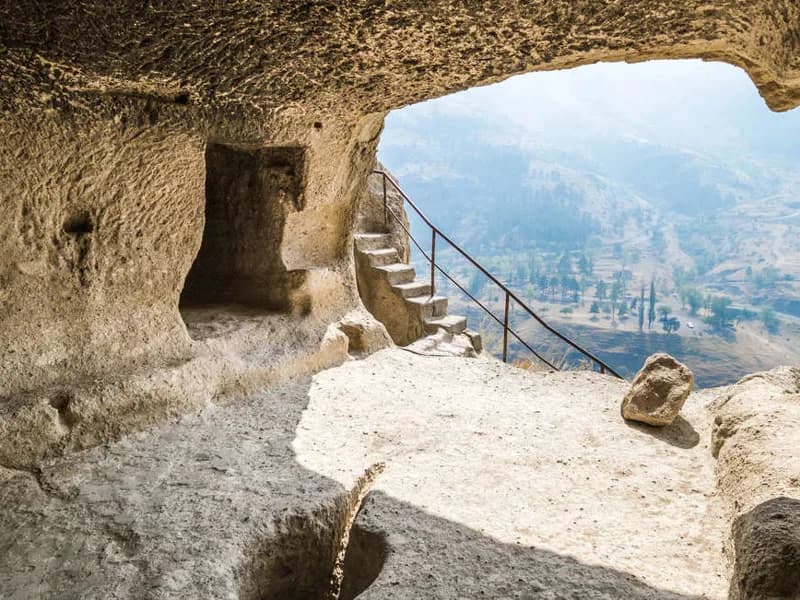
Armenia's monasteries are at their most striking in their settings. Geghard, at the head of a gorge east of Yerevan, is partly carved out of the living rock, with churches and chambers hewn from the cliff, their dark interiors lit by shafts of light from openings in the roof. Its name means "spear", after a relic of the lance said to have pierced Christ's side, once kept here. Noravank, in the south, stands at the end of a narrow canyon of red rock. Its two-storey church, with a narrow stone staircase climbing its façade, was completed in the fourteenth century and is credited to Momik, the architect and sculptor who also carved some of its finest stonework.
Khachkars, carved stone crosses set in elaborate lace-like patterns, are a uniquely Armenian art form, found at every church and monastery. At Noratus, near Lake Sevan, a medieval cemetery holds hundreds of them, standing in rows across a field. The craft of carving them is recognised by UNESCO.
Faith and language are closely linked in Armenia. Early in the fifth century, the monk Mesrop Mashtots created the Armenian alphabet, so that the Bible could be translated into Armenian, and the letters he devised are still in use today. In Yerevan, the Matenadaran, a manuscript library and museum named after him, holds thousands of illuminated manuscripts, many of them richly painted gospels made in the monasteries.
Before and beyond Christianity
Armenia's history goes back much further. At Garni, a Greco-Roman temple of the first century, rebuilt from its fallen stones in the twentieth century, stands on a promontory above a gorge, a rare survival of the pre-Christian kingdom. At Areni, in a cave in the south, archaeologists found what is thought to be the world's oldest known winery, about six thousand years old, and a leather shoe of similar age. The Armenian alphabet was created in the early fifth century by the monk Mesrop Mashtots, whose tomb is at Oshakan.
Explore Worldwide's The Best of Georgia and Armenia, fifteen nights, includes Yerevan, Zvartnots, Echmiadzin, Garni, Geghard, the fortress of Amberd, Oshakan, Khor Virap, Areni, Noravank, the Selim Pass caravanserai and the Noratus cemetery.
Explore Worldwide's Upgraded Treasures of Georgia and Armenia, eleven nights, lists mostly Georgian places, with Gyumri in Armenia. Explore Worldwide's The Best of Azerbaijan, Georgia and Armenia, eighteen nights, combines Armenia with its two neighbours, from Baku and Sheki in Azerbaijan to the wine country of Kakheti in Georgia.
Spring and autumn are the best times to visit, with clear views of Ararat most likely in the cooler months. Summer in Yerevan is hot and dry.
By Walter Pellow, the name Atlas & Passage’s editorial team writes under. Prices and dates in the trips below come from the operators and can change.