Food & drink
Georgian food, the supra and the wine made in clay jars
Georgia has been making wine for around eight thousand years, in great clay jars buried in the ground, and it has a feast, the supra, that turns a meal into an evening of toasts, songs and endless dishes. Food is one of the best reasons to go.
By Walter Pellow20 October 20264 min read
Georgia sits in the Caucasus, between the Black Sea and the Caspian, on the old crossroads between Europe and Asia. It is a small country with a strong sense of its own identity, its own alphabet and its own ancient church. Ask a Georgian about their country, and the conversation will soon turn to food and wine. Both are central to Georgian life and hospitality, and the guest, according to a much-quoted saying, is a gift from God.
Eight thousand years of wine
Georgia has a strong claim to be one of the birthplaces of wine. Archaeologists working on Neolithic village sites not far from Tbilisi have found traces of wine in pottery jars dating back around eight thousand years. The traditional method of making it, still widely used, is distinctive. Grapes are crushed and poured, with their skins, stems and pips, into a qvevri, a large egg-shaped clay vessel buried in the ground up to its neck, where it ferments and matures, sealed for months. The ground keeps the temperature cool and steady. The method is recognised by UNESCO as part of the world's intangible heritage.
Wine made from white grapes in qvevri, left on the skins, takes on a deep amber colour and a tannic, complex character, very different from most European white wines. These amber wines have become fashionable among wine lovers around the world. Saperavi, a dark, inky red grape, makes Georgia's best-known red wines. The heartland of Georgian wine is Kakheti, in the east, a broad, fertile valley beneath the snow-capped Greater Caucasus, with towns such as Telavi, Kvareli and Signaghi, a hilltop town ringed by walls. Many family wineries welcome visitors to taste wine from their qvevri.
The supra
The supra is the Georgian feast, and it is an institution. Tables are covered with dish after dish, so many that plates are stacked on top of one another. It is presided over by the tamada, the toastmaster, chosen for wit and eloquence, who proposes a long series of toasts, to God, to the homeland, to the dead, to parents, to children, to friendship, to the guests, each elaborated at length, and each followed by drinking. Polyphonic singing, Georgia's ancient tradition of harmony, often breaks out between the toasts.
What to eat
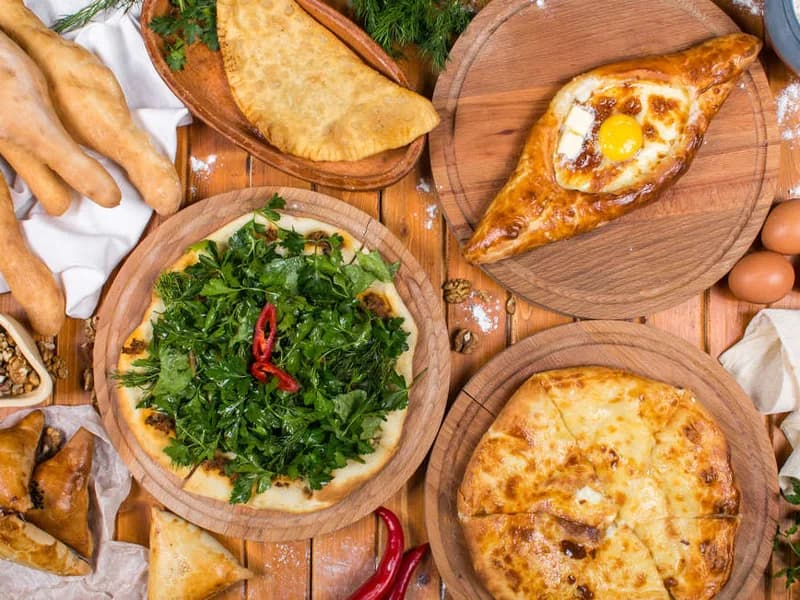
Georgian cooking draws on Persian, Turkish and Russian influences, but it is distinctively its own, with a love of walnuts, herbs, pomegranates and cheese. Khachapuri is cheese-filled bread, in many regional varieties. The most famous, from Adjara on the Black Sea coast, is a boat-shaped loaf filled with molten cheese, butter and a raw egg, stirred together at the table. Khinkali, large dumplings filled with spiced meat and broth, come from the mountains. They are eaten by hand, holding the twisted top, which is left on the plate, and sipping the broth before eating the rest. Aubergine rolled with walnut paste, pkhali made with spinach or beetroot and walnuts, grilled meat called mtsvadi and beans cooked in clay pots are all staples. Churchkhela, strings of walnuts dipped repeatedly in thickened grape juice and dried, hang in every market. Chacha, a potent grape brandy, often ends the evening.
Two other products of the vineyard are part of every visit. Chacha is a strong, clear brandy distilled from the skins and pips left over after wine-making, often made at home and offered to guests as a sign of welcome. Churchkhela, sold at roadside stalls and in markets across the country, are strings of walnuts or hazelnuts dipped again and again in thickened grape juice and left to dry, so that they look like long, knobbly candles. They keep for months, and were once carried by travellers and soldiers as food for the road.
Explore Worldwide's A Taste of Georgia: Tbilisi to the Caucasus Mountains, seven nights in May, June and September, is built around food. Its places include Tbilisi, Signaghi, Kvareli, Telavi, the Pankisi valley, Mtskheta, the cave town of Uplistsikhe, Gori, Ananuri, Stepantsminda and the village of Sno, and Gergeti beneath Mount Kazbek.
Explore Worldwide's Upgraded Treasures of Georgia and Armenia, eleven nights, includes Tbilisi and the Kakheti wine country around Kvareli, Tsinandali and Telavi. It also takes in the mountains at Stepantsminda and Gergeti, the spa town of Borjomi, the cave monastery of Vardzia, and Gyumri in Armenia. Explore Worldwide's The Best of Georgia and Armenia, fifteen nights, covers Armenia too, including the wine village of Areni.
Late spring and autumn are the best times to go, and the grape harvest in September and October is a particularly good time for wine.
By Walter Pellow, the name Atlas & Passage’s editorial team writes under. Prices and dates in the trips below come from the operators and can change.